
Voyage dans l’Inde Anglaise (Journey into British India)
Item
- Item Number
- 4
- Title
- Voyage dans l’Inde Anglaise (Journey into British India)
- Author
- J. J. E. Roy
- Date
- 1884
- Country / region
- France
- Source language
- French
- Time period
- 1880-1900
- Description
- A translation of excerpts from a late-19th-century French travelogue by the prolific writer J. J. E. Roy. The text relates his observations on religion, caste, and social life in different parts of India and among different groups, which he explicitly describes from a British point of view.
- Translated text
-
Chapter I (Lahore & Sikhs)
[9] I have then resolved to realise a dream which has for a long time nourished my spirit, that is to visit the beautiful lands of the Orient which have been visited turn by turn Alexander the Great, Tamerlan, Gengiskan, and so many other famous conquerors; to study the monuments of a civilization more ancient than that of Egypt, and the customs and religion of a people of whom the constitution and customs have not varied since thousands of years. […] I do not see what would prevent me, all while seeking service in the army of Runjet Singh, to undertake such studies of which I come to speak.
[11] (…) the kingdom of Lahore, as it exists today, is a recent creation, due to the genius and courage of the prince governing it, the maharajah Runjet Singh. Other times, that is to say less than forty years ago, a multitude of small princes or rajahs, pillagers and plunderers, but independent from each other, a sort of violent and anarchic feudalism, shared the beautiful valleys watered by the Indus, and devastated them by war and brigandage (…) Runjet Singh, rajah of the small State of Lahore. Intelligent, active, entrepreneurial, he knew how to profit from the warrior qualities of the Seikhs or Sykhs, which form the main layer of those areas’ population, to place under his domination the small princes neighbouring him (…) [13] Lahore is the first country Alexander visited on his arrival in India. It is in this country, on the banks of the Jelum river, that he vanquished Porus (…)
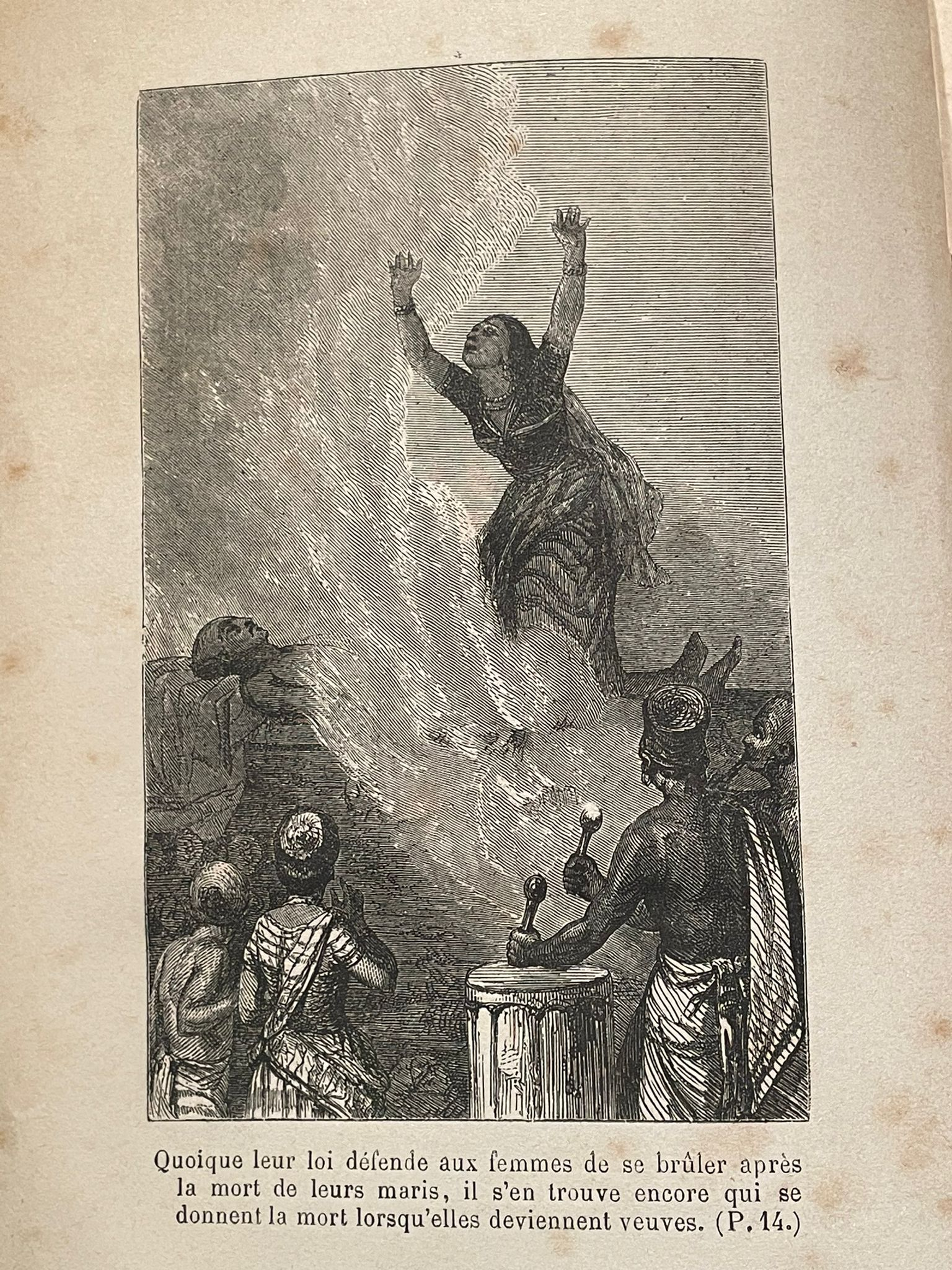
This famous nation of Seikhs, which form the principal people of Lahore, probably descendants from the valiant soldiers of Porus, which fought with glory against the Macedonians of Alexander. Their religion differs completely from that of the other Indians: they reject the cult of Brahma, Vichnou and Chiva, the three principal divinities of the Hindus, as well as the adoration of figures and images; they acknowledge but a single God, to which they address their prayers directly. This cult, more rational, more purified than that of the adorators of Brahma, is unfortunately mixed up with superstitious customs, maintained by the most complete ignorance. Therefore, despite [14] their law prohibiting women to burn themselves after the death of their husbands, there are still a great number of them who, despite this law, give themselves up to death when they become widows.
The Seikhs let their hair and beard grow, which the other Indians do not do. Their usual costume consists of blue trousers, a mantle of different colours and a bad turban. Their chiefs have their wrists ornamented with golden bracelets, and their turbans surrounded with chains of the same metal. Sober in their food, they love liquid spirits; warriors by profession and taste, they nevertheless cultivate the land, maintain large herds, and even have crafts. They make good cloth, and fire-arms which are very esteemed in India.Their children do not receive any intellectual education; they do not learn to read or write. For notions of good and evil, they are abandoned to their natural instinct; a system of education which explains why there are such great numbers of thieves and bandits in the kingdom of Lahore. At the age of eight, the children excel in mounting a horse, riding an elephant, shooting a rifle; still a few more years, and they make excellent recruits. Doing so, accustomed since their childhood to a laborious and frugal life, the Seikhs undertake and marches and support fatigue which are really surprising. In their excursions, they carry tents nor luggage, at most a small tent for their principal officer. They place themselves under cover from bad weather under blankets which serve them to cover the saddles on their marches. (…) [15] Such are the people that Runjet Singh submitted to his domination. It is not by the authority of a superior education, as he is not more lettered than his subjects, and, like most of them, he does not know how to read or write. But if he doesn’t undertake science for himself, he knows marvelously how to employ and appropriate that of others. (…) As to his religion, he is nor muslim, nor Christian, nor sectarian of Brahma; in one word, it would be easier in this case to say what he is not than what he is. He is, as many people in Europe, of a complete indifference towards religion; which some of his admirers call an admirable tolerance; which is what, I, would call total absence of religion. (…)
[18] Runjet Singh is above all a soldier; he loves war, he has grown up by war, and he commands the most warlike people of India. (…) [24] Now does the kingdom founded by the genius of a single man stand the chances of lasting? One can well address this question, when one sees at what speed empires rise and fall in this land; when one sees the Great Mogol, erstwhile one of the most powerful sovereigns of the earth, today became the very humble vassal of an English merchant company; when one dreams that the empire of Mysore, founded by Hyder Ali, a man no less remarkable than Runjet Singh, that this empire, maintained and enlarged by his son TIppo Saëb, ended up being conquered by that same British company. Do you believe now that the English will not look with jealousy upon an independent kingdom so close to their frontiers? (…)
Chapter IV (Bombay)
[61] Since my arrival, I was quite happy to maintain particular relations with the English of India during my stay of multiple years, I found there the most noble and most honest hospitality, raised and generous sentiments, as I also admire their loyalty, the order and the good harmony which seems to reign among them. I speak here, well understood, only of private relations, not of the government politics. Not only has the society in India not seemed inferior to that of Europe, but in many ways I have found it superior. There, there is not one man who does not make himself noticed in the circles of Paris or London, either by the knowledge obtained in his long travels or his ability in speaking foreign languages. (…) the libraries are numerous, and not a single work appears in Europe that is not found in India two months later. [62] (…)
[he describes the country and living conditions, especially the sharp distinction between the orderly colonial buildings and the huts belonging to the local population]
(86) One is often surprised by the weight that the wholly naked men here can carry, with such a puny appearance, and one admires the art with which they apply themselves to their bamboo crowbars, combining them in such a way to concentrate their forces. One has often seen robust sailors from Europe obliged to take recourse to Hindus to transport anchors, and blocks of stone which resisted their efforts. The largest number of such men is employed in loading and pressing cotton, while others pack and load bales on the esplanade, and make them into immense walls which seem constructed as if in Cyclopian stones. (87) A no less singular spectacle is offered by Bombay, which is the astonishing variety of people inhabiting it. There one finds gathered men of all races, of all colors, all nationalities and all the most opposed religions. From the Scotsman with blond hair, in white or pinkish color, to the dark black of Congo, you will see all the nuances which diversify the human epidermis. English, Portuguese, Jewish, Armenian, Muslims of all sects, Indians, idolaters of all castes, guèbres or Parsis, all live peacefully next to each other, each speaking his language, practicing his cult: it is the permanent tower of Babylon. The English government leaves all in full liberty, as long as the order is not troubled. (…) (90) There are so few relations between the Europeans, that is to say the English, and the other inhabitants of Bombay, Indians, mahomedans, Parsis, that it is quite hard to say which are the habits of the latter, and how they make use of their time before they enter the Fort, or after they have left it. In the morning, all, rich and poor, are equally nude, and make their ablutions and prayers; then, at nightfall, one sees Paris and mahomedans still praying on the esplanade, or keeping themselves close to the door of their country houses, while the Hindus retire within their residences. Sometimes one observes a multitude of lamps, and hears a tam-tam resonate with more intensity: it is the sign of an Indian or Muslim feast. If, to the contrary, you see aligned in the streets benches similar to a college, and if men dressed in white, the head covered with a turban in painted paper, come to occupy them and discussing profoundly, it will be the day of a feast with the sectarians of Zoroaster (the Parsis). If sometimes you hear the high-pitched sounds of a violin playing ancient airs from Italian or French operas; you approach, and you discover, through the banana and coconut leaves, a house of (91) meager appearance, from which issue forth cries of joy and happiness unknown to the British gravitas. You see people dressed in the European way who waltz and dance quadrilles or fandangos. They only differ from Hindus in the color of their skin; many are even whiter than those of elevated castes. They are descendants of the first Europeans who conquered India, valorous companions of Albuquerque and Vasco da Gama, they are Portuguese in the end, of which the name has today become almost an insult in this land. (…)
Chapter VI (Customs and religion of the Hindus)
[at Bombay] As here are found representatives of all parts of India, this study will apply to the whole of India, and will dispense me of returning to this topic when I speak of other towns and countries of India. (94) I will start by speaking of the Indians or Hindus, the primitive inhabitants of this vast near-island which extends from India at the Ganges, and the Himalaya to Cape Comorin and the island of Ceylan. I do not pretend to report here on everything that was written on the high antiquity of these people and their civilization, which one wants to place back in time thousands of years before the epoch that Genesis assigns to the creation of the world. Since a long time a healthy criticism set these ridiculous exaggerations right, all while acknowledging that the Indian civilization effectively goes back to a very ancient antiquity. (…) the Bible cites a land of Ophir, from where the vessels of Salomon join those of the Phoenicians 1000 years before J.C. (…) the position of Ophir has long been searched by erudites; one no longer doubts today that this land should be placed on the west coast of India, near Surat or Bombay. Another historical proof of the high antiquity of the Indian civilization, and this proof seems to me the strongest and most decisive, is the identity of the religious and political system of the Indians to the centuries of Alexander and the Ptolemies, with that which modern Hindustan offers us. The division in castes and the rigorous separation fo castes, an essential and fundamental institution, issued from the religion of Brahma, already existed. The Macedonians found there the most remarkable kinds of fakirs, or religious men, who strike with amazement the eyes of modern-day travelers. (95) The ones, living in the forest, nourish themselves on roots, and cover themselves with tree-bark; others peddle amulets, miraculous remedies, make serpents dance or tell fortunes. One sees one stretched-out on the soil during an entire day, receiving without emotion torrents of rain flooding his body; this one, placed all naked on an almost ardent stone, braves the violence of the sun’s rays and the stings of insects. Strabo, who reports these facts, by the testimony of Alexander’s companions, rejects as a fable that Indians knew how to bend their fingers of the rear hand and those of the feet forward; while they are exercises to which the fakirs dedicate themselves daily, and of which I have often been witness at Benares and Calcutta. (…) (96) The religious and political institutions of modern Hindustan seem therefore to have existed, in their essence, 1000 years before Jesus Christ, that is to say at about the same time as Salomon. While admitting, after reasoning, that the Hindus are one of the most ancient nations on the globe, we have to be careful of exaggerated writings. Not a single authentic Indian monument dates back earlier than the century of Moses Their astronomic tables have been calculated in retrograde, as the famous geometer Laplace has demonstrated, in his Exposition du système du monde; and the famous Sourya-Siddhanat, their most ancient treatise of astronomy, which is pretended to have been revealed for more than 2 million years, seems to have been composed about 750 years ago (Bentley, Asiatic Researches). The most ancient of the sacred writings of the Indians, the Vedas, to judge by the calendar found annexed to it, and according to the position of the colures of solstices which this calendar indicates, may go back 3 200 years, epoch close to that of Moses. (…) The Hindu nation, united since about 3000 years under the same beliefs, the same laws, the same institutions, presents a phenomenon as rare as it is interesting, while (97) its native land has been invaded many times, and by a great number of hordes of strangers attracted by the fertile soil and the so little warlike character of the indigenous people. (…) (98) The Hindu nations have sometimes mixed with nations come from abroad, and have adopted the religion and customs. Also the Seikhs, of whom I already spoke, are only separated from other Hindus by a new belief and the institutions to which it gave birth. Many Indians have also adopted the Muslim religion, which has been brought to them by Arabs, Persians, and especially the Mongols. We will see further down that a certain number of them have adopted Christianity. (…) (98) In general, the Hindus are susceptible to participate in all the wellbeing of civilization. Those of high class are of an excessive politeness; but they maintain their dignity. Their hearts are not closed to patriotic sentiment; they have no sympathy at all for their dominators, of whom they (99) appreciate the laws and institutions full of wisdom as an advantage which Hindustan will enjoy sooner or later, while the mass of the people seem totally indifferent to the power which the English hold over their country (…) the Indian people speak different dialects which all relate to a common undercurrent, that of Sanskrit or samskrda, language in which are written all the ancient sacred books of India. This idiom, remarkable by its perfection, is today a dead language (…) the Sanskrit approaches, by its words as well as forms, the Zend, the Persian, the Greek, Hebrew, Latin, Teutonic or ancient German, gothic and Icelandic. These traits of parenthood surprise as much by their manifest resemblance than by its astonishing dissemination. (…) Roots that do not exist in German dialects are known to be common to Sanskrit and Icelandic, languages separated by (100) a quarter of the globe’s circumference. (…) (100) The Hindu nation is still divided, as in antiquity, into four castes, word borrowed from Portuguese; the Indian word is dehadi. Each cast has privileges, functions and particular laws; the higher the caste is Elevated, the more restrictions are multiplied and prerogatives are honored; the fourth caste has the least laws to follow, but has also little consideration or rights. Everyone stays invariably within the caste into which one is born, and practices its duties without ever being able to uplift oneself to a superior caste, whatever is one’s merit or genius. The most cruel penalties await those who would want to subtract themselves from the laws prescribed for one’s caste. The Hindu apathically sacrifices his health and even his life to this point of honor. (…) the law of Manu is inflexible (…) (102) the excessive intolerance of the Hindus in the observation of their caste laws. A code, both civil and religious at the same time, scrupulously arranges all the distinctions between castes, and prescribes the duties of each one. This code is in vigor since thousands of years, and the Hindus have never dreamt of modifying its rigor. The most noble caste is that of the brahmes or brahmanes, priests; then come the kchatrias, or rajahs, warriors; that of the veissiahs or vessias, agriculturists and merchants; finally that of the sudras or soudras, artisans, workers, servants. Outside of these four castes, the descendants of those Hindus who, by illicit marriage, renounced to the rights of the four noble classes, are comprised in the divisions of ignoble or despised, called barum-sunker or warna-sankra, species of mixed castes; they live covered by a sort of local amnesty, but do not dare to communicate with any individual of the noble classes. Finally, below this bastard classes, and outside of any caste, one sees unhappy pariahs, which the Hindus rejected form their society, and who undertake the most vile and disgusting occupations (…) (103) Each of the four noble castes is subdivided into many others of which it is not easy to know the number, as this division varies according to localities, and that such division of caste is not found elsewhere. For example, among the brahmes, one distinguishes in the south three or four principal castes, which themselves count about twenty subdivisions each. The demarcation lines between them are so pronounced, that they oppose any sort of fusion of a subdivision with another, especially operated by marriage. The case of xatrias and that of vessias also has many subdivisions and divisions. (…) the first is more considerable in the north of India, while the brahmes affirm that the tribe of real xatiras no longer exists, and that those who pass as such are but a race of bastards. (104) The constitution of the Hindus is founded on Brahmanism, or the cult of Brahma, religion which admits the existence of a triple divinity, Brahma, Vichnou and Chiva, from a crowd of inferior divinities preposed to govern the world, as well as the spirits of the good and bad, immortality of the soul, the metempsychosis, the purification of souls by voluntary abstinence and religious practices. The brahmes teach that the Indian people have been created by Brahma; the brahmes issued from his head, and that is why they are the most noble caste (…) The Indian mythology seems to be, as that of the Greek, a mixture of multiple beliefs, which are founded in each other and which offer all allegories on the eternal power of nature. Iswara, Indian divinity, resembles in many traits Osiris of the Egyptians and to the Bacchus of the Greeks. Vichnou and Chiva both have astonishing traits of resemblance to Jupiter. Many other traits of resemblance prove that the Indian and Greek fables have a common source. The brahmanic cult is accompanied by a great (105) number of ceremonies and solemn customs. There are horrible ones, such as the procession of the god Djaggernath or Jagrenat, of which the wheels of the heavy chariot runs over fanatics who, throwing themselves before it, believe to find the most glorious death and eternal bliss. There are other Indian feasts where tumult reigns, where licentiousness presides, and where the impudic Lingam is carried around before the eyes of the prosternating multitude. There are renewed al the disorders, all the bacchanalic abominations and the feasts of the good Goddess among the ancient pagans of Rome and Greece. But let’s halt our glance towards other tableaux. Ablutions and lustrations form an principal part of the brahmanic cult. Every kind of water is good for purifications, seen that it is limpid. That of the Ganges furnishes the water by excellence (…) (105) The temples where the Indians celebrate their cult are named pagodas. A great number of them are found in all parts of India. The most famous are found in the isle of Elephanta, near Bombay, at Illura and at Jagrenat. The pagoda of Elephante, which I visited during my stay at Bombay, is considered the most ancient of all; she carries the name of Kalpuri and that of Elephanta. This name comes from a black elephant, erstwhile sculpted in rock (…) (106) Astonishing mixture of force and weakness, softness and ferocity, the Indian presents us with a tableau of the human race which, without passing by the different degrees of a free civilization, has been enchained, polished and degraded by superstition and despotism. The man who sacrifices his life not to hurt any of the bizarre laws of his caste would not dare to arm himself against strangers oppressing his homeland. (…) the Hindus are slavishly attached to their religion; they practice its superstitious rites, as absurd as they may be. It is thus that, in their religious feasts, men who want to pass themselves as pious murder their bodies and impose all sorts of tortures, in the hope of being agreeable to their gods. The fakirs make life into a perpetual torment, and submit themselves by devotion to the most insupportable habits. (107) I read in the Bombay Courier that one of these ceremonies, which become more and more rare, thanks to the intervention of the English government (..) The brahmes maintain and thrive by all sorts of means through the popular superstition, which is for them an infallible source of wealth. They don’t need recourse to more ingenious ways; the most gross rogueries succeed without trouble in the eyes of the blind people. (…) Four or five years ago, a brahme imagined a singular means of procuring money and presents. He announced to the adorators of Brahma, one of the gods of the Indian Olympus, he would render this deity visible to them, not in the form of inanimate statues, but in the human figure of a man talking, walking and acting. He asked for six days and the needed money and preparatory sacrifices. On the indicated day, the good Indians ran as a crowd to the pagoda. (…) the imposter saw from afar an old man with a venerable air, well dressed, and the front decorated with three bands of color as all sectators of Brahma wear. He prostrated himself before him, crying out “See here, the great god! See here how he approaches you!”. The idolators threw themselves down before the old man (…) useless to mention how the wily brahman profited of the tumult to escape with the money destined for the sacrifice.
- Annotations
-
- Just Jean Etienne Roy (1794-1871) was a prolific French writer, who wrote around 200 works under various pseudonyms. He served as secretary to the French consul at Rio de Janeiro, and was otherwise also well-traveled. His description of India is based on a journey from Marseille to the Levant, starting the 15th of April 1839. From Egypt and the Red Sea, the author travels onwards to British colonial India with the design to join in the footsteps of agents like Jean-François Allard (a veteran from Napoleon’s campaigns who joined and ‘reformed’ Maharaja Ranjit Singh’s army in the Punjab. The author immerses himself in British colonial ‘high society’ in India, and presumably (and self-avowedly) describes India according to British perspectives (rather than interacting with Indian traditions or inhabitants in any meaningful way).
- The author travels to multiple destinations in British colonial India, where he describes customs and traditions.
- Complete title
- Voyage dans l’Inde Anglaise
- Author details
- Roy, Just Jean Etienne, 1794-1871
- Date of publication
- 1884
- Dates of travelling
- 1839
- Publisher
- Alfred Mame et fils
- Place of publication
- Tours
- Archival source or library
- n.a.
- Locations in India
- Benares, Bombay, Calcutta, Lahore
- Keywords
- Sikh, Hindus, Hinduism, heathen, Gentoo, Islam, antiquity, ancient, violence, anarchy, feudalism, religion, custom, cult, Brahma, Vishnu, Shiva, idols, idolatry, prayer, superstition, sati, theft, morals, nudity, labor, Jewish, Armenian, caste, race, skin color, mahomedan, festival, Zoroaster, Portuguese, Phoenician, Ophir, Salomon, Alexander, fakir, Bombay, Benares, Calcutta, astronomy, Vedas, institutions, politeness, patriotism, distrust, Sanskrit, caste laws, Manu, divinities, spirits, soul, Ishwara, Osiris, Jupiter, horror, Jagranath, tumult, impudence, lingam, disorder, bacchanal, pagan, Ganges, temples, Elephanta, Elora, superstition, despotism, devotion, adoration, Olympus
- Translator and copyright
- Wim De Winter, 2025
- Media
 image_8.png