

De Indische krisis uit het standpunt van christelijke beschaving beschouwd (The Indian crisis, as seen from the viewpoint of Christian civilization)
Item
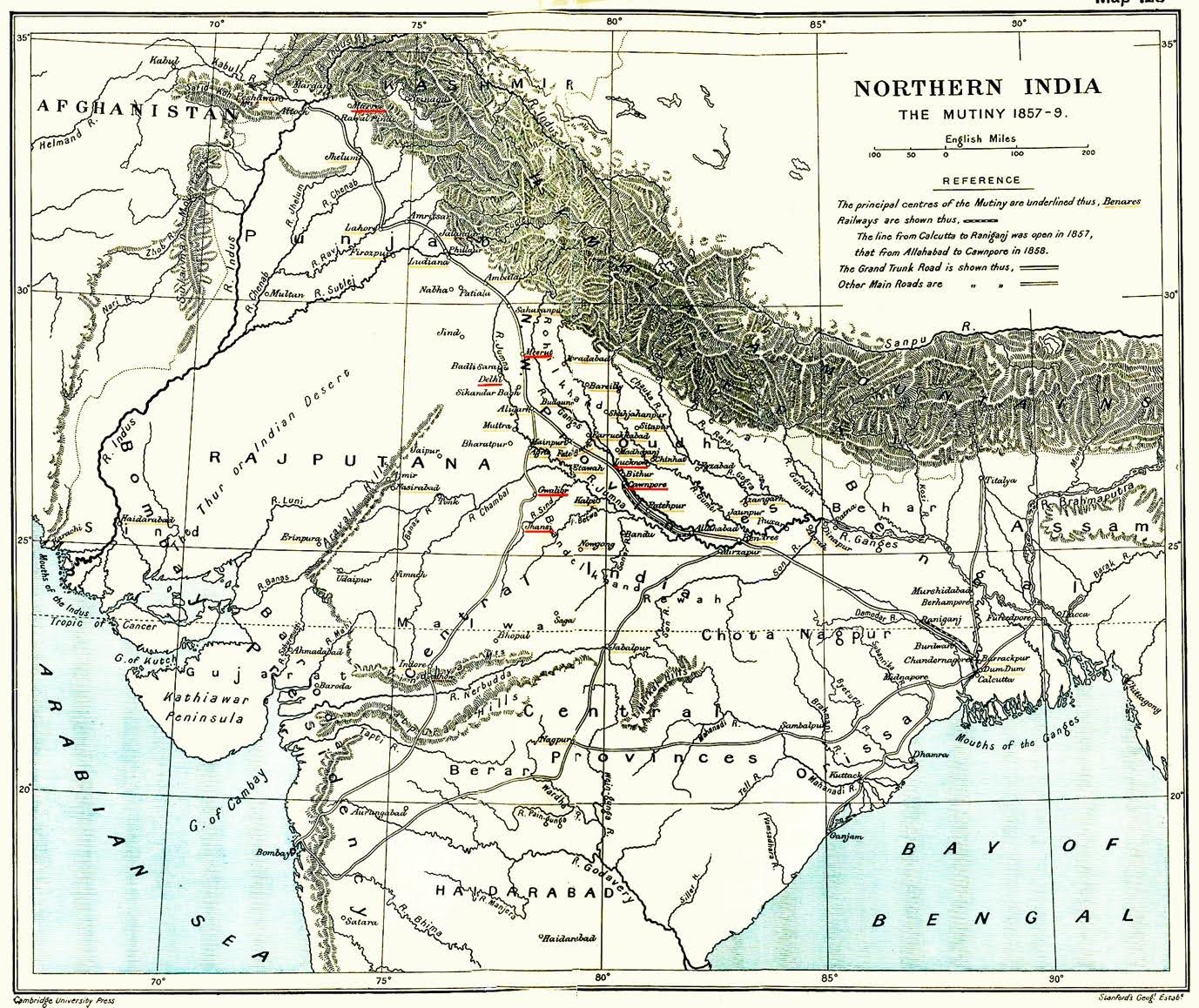
- Title
-
De Indische krisis uit het standpunt van christelijke beschaving beschouwd (The Indian crisis, as seen from the viewpoint of Christian civilization)
- Author
- Wilhelm Hoffmann
- Date
- 16.4.1858
- Country / region
- The Netherlands
- Source language
- Dutch
- Time period
- 1840-1860
- Themes
- British India
- Christianity and Christians
- Colonialism
- Europeans in India
- Hinduism and Hindus
- Religion
- Society
- Description
- A translation of an article on the ‘Great Mutiny’ or Indian Rebellion of 1857, where the author relates it to the policy of religious neutrality of the East India Company. The original Dutch article was published in 1858 in a periodical of the Dutch Reformed Church but was itself a translation of a German text by Dr. Wilhelm Hoffman.
- Translated text
-
In England, where, a short time ago, there was only little concern with the Indies, but where the rule of that country was regarded as a settled issue, and therefore all care was left to the East India Company, the government and the missionary societies, the terrible revolt of the native army, and with it a portion of the natives, has produced a feeling of terror similar to that which seizes those who live near a volcano, when the ground on which their houses stand trembles under them. Nowadays, things are discussed loudly and in large meetings, which used to be whispered only among missionaries and their trusted friends. Meetings are being held and resolutions passed, from which it may be perceived that the complete confidence in the certainty of British rule in the East Indies, which had hitherto hardly been disturbed by the utterances of a few statesmen and missionaries, is now deeply shaken. One remembers now the warning of Sir Thomas Munro, an foremost long-retired governor of the Indies: “British rule in the East Indies has more to fear from secret conspiracies than from public opposition. This danger, however, must be increased by the extension of our possessions in the East Indies, since it necessarily increases the bad relation between the number of rulers and subjects, which is already so unheard of. If we could win a capable, unified crowd of natives, who, united with the mass of the nation by equality in language, labor and external endeavor, were also united with the British government by the bond of religion and of mutual security, we would have abundant means of knowing what was being forged in the dark among the people, who are particularly against our rule. In time, the existence of a Christian Hindu church held in esteem, would substantially strengthen our power against the inevitable events to come in a country, which, like the Indies, had lived for centuries almost exclusively in upheavals. There is no longer any doubt, as it was said not only in the daily papers, but also in a meeting held at Edinburgh on November 9 of last year, under the chairmanship of Colonel Anders, and attended by many Lords, members of Parliament, military officers, professors, clergymen, etc.: we, as a nation, have closed our eyes to the tremendous responsibility, which rests upon us on account of the possession of the East Indies. We considered the East Indies only as the land, where our sons could acquire wealth, to spend it later in the homeland. We regarded it as the field of trading ventures, as a showplace of military glory; but not in the light of our national duties towards a great empire."
Viewed from these perspectives, the Day of Prayer, which was held throughout Great Britain regarding the Indian uprising, was very appropriate. The nature of the rebellion itself gave cause to become aware of the forgotten duty. Lord Benholm, in a speech delivered at the above-mentioned meeting, says of it, “one of the chief features of this rebellion is the arrogance, cunning, and secrecy, which the mutinous sepoys practiced so long and to such an extent, and by which even the shrewdest and best-educated Europeans were deceived, as well as the abominable cruelty, of which the annals of the wildest peoples provide no example. - Did we not know from Scripture that Satan is a liar and murderer from the beginning? Then what else could be expected from his worshippers who follow his effort? – Has Scripture not since long given the remedy against it, namely, the Son of God, who breaks the works of devils? - The curse and the antidote were well known. Sound human reason, not to speak of Christian wisdom, should have ordered the use of the antidote, should have tried to kindle something of that light which makes one wise unto salvation and to counteract the abominable superstition, which manifested itself in Sati (burning of widows), infanticide, service of Dschegannath (Jagannath), as well as in other lewd and abominable idolatries, in this dark land, where religion did not put a dam against the depraved heart of man. Most likely, things would be entirely different in the Indies today, if more had been done in the last fifty years for the Christian enlightenment of the people.”
It is true that not nearly everything mentioned here as a revelation of the religious situation still exists today, but this is not the result of the work of the East India Company…as a Christian government, but most of it has been done in spite of it by well-meaning governors. Already the Marquis Wellesley, as governor-general, when the New Testament was presented to him in Bengali, hailed it as bringing salvation to the people and ordered the transcription of the Psalms and Isaiah; the commissioner for Moulmein (in Burmah) urgently advocated the introduction of the Bible into the country's schools, but the Court of Directors in London turned it down (1846); the Marquis of Tweeddale, as Governor of Madras, advocated the establishment of one hour a day of biblical instruction in the Government schools (1847), while leaving the pupils free to participate or not, as is the custom in Ceylon, a colony of the Crown; but his proposal was not accepted, nor was that of the Governor-General Lord Canning, when he wished to delegate the schools of the recently risen Sautals in Bengal to Anglican missionaries (1857). The reply from London was, “There was no need for religious instruction in these schools.” Since 1813, and especially since Lord Glenely’s settlement in 1833, the greatest evils have been counteracted gradually. Lord William Bentinck prohibited the burning of widows as acts of murder under criminal penalties; the practice of infanticide and the fraternity of Thugs (murderers and thieves in the service of the goddess Kali) were fought and abolished with great difficulty, slavery opposed, the payment of tribute to the State treasury for idolatry, (at least in its most hateful forms), the taking of oaths to Christian officials for pagan deities, the parading before and saluting the processions of idols by English troops, the official prayers to the gods for rain, the immediate control of temple properties and the supervision over pagan festivals by British officials, abolished. Some of these abolishments were extorted by public opinion at the Court of Directors, having been preceded in this by the government of Ceylon, which also appointed the priests of Buddha, and paid for the so-called devil's dances, as if these occurred in the service of Her Majesty.
It did not remain unknown to the Hindus that these things were already taking place and that their actual government disagreed with them. And how could this be, since the disparagement of Christianity, the aim to prevent its influence on Pagans and Muslims, the religious “neutrality”, as it was officially called – in reality, however, conscious opposition to Christianity and the mission – was a manifest characteristic of the former European government in the Indies. And would the pagans, even when they were led in a new direction to some extent in later times, forget this so lightly? Would the impression it had made also disappear with the deed? …
Truly, the commercial nature of the Company is one of the main causes of the false system, of which the phrase “denial of Christianity" is but a gentle euphemism. Does not every civilized Hindu know – and there are many today, who in newspapers, etc., bring that knowledge to their people – what opposition the Company showed to the settlement of the first missionaries in its territory? Her subjects were similarly minded. And this was hardly to be expected otherwise from officials, who could live in Calcutta for 26 consecutive years (from 1689 to 1715) without any Christian religion, and whose superior annually sacrificed a rooster on the anniversary of the death of his heathen wife. Not among the English, but among Germans and the Dutch the first thought of a mission in Calcutta awoke, which, however, only in 1758, almost 40 years after the establishment of an Evangelical church there, materialized through the mission of the missionary Kiernander from southern India (Tranquebar). And even though it soon failed again, it served to advance the missionary work spiritually through the English strongholds until new steps were taken in Europe. As is generally known, the Baptists Carey and Thomas entered the forbidden land without the required permits from the Company, which would have been denied to a missionary indefinitely (as Dr. Paterson actually experienced). Their followers had to settle on Danish territory (Berhampur). In the year 1806, a native regiment gave a prelude to the present uprising by murdering its European officers at Wellur; then, as now, this was the fault of the mission in the eyes of the malicious, though there was not even the remotest semblance of religious motives in the matter; as a result, the Company almost closed Northern India to the Gospel again. And was it not because of the same restriction that, in Madras, a missionary of the London Society was arrested on his arrival, put in prison, and dragged to his grave by fever, while this was the place where the mission of the times of Schwarz could have been known more widely? What was it that compelled the governor of Bombay to send the American missionaries Hall and Nott immediately away and even to detain them as prisoners at Cochin, while they, like their colleagues Newell and Judson, had already been sent away from Calcutta? A competent expert on the Indian mission says: “One need only open one of our principal journals from that time and see what eloquence was required to dispel the mistrust towards the missionaries, and what fear the officials in India and even members of Parliament in the motherland expressed, that the quiet efforts of a few Christian men endangered commercial interests and even our rule in the Indies. Read the old parliamentary reports and be ashamed to realize that it took the full force of persuasion and the moral influence of a Wilberforce to prevent the House of Commons from taking measures that would have required all missionaries to be recalled from the Indies. Pick up an old volume of the Edinburgh Review and read the article by a clergyman of the Church of England, who sought to prove that it was impossible to shake the rule of Brahma’s religion over the mind of the Hindu, and that this religion was as suited to the Indies as Christianity is suited to us.”
- Annotations
-
- This is a translation of an article titled “De Indische krisis uit het standpunt van christelijke beschaving beschouwd” (The Indian crisis, as seen from the point of view of Christian civilization), which was published on April 16, 1858, in De Heraut, a principal periodical of the Dutch Reformed Church, based in Amsterdam. The Dutch article is itself a translation of an article written in German and originally published in the Deutsche Zeitschrift. The author Dr. Wilhelm Hoffman had been inspector of missions in Basel and professor and superintendent of the seminary in Tübingen; in 1852, he was appointed by Frederick Wilhelm IV of Prussia as court preacher in Berlin and later as general superintendent of the Brandenburg consistory.
- The article was written in the wake of the Indian Rebellion of 1857 and blames the English administration for not having done enough to Christianize the Indian people. By having focused too much on (personal) profits from trade instead of taking on the responsibility of ‘civilization’, the author believes that the British have induced the crisis in India themselves. The article is a call for (further) Christianization of the Indian peoples.
- Complete title
- De Indische krisis uit het standpunt van christelijke beschaving beschouwd
- Author details
- Hoffmann, (Ludwig Friedrich) Wilhelm, 1816-1873.
- Date of publication
- 16.4.1858
- Publisher
- De Heraut; H. De Hoogh
- Place of publication
- Amsterdam
- Archival source or library
- Delpher
- Locations in India
- Bengal, Moulmein, Madras, Ceylon, Calcutta, Tranquebar, Berhampur, [Wellur], Bombay, Cochin
- Keywords
- Missionaries, Hindu, Christianity, Gospel, Calcutta, Missions, Heathen, Idolatry, Superstition, East India Company, British government, Sepoy Mutiny, Indian Rebellion, Colonialism, Thomas Munro, Sati, Thuggee, Infanticide
- Translator and copyright
- Jaro Demetter, April 2025
- Media
 unnamed (1).jpg