

De thug’s; een ijselijke moordenaarssekte (The thugs; a horrifying sect of murderers)
Item
- Item Number
- 8
- Title
-
De thug’s; een ijselijke moordenaarssekte (The thugs; a horrifying sect of murderers)
- Author
-
Paul De Mont
- Date
-
25.6.1933
- Country / region
- Belgium
- Source language
- Dutch
- Time period
- 1920-1940
- Description
- A translation of a Belgian newspaper article on the thugs, originally written in Dutch and published in 1933. The author draws on a British book by James L. Sleeman and describes the eradication of thuggee as an illustration of the positive effects of British colonial rule in India.
- Translated text
-
There is certainly a lot to be argued against colonization. Should England, France, Holland, and the other powers wish to answer candidly to the question: “By what right have you ensconced yourself in Africa, in Asia and elsewhere?”, they would have to answer: “By right of the fist”. There is no doubt that particularly in the early times, when private shipping companies or societies funded colonial expeditions, appalling atrocities were committed by the whites.
Since the governments gradually took over the control of the colonial territories, especially since the second half of the nineteenth century, things have changed for the better. It is thanks to the intervention of the European powers that slavery, cannibalism, and other equally odious barbaric practices are gradually disappearing. One may wonder whether the evacuation of the colonies by the whites at this time would not spell disaster for the natives themselves?
Such a steadfast and principled man as Gandhi takes this into account when he deigns to negotiate with the British. After all, it is thanks to their presence that he can wage and sustain his struggle in favor of the pariahs. For Muslims and Hindus, who so bitterly oppose and fight each other, would quickly agree to suppress the pariahs, if the British did not support Gandhi’s moral authority in this matter with their armed forces. It is they who curb and restrain the maharajahs and other local rulers.
However one may judge their policies in India, it must be counted as a great achievement, for example, that they succeeded in rooting out the Thugs, who had plagued India for about three centuries. It was General Sir William Sleeman, who took up the fight against these professional killers a little over a century ago, as testified by the account of his grandson, Colonel James L. Sleeman (Thug, or a million murders, Sampson Low).
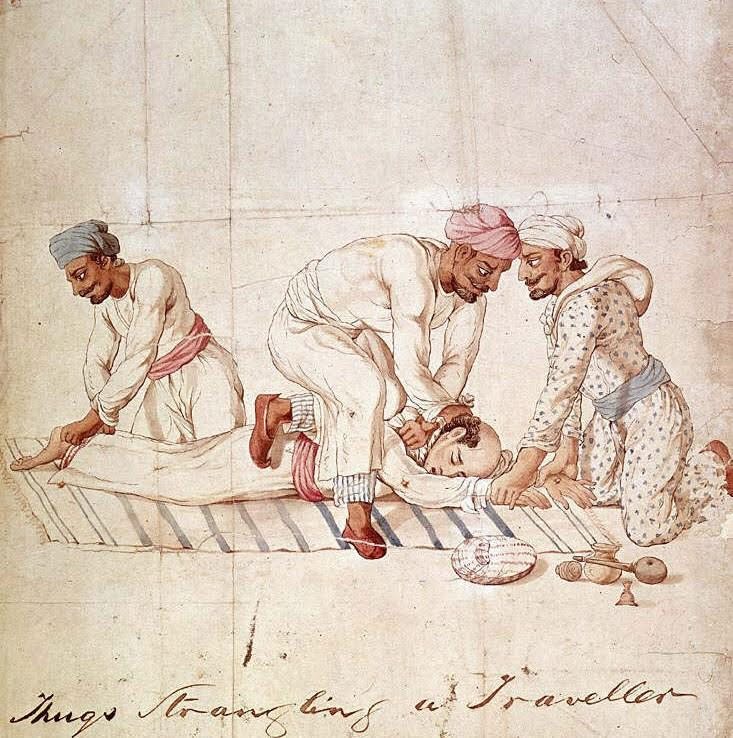
De Thugs killed not out of rapacity, but out of religious fanaticism, in honor of their goddess Bhowani. They were forbidden to shed blood: therefore, they strangled their victims with a special noose called ruhmal. A certain Buhran confessed that in forty years he had committed 931 murders, and thereby apologized for his negligence, for he had neglected to remember a large number of other murders; when General Sleeman asked him if he felt any remorse, he replied more or less: “Why should I feel remorse? Do you not tremble with joy when you hunt and are on the trail of game? What a pleasure to gain one’s confidence … and then at the appropriate moment to put the sweet ruhmal around his neck…”
Before being promoted to the highest degree of strangler, members of the cult first had to serve as scouts; then they were allowed to bury the corpses; later still, they were allowed to hold the legs of the victims; finally, and after a probationary period of years, they were empowered to wield the noose, the highest ambition of any Thug.
It is estimated that more than a million victims fell prey to the Thugs. All ruses and ambushes were theirs. Once, a Muslim dignitary came riding along a lonely road, with two servants. There he found five Muslim sepoys, seated around the corpse of one of their companions, near a freshly dug grave. Whether His Highness would want to conduct a funeral service according to the precepts of the Qur’an? The august traveler readily agreed, “had a carpet spread out, and began the preparations for the burial. Since, however, according to the regulations, he had to be unarmed to say the prayers, he stripped himself of his armor and, asking for water, washed his feet, hands and face so that he would not say the holy words in a state of impurity. Then he knelt, and began to say the service in a loud, clear voice, with a Thug to his left and right, and the other a few steps behind, beside the servants. … When all was ready, the chief Thug gave the jirnee or sign, the ruhmals were struck around the necks of the victims, and a few moments later the Mogul and his servants lay dead in the prepared grave…”
On another occasion, a group of Thugs followed on the heels of a group of about sixty armed travelers. One straggler after another was silently ambushed and strangled, so that finally the entire caravan was annihilated!
So carefully did the killers proceed that General Sleeman did not begin to suspect the extent of their criminal activity until 1824, when an apprehended Thug snitched on the game. To make their victims disappear without a trace, the Thugs had laid out secret graveyards everywhere: it was on one of these burial grounds that the British had set up camp. General Sleeman noted: “A pundit and six servants, murdered in 1818, rested beneath the cords of my sleeping tent, a havildar and four sepoys, murdered in 1824, lay beneath my horses, and four Brahmin Ganges water carriers, killed shortly after the pundit, lay under my sleeping tent itself.”
Then the British decided to make short work of the sect. General Sleeman received full power to exterminate them: between 1826 and 1835, 1.562 suspects were arrested: 1.404 made confessions and were hanged or imprisoned. In addition to Buhram, who boasted 931 cases on his record, Ramzan and Futty Khan were eligible for 604 and 508 respectively. They were veterans, with several dozen years of service!
To end with one more anecdote: “An Englishman, Dr. Check, had a Hindu in his service, to watch over his children. The man was well liked for his gentleness and tenderness … Every year he was given a leave of one month, supposedly to visit his old mother. This gentle and exemplary servant was later exposed by Sleeman as a Thug: gentle, kind, conscientious and punctual for eleven months out of a year, he spent the twelfth strangling.
It is not surprising, when one reads all this, that Sir William Horwood, former chief of the British police, could write: “Of all the benefits which British rule has brought to India, the suppression of Thuggee must, to the Hindus, constitute one of the most outstanding.”
- Annotations
-
- This is a translation of an article titled “De thug’s; een ijselijke moordenaarssekte” (The thugs; a horrifying sect of murderers), which was published on June 25th, 1933, in the section Het Algemeen Nieuws (which translates to “General News”) of the Brussels periodical Sportwereld. The text is written by Paul De Mont (1895-1950), who was the chief editor of Het Algemeen Nieuws until 1936, when he became a senator for the far-right political party Rex.
- The author writes about the so-called ‘thugs’, who allegedly were part of a religiously motivated criminal collective, known for their specific modus operandi. According to (often British) colonial sources, they deceived, strangled, and robbed unsuspecting travelers on desolate travel routes, thereby following divine instructions from Kali. Systematic persecution and suppression of the thugs came about in the 1830s, resulting in the creation of the Thuggee and Dacoity Department, led by General William Henry Sleeman (1788-1856). In 1839, he declared that thuggee as an organized system had been effectively eradicated. De Mont uses the phenomenon of thuggee as an example of good things resulting from British rule in India.
- In his description of the thugs and their organization, De Mont relies heavily on (and refers directly to) the book Thug; or, a million murders, which was written by James L. Sleeman (grandson of W. H. Sleeman) and published by Sampson Low in the same year as De Mont’s article came out (1933). The final quote by Horwood is taken from the foreword of the same book.
- All emphases in the text (by use of bold typeface) are preserved from the original text. I have not added nor removed any emphases.
- Complete title
- De thug’s; een ijselijke moordenaarssekte
- Author details
- De Mont, Paul, 1895-1950
- Date of publication
- 25.6.1933
- Publisher
- Sportwereld
- Place of publication
- Brussels
- Archival source or library
- KBR (Royal Library of Belgium), DIGIT 735
- Keywords
- Thug, Thuggee, Thuggism, Bhowani, Hindu, Sleeman, Rhumal, Jirnee, Cult, Sect, Colonialism, Crime, Criminal
- Translator and copyright
- Jaro Demetter, April 2025
- Media
 unnamed.jpg