
Uit de Heidenwereld: Een Hindoesche roversbende (From the Heathen World: A Hindu Band of Robbers)
Item
- Item Number
- 16
- Title
- Uit de Heidenwereld: Een Hindoesche roversbende (From the Heathen World: A Hindu Band of Robbers)
- Author
- Anonymous
- Date
- 7.8.1893
- Country / region
- The Netherlands
- Source language
- Dutch
- Time period
- 1880-1900
- Description
- Translation of an article titled published on August 7, 1893, in Het Nieuwe Dagblad voor Utrecht en de Provincie, a Dutch regional newspaper based in Utrecht and intended for a Catholic reading public.
- Translated text
-
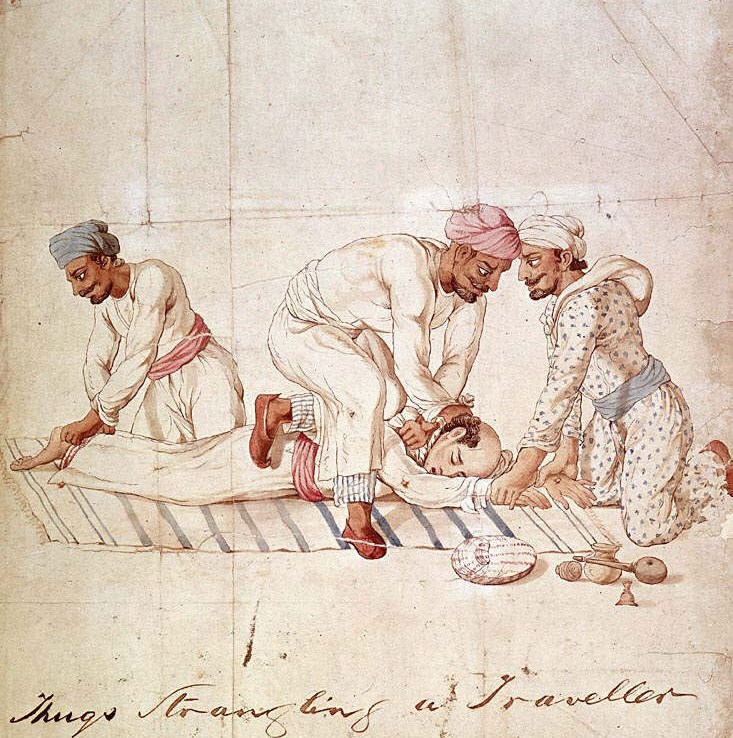
The East Indies there is a socially organized gang of semi-religious assassins, who join the unsuspecting traveler, throw a noose around his neck at an opportune moment, and thus strangle him with great skill. These assassins are called Thags. Mohan, now a native Christian, while still a heathen, was in such close contact with a section of them that he only escaped their bloodthirsty hands as if by a miracle of God. Mohan, born from a small town near Mirat, was in fact a pilgrim. As such, he had already visited the temples on the west side of Hindustan and was once again traveling to go on pilgrimage to Oude, the city of the god Ram. In a small town, not very far from Lucknow, he met a man, who at first sight presented himself as a pious penitent. Our pilgrim, who had a deep respect for such people, gave him the best he had as a gift in order to share some of his merits. Thereupon the penitent, in gratitude for the kindness received, offered to lead him to his lord and master, who, being a great saint, surrounded by his disciples, in the lonely forest, far from the bustle of the world, had stationed his army and did not allow everyone to see his edifying sight or even his instructive conversation. Mohan was feeling as if beside himself over the affectionate offer and traveled with him many miles toward the forest. They arrived there by nightfall, an impenetrable wood and bush surrounding them. As Mohan looked around a little, his eye fell on a pair of recently dug graves. Already he suspected treachery, when now as many as fifty men approached; and when these asked his conductor in obscured language, “Were you lucky, brother!” he no longer doubted that he had fallen into the hands of those assassins who are the terror of the lonely Indian traveler. There was no longer any thought of running away; the night had shrouded everything in thick darkness and no human quarters could be found far and wide.
They prepared for him, against his will, a night's shelter among them and then performed their evening worship before the statue of Kali, the blood goddess, whom the Thags chose to protect their bloodthirsty craft. How did he become desperate when he heard the robbers, in a language he happened to understand, thanking the goddess for having so graciously provided another victim for them!
Since Mohan had caught a bad cold, these bloodthirsty people feigned the most tender sympathy. They immediately prepared him a medicine and asked him to take it. However, he had repeatedly heard of a substance that he knew to be poison, and so all the friendly invitations were in vain. About 10 o'clock they laid down to rest. Mohan, however, remained seated with his hand on a long axe, which he always carried with him on his travels, in a state of indescribable fear. He had almost no clothes on, and December nights are not the warmest in northern India, which is so near the snowy peaks of the Himalayan mountains. Still, the sweat ran off him by the streams.
After a while, he heard a soft rumble in the nearby woodland. It was as if they were digging a grave for him. Suddenly a figure emerged from it. One of his companions asked, “Did you make the bed?” “Yes!” was the short answer, which passed through Mohan's soul like a double-edged sword.He jumped up and looked around him with the most anxious attention. At last he saw a man sneak up on him. This man had already come very close to him, when Mohan raising his axe with a thundering voice called out to him, “Go away, or I will strike you down!” - “I know,” he continued in a voice trembling with agony, “I know who you are and what you want; take my money and my clothes and give me life!”
As he spoke thus he threw all that he had with him to the ground. But the others replied with devilish composure, “Don't be so agitated, we will take it!”
With the axe in his outstretched hand, the man remained standing terrified and challenged them, to take his goods that had been tossed on the ground. They stood as if petrified and encouraged each other to attack; but none of them ventured. “Come, all together on him!” cried the chieftain; but no one stirred. The merciful God struck them all with terror.
As Mohan stood, he remained standing all night with a beating heart, gushing with sweat, with axe raised. O what a struggle now arose in his heart! He had already visited so many temples and yet found no peace for his conscience.
He now wanted to visit the remaining places of bliss in the North as a pilgrim; if he could find rest there too for his weary and burdened soul. Now he found himself suddenly and unfulfilled on the brink of the grave and eternity. Fervent prayers and even more heartfelt sighs erupted from within him to the unknown God.At last the dark night drew to a close. Dawn was breaking - in Mohan's soul, too, the dawn of hope for life arrived, when he heard from afar the bustle of passing merchants. But how could he make his desperate situation known to them? Had he uttered even one cry for help, the bloodthirsty men who had him surrounded would have beaten him on the spot, encouraged by the need.
Already the sun, which in Hindostan follows twilight immediately, was rising on the horizon.“Get out of here!" cried the bloodhounds.
Mohan was blind in the right eye. When he suddenly turned to the right side, he already saw the infamous “silk cloth with the knot” coming toward his neck. There was only just enough time left to shelter the neck from it by raising the arm. But the bow fell around his arm and cut deep into the flesh with the sharpness of a sword. Now in terror he swung his axe, struck down his opponent with one hack, made his way through the others with several axe heaves and crossed the nearby river. Fortunately, he found a plain spot, while the Thags pursuing him got into a deep swamp. Thus he escaped.
His first course was to the chief law officer in the neighboring town. But the latter either feared the robbers or was himself in league with them, for he hardly listened to Mohan. “Are you delirious?” he scoffed, "that holy man and his holy companions would be Thugs? Impossible!"
Only when Mohan threatened to go to the regent of Lucknow, at whose court he had an influential kinsman, did the startled official send soldiers to the forest. Fortunately, they brought back his few possessions, and Mohan was able to continue his way in peace.
Mohan had grown weary of pilgrimage; he surrendered to the true God who, at his pleading with a weeping heart, had saved him from the trap of the murderers.
- Annotations
-
- This is a translation of an article titled “Uit de Heidenwereld: een Hindoesche roversbende” (From the Heathen World: A Hindu Band of Robbers), which was published on August 7, 1893, in Het Nieuwe Dagblad voor Utrecht en de Provincie, a Dutch regional newspaper based in Utrecht and intended for a Catholic reading public.
- The author writes about the so-called ‘thugs’, who allegedly were part of a religiously motivated criminal collective, known for their specific modus operandi. According to (often British) colonial sources, they deceived, strangled, and robbed unsuspecting travelers on desolate travel routes, thereby following divine instructions from Kali. Systematic persecution and suppression of the thugs came about in the 1830s, resulting in the creation of the Thuggee and Dacoity Department, led by General William Henry Sleeman (1788-1856). In 1839, he declared that thuggee as an organized system had been effectively eradicated. According to the translated article, they had once again returned to wreak more havoc in India.
- Complete title
- Uit de Heidenwereld: Een Hindoesche roversbende (From the Heathen World: A Hindu Band of Robbers)
- Author details
- Anonymous
- Date of publication
- 7.8.1893
- Publisher
- Het Nieuwe Dagblad voor Utrecht en de Provincie
- Place of publication
- Utrecht
- Archival source or library
- Delpher
- Locations in India
- Mirat (Meerut), Lucknow, Oude,
- Keywords
- Hinduism, Cult, Thuggee, Thug, Kali, Crime, Criminal, Sect
- Translator and copyright
- Jaro Demetter, October 2025
- Media
 image003.jpg