

De moordgodin Bowani (The murder goddess Bhowani)
Item
- Item Number
- 17
- Title
- De moordgodin Bowani (The murder goddess Bhowani)
- Author
- Anonymous
- Date
- 17.8.1934
- Country / region
- The Netherlands
- Source language
- Dutch
- Time period
- 1920-1940
- Description
- Translation of an article published on August 17th, 1934, in Het Nieuwsblad van het Zuiden, a Dutch regional newspaper based in Tilburg.
- Translated text
-
Atrocities of an Indian sect.
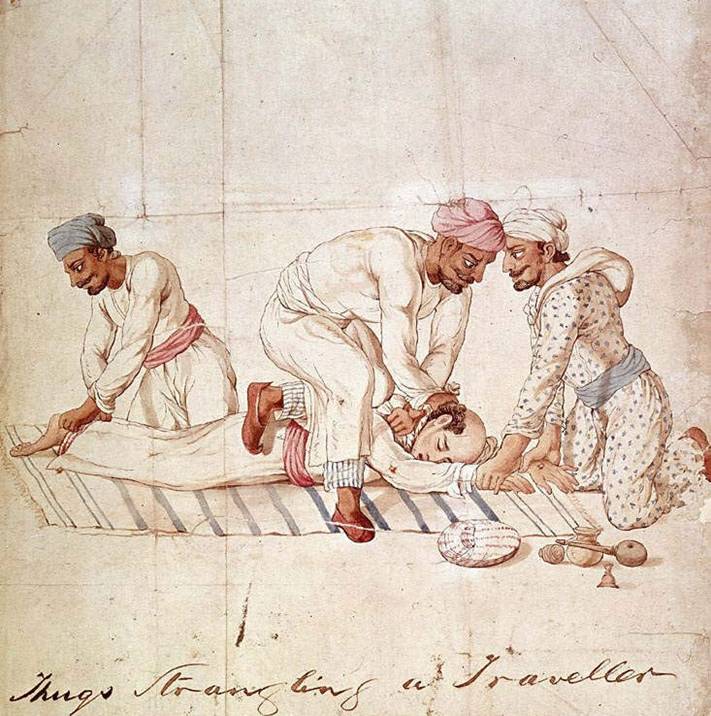
Recently, a terrible message reached Europe from the English East Indies. Reportedly, the dreaded sect of stranglers is making itself heard again. It was thought to be long extinct. It is in fact the sect of Thugs.Robbery as cult.
The religion forbids the Thug to rob a living human being. Without regard for age or sex, rank or nation, they strangle with a noose any victim that falls into their hands. Having robbed the corpse, they bury it as far as time and circumstances allow. This again is done according to another precept that ordains no dead person to be deprived of the earth. However, it is also done out of prudence in order to erase every trace.According to Indian folklore, this sect is very old and must have arisen shortly after the creation of the world. The goddess Bhowani is worshipped as its founder. Dissatisfied with the characteristics of humans, she wanted to exterminate the entire human race except her own adherents.
So she summoned her adherents and taught them the art of strangulation with a cloth. The money and property of the murdered if fairly divided would belong to them. For the disposal of the corpses they promised to take care of them personally.The Thugs did as their goddess ordered. But one day a curious Thug hid to see what the goddess was doing with the corpses. Knowing herself to be spied on, however, she declared that, for punishment, she would not hide the victims anymore. The Thugs now had to bury the strangled ones themselves.
The animals decide.
The symbol of goddess Bhowani is not a noose but an axe called hschun. Each gang owns its own axe, which grants special rights to the bearers. In the pagoda it lies at the feet of the goddess, while the Jemadars, or captains of the gangs, perform their own ceremony called the puga. Amber is burned in an urn, swirling up gray-white and filling the interior of the temple with its odor. Drums and gongs begin to thump. The Jemadars crouch in a circle around the image of the gods and rock back and forth to the monotonous music of gongs and timpani.The rhythm of the drums quickens. More passionately they wallow their bare upper bodies as they hold up flaming sandalwood torches.... wilder and wilder it gets.... a savage ecstasy. Meanwhile, the ordinary Thugs gather in front of the pagoda and listen with glazed eyes to the droning tones of the xylophone.
Only at dawn the noise quiets down and the ceremonies end. The axe is carried away by the Jemadars and handed to the standard bearer. Awaiting a favorable sign of whether the planned raid will succeed, it is thrown in the direction the gang plans to take. Dead silence reigns. Now if one of the animals makes its voice heard or shows itself to the right of the direction, which counts as a favorable sign, the Goddess is favorable to the plan. However, if an ominous animal appears or walks e.g. an owl on the left, it is a bad sign and the plan does not go ahead.
The pagoda in the jungle.
Since the religion forbids the Thugs to shed blood, they have no weapon outside the garrote scarf [den palos]. If they are caught despite their careful precautions and cunning tricks by soldiers or policemen, they surrender without resistance.
At the first opportunity their execution is avenged by comrades of other gangs. Thus it happened, for example, that soldiers who went on leave disappeared without a trace and were prosecuted as deserters while their families thought they were on duty. However, when desertion increased tremendously in recent times, a special commission of inquiry was set up by the military government.The investigations that were instituted with feverish haste suddenly had a sensational result: the soldiers had been killed by Thugs during the furlough trip.
It is impossible to determine the annual number of victims. Delinquents calmly confessed that they had strangled as many as 10 to 20 people in their lifetime. One notorious Jemadare even boasted of having accomplished the strangling of 86 people, some while following commands and others by himself. The loot that his gang made was very large: 2 ½ lakh rupees, in our currency more than 1 million guilders.Since the sect has followers and allies in all ranks, even at the royal court and among officers of the Nizam, it is extremely difficult to catch them. Even principal merchants are in connection with the Thugs and perform fencing work. Their own language and secret identifying marks facilitate their mutual relations. Yet they are fearfully concerned that people will identify their sect with a gang of robbers. They intend to act only according to the precepts of their religion.
The English government will once again try with all rigor to rid the country of this terrible scourge, just as it did once in the last century. High bounties have been offered on the heads. The death penalty will be carried out immediately after capture.
A strongly equipped company, led by seasoned officers, traverses the jungle, where the murder goddess Bhowani, as the avenging guardian of the gang's treasures, must have her temple, guarded by priests of her sect. Gangs that returned to the temple were captured. Closer and closer one comes to the secret of the jungle pagoda that will one day reveal itself to the world in its entire terrifying form.
- Annotations
-
- This is a translation of an article titled “De moordgodin Bowani” (The murder goddess Bhowani), which was published on August 17th, 1934, in Het Nieuwsblad van het Zuiden, a Dutch regional newspaper based in Tilburg. The article is presumably not original to Het Nieuwsblad van het Zuiden; it was also published on September 11th, 1934, in the Nieuwe Venlosche Courant (another regional newspaper), which suggests that the article might have been widely spread among Dutch regional newspapers in these months.
- The author writes about the so-called ‘thugs’, who allegedly were part of a religiously motivated criminal collective, known for their specific modus operandi. According to (often British) colonial sources, they deceived, strangled, and robbed unsuspecting travelers on desolate travel routes, thereby following divine instructions from Kali. Systematic persecution and suppression of the thugs came about in the 1830s, resulting in the creation of the Thuggee and Dacoity Department, led by General William Henry Sleeman (1788-1856). In 1839, he declared that thuggee as an organized system had been effectively eradicated. According to the article, they have returned to wreak more havoc in India.
- I presume that the article has made a mistake towards the end of the second section “Robbery as cult” in the phrase “For the disposal of the corpses they promised to take care of them personally.” I believe it is not “they” who promised to take care of the bodies, but “she”, the goddess Bhowani. This would also make the subsequent paragraph more sensible, where the author explains how the task of burying the victims has passed upon the thugs. It is, of course, possible that I have misunderstood some connotation or meaning of the Dutch article. Therefore, I will include the original Dutch text here: “Voor het verdwijnen der lijken beloofde men persoonlijk zorg te dragen.”
- Complete title
- De moordgodin Bowani
- Author details
- Anonymous
- Date of publication
- 17.8.1934
- Publisher
- Het Nieuwsblad van het Zuiden
- Place of publication
- Tilburg
- Archival source or library
- Delpher
- Keywords
- Thug, Thuggee, Thuggism, Bhowani, Kali, Sect, Cult, Crime, Divination
- Translator and copyright
- Jaro Demetter, October 2025
- Media
 image004.jpg