
Dwars door Britsch-Indië (Across the British East Indies)
Item
- Item Number
- 18
- Title
- Dwars door Britsch-Indië (Across the British East Indies)
- Author
- Ant. L.
- Date
- 18.1.1930
- Country / region
- The Netherlands
- Source language
- Dutch
- Time period
- 1920-1940
- Themes
- Brahmins
- British India
- Colonialism
- Europeans in India
- Hinduism and Hindus
- Religion
- Society
- Stereotypes
- Description
- Translation of an article published in the Dutch Catholic newspaper De Tijd, on January 18, 1930.
- Translated text
-
When I went to the East Indies, to tell the readers of [this periodical] about it, I had already read a few things about this awe-inspiring country. But how it appears to the foreigner when experienced first-hand.
To get to know the people of the East Indies, their souls and their customs, one must study their religions. But not in the big cities, where the pseudo-service of the watered-down forms of religions have spread, but in the sacred Hindu towns of the inlands, where the sacrificial altars are still smoking, where the holy waters are still murmuring, and where in the darkness of the temple thousands forget their earthly existence and, in self-flagellation, divest themselves of their physicality while praying before the images of the gods, which appear so strange and nonsensical to us Europeans.
The car buzzes through the vast land and brings a new rhythm to the silent, colorful contemplation and quiet life of the ancient cities. But the psyche of the people remains entirely the same as thousands of years ago. Religion, blood sacrifices, dark superstitions, belief in devils, in reincarnation in good and evil spirits, in witches’ spawn and devils’ dregs and the exaggerated alienation of material interests has remained the same as before. Interaction with spirits still dominates the Indian’s life. His entire life is entangled with this interaction, and with his belief he fights courageously and bitterly against the onrushing waves of Western civilization.
I believe that there is no people on earth so deeply rooted in their religious reflections, and so enmeshed in the fanaticism of their religious worship as the Indians are.
The religion of the Hindus, to which two-thirds of the 340 million inhabitants of India belong, grew out of Brahmanism. It dominates the North of the Land of Five Waters and the Himalayan Mountains, with the pearl island of Ceylon as its lower limit. This religion is so ingrained in the great masses of the people that no power, except a divine one, would ever succeed in eradicating it.Our car buzzes through the picturesque towns and villages. The landscape and the banks of the rivers are strewn with temples, sacred ponds, figurations of gods and sacred trees. In all these monuments a primal force reveals itself from the time when people personified the forces of nature in gods and when they still worshipped the god of thunder Indra, the god of fire Agni and the god of the moon Soma. In all these attributes proper Hinduism also emerges, which is closely related to Brahmanism, with its caste-system, deification, and the boundless capriciousness of the highest order of Brahmins, who felt themselves to be deified beings on earth and were the first of all to believe in the migration of the soul.
I found this belief in reincarnation still woven throughout the religions of India as a common thread. Herein culminates the Hindu’s whole conception of man’s present and future life. This belief I saw at work in the fakir as much as in the beggar. Fatalism and belief in the administration of fate as ordained by the gods also govern the service of the dead, which manifests itself in the burning of corpses and in the immense riches of the many temples in their different forms.
When I speak to fakirs and beggars, I understand from their answers the poverty, nakedness and chastisements to which they surrender. “Life runs like nature -- they say -- it passes and returns”. After this life -- so is their belief -- man, animal or plant will live on and in this new form of life will either be punished or rewarded for their past deeds. This transformation of life continues until man is completely purified and can enter Nirvana.I still found the use of bloody animal sacrifices in all the places I visited. The Hindu sacrifices to the gods elephants, camels, parrots, monkeys, goats, cats, fragrant flowers, water and other things.
In the great temple of Madura, I saw numerous more sacred elephants, camels and parrots, sacrificed by the pilgrims. In Benares, I wandered through a monkey temple, in which I found four hundred of these animal human imitations, crowded into every nook and cranny and even on the roofs of the temple. North India even possesses a temple in which the cat is revered as a sacred animal. According to the teaching, in order to be saved, man must cling to God, just as the young monkey clings to its mother; but in North India, the God Rama saved humanity, just as the cat takes up her young.I was able to study locally the focal points of Hindu life with regard to the two great movements; Vishnuism and Shivaism. Both flourish alongside many sects, manifesting themselves in the striking forms of idols and a variety of temples.
To Vishnuism, which worships the ancient sun god as the director of all life, belong the upper strata of Hindus. The god is depicted in a blue color, with four arms, in whose hands he holds a lotus flower, a discus, a club or a shell. Shiva, a variety of the storm god Rudra, is worshipped by the lower classes of people. He is depicted with a head with a braid on top, or also with five heads. In addition, he wears a collar consisting of skulls and other terrible attributes.
Behind these two highest gods, whose figures can be seen everywhere, especially on the great towers of the temples and in the temples themselves -- often in awe-inspiring dimensions -- there follow several more gods, who are invoked by Hindus in all manner of life situations. The rural population has the monkey god Hanuman as their patron god. Those who are childless worship the god of fertility. There is a god against cholera, against smallpox, etc. The god Ganesha is depicted in human form with an elephant snout between sacred snakes, which are usually found as giant sculptures in the temples.
The impressions gained here by the foreigner are so great that it is difficult for me to distinguish the essential from the unessential. The ceremonies and grand customs to be seen here are indescribable. When I visit the places of pilgrimage I see images, which rival in unspeakably extreme art, childish superstition, fanatical religious imagination, dark demon service.
People often behave like children in their religious ceremonies and sacrifices.
In Bombay, I saw only a caricature of these religious matters, for there prevails the spirit of a city of millions, where Hindu religion has become a commodity. For the first time I beheld the real Hindu religion in Muttra, a small place of pilgrimage between Delhi and Agra, which is simultaneously a place brought into prominence by excavations from Hindu, Mohamedan and Jainist times. Picturesquely standing on the banks of the Jauna are the small temples of gods; in dark corners here, ancient India still dreams. In the sound of the countless bronze bells, without which no Hindu temple could exist, a great tradition hums on. In the middle of a small temple courtyard in front of a stairway leading to the stream, I met a family with children, parents, and grandparents. A priest was shaving the children’s delicate heads with a blunt knife to prevent further hair growth. Bloodied and groaning, they were then baptized in the cold water of the stream. The shorn off hair was mixed into a rice cake and thrown into the river. Ravens came in great flocks and rejoiced at the welcome spoils. Men and women likewise descended into the river to bathe, for by the holy water soul and body are cleansed.Even more curious, and even more repulsive to the outsider, is life in the great pilgrimage city of Benares. Whoever takes delight in idylls, in a colorful life and in the picturesque grandeur of life goes to Benares, the greatest place of pilgrimage on the Ganges, which is visited annually by many thousands of pilgrims from all places. Here life is often grand, but also repulsive and disgusting, and the scenes one experiences are sublime and edifying.
Picturesque is the labyrinth of alleys, in which I wander through the native city and where one finds colorful clothing, sacred cows, businessmen, grave painters and small temples. The number of temples in Benares is about fifteen hundred, including about three hundred Mohammedan mosques.One structure, which particularly struck me is the golden temple from the eighteenth century. One hundred years ago, a rich Indian spent his wealth of gold on this temple, while he had the two towers gilded. Here also murmur the springs of wisdom, into which sacred sacrificial flowers are thrown. Pilgrims drink the brackish water, which is given to them by Brahmins.
Here again I am fascinated by the peculiar spectacle of temple animals. In the temple of Annapurna in Benares, the goddess of wealth, sacred peacocks and cows are kept. In the temple of Durga, the sacred monkeys act insolently and obtrusively. For a drinking fee, which the sacrificial priests always welcome, I was allowed to watch them feed. Bloody animal sacrifices are also still commonplace in this temple, where religious life leaves a dark and repulsive impression.
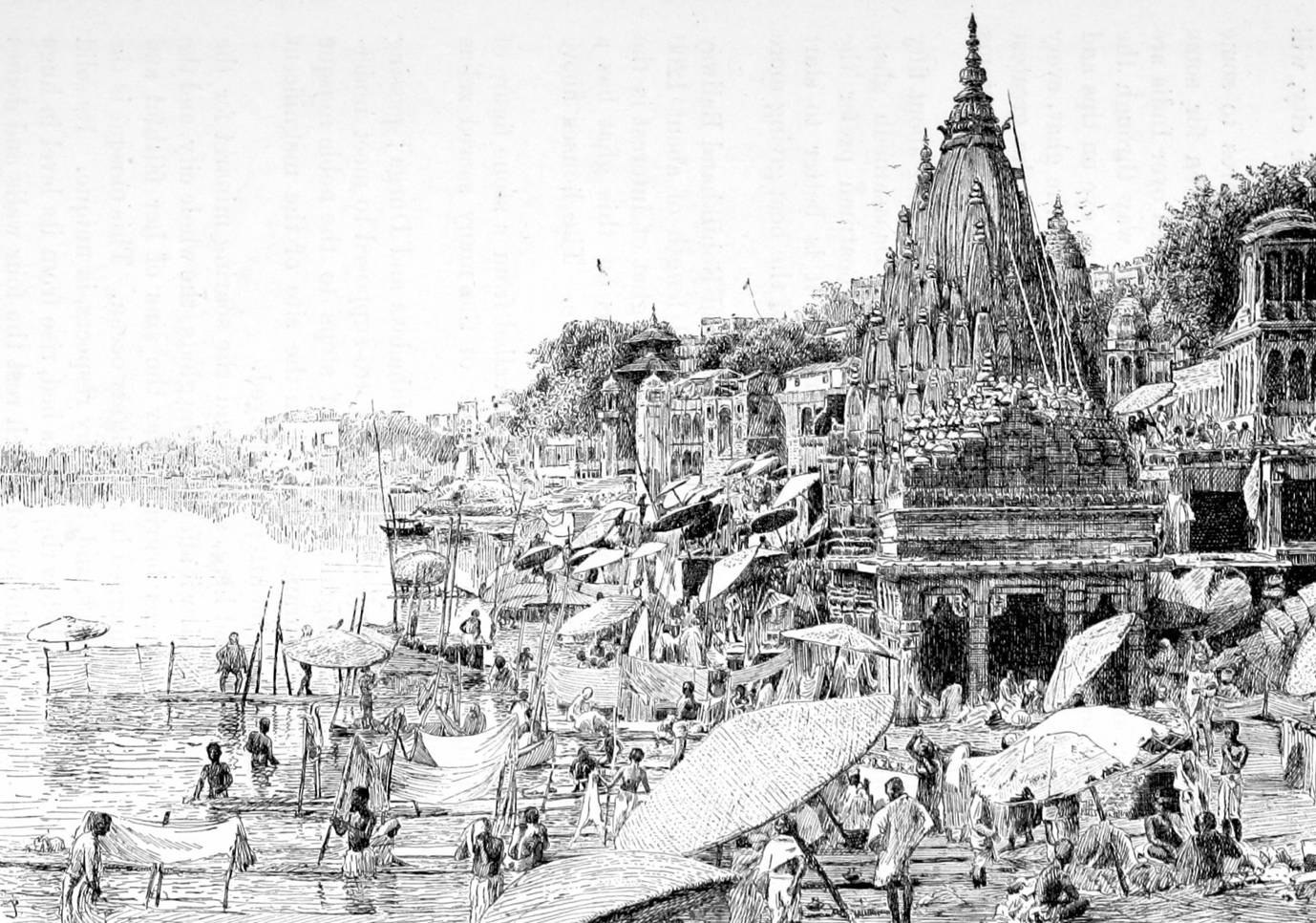
The most amazing and simultaneously most shocking impression I had along the five-kilometer long front of the Ganges River were the forty-seven gates and bathing places for pilgrims are located. Before the sun rose and while still thick mists slid over the waters of the broad river, I saw pilgrims by the thousands on the broad steps of the riverbank disrobing and descending into the yellow tide, washing their brown and black bodies. As I let myself row upstream in one of the primitive wooden boats, I slipped past a motley, busy life everywhere. Many thousands stood in the waves up to their chests, sheltering their heads and eyes, as they bore their gazes longingly into the rising sun. I also saw decrepit old men and women, blind or infirm people trembling and sitting down in mute delight in the cold water. Groups of people swarmed across the steps, with fakirs philosophizing on planks from which nails stuck out, or they meditated in the glowing rays of the sun. And numerous penitents in brown robes or completely naked, with painted bodies and heads strewn with ashes, spent their existence in reveling in souls’ faces. Often I found decrepit people, close to death, crouched on the steps. One knows that among Hindus it is considered the greatest mercy to die in Benares.In certain places I saw heaps of skulls and bones thrown together. The corpses are being burned. All the time the piles of wood are crackling and people are seen standing on the bank, throwing the many or few burned remains of the bodies into the sacred Ganges. A small red chapel still marks the place where the widows used to be burned, which today, thank God, the government no longer allows.
Pondering, I rocked in my primitive boat down the stream past all these eccentric expressions of religious life. The wild water sang its ancient song, scouring and eroding the stone steps, where the once magnificent palaces and ancient temples of the gods were gradually falling into disrepair.
On these shores it is as though a mysterious power has decreed the downfall of these places, as if a spirit is blowing along the shore, slowly but surely preparing the death of these terrifying places and proclaiming in the East Indies the dawn of a new age. May this spirit of life raise the land of so many creative souls from the confusion of dark religion, which paralyzes this imaginative people in its own instincts. What a blessing for the new civilization, if the old mystical India would die out and this land of magic and sorcery would let in the light and life that has risen from Bethlehem over the kings and their peoples! - Annotations
-
- This is a translation of an article titled “Dwars door Britsch-Indië” (Across the British East Indies), which was published in the Dutch Catholic newspaper De Tijd, on January 18, 1930.
- Complete title
- Dwars door Britsch-Indië
- Author details
- Ant. L.
- Date of publication
- 18.1.1930
- Publisher
- De Tijd
- Place of publication
- ‘s Hertogenbosch
- Archival source or library
- Delpher
- Locations in India
- Agra, Benares, Bombay, Delhi, Madura, Muttra
- Keywords
- Hindu religion, religious practices, temples, Ganges, Benares, false religion, Hindu gods, Shiva, Vishnu, Brahmins, animal sacrifices, ceremonies.
- Translator and copyright
- Jaro Demetter, October 2025
- Media
 image003.jpg