
‘Alleen de haat is reëel’ (‘Only the hate is real’)
Item
- Item Number
- 19
- Title
- ‘Alleen de haat is reëel’ (‘Only the hate is real’)
- Author
- L.D.L.
- Date
- 9.1.1958
- Country / region
- Belgium
- Source language
- Dutch
- Time period
- 1940-1960
- Description
- Translation of an article titled “Wat is de kleine wereld groot! ‘Alleen de haat is reëel’” (How big is the small world! ‘Only the hate is real), published in the Belgian Catholic newspaper De Standaard, on January 9, 1958.
- Translated text
-
A distinguished and cultivated official of New Delhi was of the opinion that it is difficult to prevent that even today, in certain religious sects of both India and Pakistan, children and adults are killed as sacrifices to the gods, that thousands die of hunger every year while there is an abundance of meat in the country, that some widows still secretly , after the death of their husbands, on the orders of the priests and in order to gain salvation, commit suicide, that millions are deprived of all education, and that millions again bathe in and drink from the sacred waters of the Ganges, which, because of the presence of cattle, of cadavers, of fertilizers of all kinds, are so dirty and foul-smelling that they have no equal anywhere … because, as some modern philosophers teach, in this life everything is only appearance and illusion ... and much of India still believes this to be the case. Only man's final destination, merging with, or better yet disappearing into the deity is reality. Therefore, since everything is appearance and illusion, one cannot envy wealth, one cannot worry, one cannot know pity, rebellion, charity. After all, it is all of so little importance. However, one thing does seem to be real and true - at least according to the official - and that thing, that phenomenon, is called “hatred.”
Indeed, the hatred is very real in India and Pakistan. And not only the religious hatred that exists between the two aforementioned countries, so fierce that it is a serious threat to the economic, social and financial development of these regions, but also the hatred that exists amongst Indians themselves. The hatred is a legacy of the British. (That may be the reason why it is so real). However, do not think that it was the British who introduced hatred into India. Certainly not. The British did introduce some good roads, a savvy tax system, some beautiful cities and the morning tea, but that’s all. They had too much work with exports to pay any more attention to imports. So the hatred is not due to them either. They did fuel that existing hatred, led it to its fanatical boiling point, and that was the worst service one could do both Pakistan and India.
Among the refugees
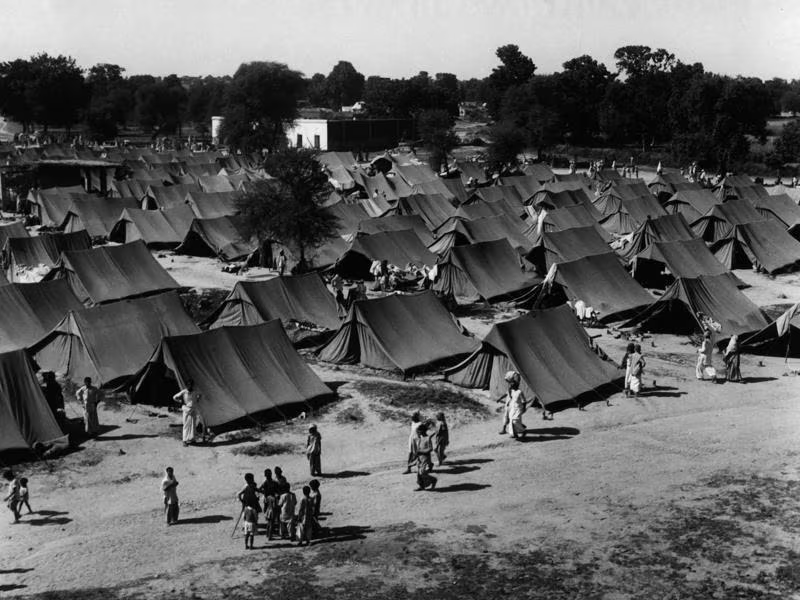
The strongest evidence of this hatred between Muslims and Hindus is found in the millions of refugees still living in both countries today. Recently there was a moving article here about the many refugees from the countries behind the iron curtain. Those people have found refuge, mostly dubious, in Berlin or in the West and their condition is unenviable. I suppose that is true ... but their life is still heaven compared to the existence that the refugees in Pakistan and partly in India have known for about a decade.As the British left the country, the country was divided into “Pakistan” and “India.” The division was crazy because it was done purely on religious grounds and did not take into account the financial, economic, industrial, and social structures of the two regions. Pakistan became Pakistan because in this country lived mostly Muslims [Muzelmen] and India became the country of Hindus, these are the people who practice the Hindu religion.
(Perhaps it does not hurt to touch on this again because a few months ago an advertising brochure for the World's Fair arrived in Delhi and caused a lot of commotion. Under a photograph, the brochure noted that three Hindus were admiring the Atomium. Of those three Hindus, two were Sikhs who are Indian but certainly not Hindus because they profess their own religion. In Belgium such an error does not seem to be a big deal, but in India it takes on enormous proportions.)
At the time of partition, millions of Hindus were in the area that had suddenly become Pakistan. Many of these people wanted to go home to their new homeland, the new homeland, at least, of their religion. About twelve million set out to travel thousands of kilometers on foot, on horseback, or with cows, buffaloes and donkeys. Rarely had the world seen so much misery on the road. The flight from Hungary, the flight from Belgium and France in 1940, were child's play compared to the march of these millions. While this march had begun, in 1947, a half-witted Sikh, a man who would henceforth be incorporated into India and therefore had to leave his glorious Punjab in Pakistan, got it into his head to kill a Muslim in Calcutta. A few days later the reaction came in Pakistan where a Hindu was killed. For two months then there was killing, burning and looting on both sides of the border ... while the British remained present quietly and allowed this to continue. It is estimated -- and even now officially admitted -- that in this massacre, this wild religious war, about one million people, men, women and children, lost their lives.
After two months of killing, some peace came and the refugees could think of a new life. Looking at that life though European eyes, one wonders if it would not have been better for the refugees to die. For their existence is degrading: the animals have it better. In India they have more or less assimilated into the local population or they live in the jungle ... so they are less conspicuous there, because the misery there is equally great and bad everywhere. But in Pakistan hundreds of thousands could not assimilate and a good number of them can still be found today in the suburbs of Karachi. They live there on vast, barren lands. Living is actually the wrong word here. Those people shack up there in indescribable conditions: you can smell them long before you see them. The world of the refugees in Karachi stinks. Hundreds of thousands of people live in mud houses without windows if they are well off; otherwise they shack up under tents, under a straw roof ... or have nothing at all to shelter themselves. They have drawn a square with stones around their mat and their meager possessions. That then is their home. This is where families of ten children live; this is also where the meager livestock live. Men, women, and children live together, also in the mud houses ... where even on the ground you will find the droppings of men next to those of animals. No one thinks of sweeping these things away ... Surely it smells as bad outside as it does inside.
The lands are usually near the sea so they are very humid. No wonder then that thousands of people die there from tuberculosis and pneumonia. No wonder then that when it rains heavily (as it often does) the houses, the tents, the straw huts are washed away, the people get wet ... and die again from cold and deprivation because they don't even have fresh clothes to put on and they still have to stay on those flooded lands. All diseases flourish in these refugee camps and despite all good will, the government is powerless. The calamity is too great to fight it effectively locally, and the refugees themselves, possessed by religious hatred and convinced that they are “greats” because they had to leave their countries for their faith, are often themselves an obstacle on the road to sanitation. Most of these people, by the way, rarely work; they live by theft, by charity, and by what they find left and right. They rarely eat enough to stay healthy alive.
Rather dead than Hindu
There is plenty of work for these and others, both in Pakistan and in India. But most of them refuse to move a foot. Never will they accept to go out to work in regions where other people than their fellow believers live. They will not even want to trade with dissenters. It is still the case that in both countries one finds Muslims and Hindus who would rather burn or lose their crops than sell them to those of other faiths. In certain regions, Pakistan has rich agricultural lands ... but the factories that are supposed to process these products are in India's territory. People will rather lose the produce than have it processed in India, and in India they will mostly rather not have produce or have it come from distant countries at more expensive prices than buy it in nearby Pakistan.One night we caught a Hindu in our hotel room and a week later I got into an argument with a Muslim who wanted to empty half of our car. We argued with those folks and then talked ... only to be told by both of them that, what they were doing was totally fine since we two were just strangers, dissenters, after all. Especially in rural areas, despite the praiseworthy efforts of governments and leaders, there is still hatred and disdain for the stranger, for the Christian dog. And that too is a consequence of religious hatred.
However, there is great difference between that hatred in Pakistan and in India. In Pakistan, those in charge are doing their best to counter that hatred, to eradicate it, to encourage the people to be more reasonable. In India, that hatred is often stirred up by the priests (of the local religions) and by some powerful landowners. For reasons other than religious ones, of course.
That hatred in India must serve to keep property, development, education in the small circle of small select castes. That is why it is aroused, skips from the religious plan to the nationalistic and the social and, in India itself, gives rise to many riots and murders. This week there were riots at Madas. As a result of that hatred. A hatred that has overplanted itself even on the language struggle. Which, as we think we are demonstrating, is more complicated than with us.
- Annotations
-
- This is a translation of an article titled “Wat is de kleine wereld groot! ‘Alleen de haat is reëel’” (How big is the small world! ‘Only the hate is real), which was published in the Belgian Catholic newspaper De Standaard, on January 9, 1958.
- Complete title
- Wat is de Kleine wereld groot! ‘Alleen de haat is reëel’
- Author details
- L.D.L.
- Date of publication
- 9.1.1958
- Publisher
- De Standaard
- Place of publication
- Brussel
- Archival source or library
- KBR (Royal Library of Belgium), DIGIT 840
- Locations in India
- New Delhi, Calcutta, Madras, (Karachi)
- Keywords
- India, Pakistan, Religious conflict, Hinduism, Islam, Refugees, Partition
- Translator and copyright
- Jaro Demetter, October 2025
- Media
 image003.png