
V imenu Gospodovem (In the Name of the Lord)
Item
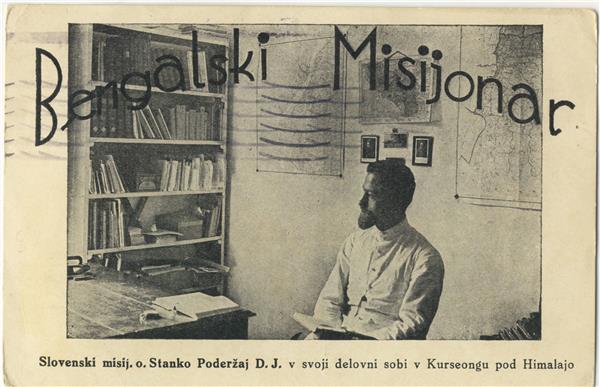
- Title
- V imenu Gospodovem (In the Name of the Lord)
- Author
- Stanko Poderžaj
- Date
- 1929-1930
- Country / region
- Yugoslavia
- Source language
- Slovenian
- Time period
- 1920-1940
- Themes
- Art and architecture
- Brahmins
- British India
- Buddhism
- Caste
- Christianity and Christians
- Colonialism
- Europeans in India
- Gender
- Hinduism and Hindus
- Islam and Muslims
- Jains and Jainism
- Language
- Law
- Politics
- Description
- The translation consists of excerpts from a travelogue by Slovene Jesuit missionary Stanko Poderžaj, originally published serially in eleven installments of Katoliški misijoni, Ljubljana. The chosen passage concerns the author’s visit to the Kalighat temple in Calcutta.
- Translated text
-
“(158-165) Visiting the gods
The worship of the terrible goddess of death and vengeance, whom the people prefer to call their beloved mother Kali, is widespread among the common people of Calcutta. So, on the occasion of my journey through the pagan metropolis, I was eager to visit her most famous temple, Kalighat. The first of our missionaries to visit it years ago was Father Anton Vizjak, who almost paid with his life for a slight inattentiveness on his part. This was another reason for me to want to see this place even more. In the hope of being able to observe everything closely, all three of us set off for the infamous temple in the early morning of 16 December. Our guide was Father Anton Vizjak himself.
The shrine has something of an interesting history of its existence. The wife of the god Shiva, Kali, was furious because her brother-in-law had neglected her husband Shiva. So in a state of agitation she threw herself on the burning pyre that had been prepared for the sacrifices. Already the soul had left the body when her husband, the terrible Shiva, heard of what had had happened. He immediately came down from the Himalayas, where he was at the time, picked up the body of his dead wife, whom he now called “sati”, and in terrible anger and pain began to dance with her so deliriously that the whole earth trembled and was in danger of being swallowed up by the ocean. So, Vishnu, the preserver, took his disc and hurled it with all his might into the dead Sati, which, as a result of the terrible impact, shattered into 51 pieces. Wherever a fragment of her dead body fell, a holy place emerged. The toe of her left foot fell where today stands the Kalighat temple. It is said that this toe is still guarded in a golden casket, but no one has seen it, because the casket is encased in golden rings and anyone who so much as touches it, it is said, will breathe his last on the spot. They for sure know why!
We were no longer far from the temple, but we did not see it as yet, because it was completely tucked behind the houses nearby. So we resorted to asking some pagan to direct us. The man had not yet opened his mouth when, in poor but nonetheless fluent English, the temple priest himself came forward, offering to show us the way and the shrine himself. Father Vizjak thanked him profusely for his kindness and curtly turned down the offer, saying that we didn’t have the money for a guide. “You don't have to pay anything,” replied the priest, visibly unhappy with our response, “it is my sacred duty to show everyone the shrine of the greatest goddess, our mother Kali.” – “Another priest told me the exact same thing three years ago,” replied Father Vizjak, “but then demanded ten whole rupees (220 dinars) from me. So, as I have said, thank you very much for your kindness!” – “Hold on, sir!” exclaimed the priest, seemingly offended, “I am not as dishonest as some of the priests, even in our temple; I am highly educated and time does not permit me to harass people by begging. If I get something, well and good; if not, I do not ask for anything.” – “Well, if he is so generous, then so be it,” remarked Father Vizjak, beckoning to the priest of Kali to lead the way. So, accompanied by a true servant and priest of the terrible goddess Kali, we set off for her most famous shrine.
I was careful not to miss anything. To the left of the temple entrance is a holy bath, where, even before sunrise, women are bathing, seeking blessings... A little further on, I noticed a low tree decorated with hideous figures, with women hanging stones on it, saying: “As I give you this fruit, so give me yours...”. We came to the temple courtyard. It was teeming with people, almost more men than women. They were climbing the low staircase to the main part of the temple, where we were not allowed. Our guide took us to the other side to a side entrance very close to the gate, but the crowd was too great for us to be able to penetrate it, not even with our eyes. I stepped a little closer, but immediately Father Vizjak warned me not to go too close, and especially not dare step on the staircase. He had been so unthinking all those years ago, and had sinned against the temple rules. It was sheer luck that everyone present did not pounce on him.
I turned around and followed the others. I began to observe worshippers of the terrible goddess. All around me wild, passionate faces. We met clusters of men and women whose faces were completely overtaken by wild passion. More and more new visitors started coming to the temple. Some of them brought offerings and handed them to the priests; so, as a sign of their affection for the great goddess, their bent backs received a blow from the priest. – A medium-sized pagan entered the courtyard. Immediately a priest approached him and offered him a beautiful wreath of yellow flowers. The visitor, apparently a poor man, waved the offer away, saying that he has only come for a short visit to the great mother. But the priest went after him and kept pressing him to buy a wreath to honour the supreme deity. The pagan refused and defended himself, but the priest threw the wreath round his neck and without a word – presumably so as not to offend the deity – the poor man deducted the sum due. – I have seen pagan mothers come to the temple with their infant children and incite the children to idolatry. They would stop at the place where we also stopped at that very moment: in front of the block where they slaughter and sacrifice black goats. The whole block was splattered with fresh goat’s blood, but at this time they did not conduct slaughter. The priest informed us that they would not be sacrificing again until half past ten, and it was only eight o’clock. What a sad and abhorrent scene! It pierced my heart with pity to see these blinded people touching the blooded wood with the greatest reverence. At that moment I forgot everything else and gazed mutely at the pitious scene ...
At that moment, a mother approached from the crowd of people with a three- to four-year-old child. She put her thumb in the almost congealed blood, as we dip our finger in the blessed water, pressed it to her forehead and bent over the block so that the blood-stained thumb touched her forehead and the little finger touched the hideous contraption, all the while whispering gibberish. When she had finished this tribute to mother Kali, she straightened up, scraped her thumb a couple of times on the bloody block, and walked away; meanwhile her little son tried to impersonate his mother, which he did not quite succeed. The mother now turned to wait for her son. Our eyes met at this point. She must have seen the inexpressible pain on my face, because at once she stopped in her tracks and stared at me, motionless as a statue, for perhaps a quarter of a minute. I did not lower my eyes. But rarely in my life have I prayed so fervently as at that moment when I gazed into the confused, petrified eyes of the unhappy heathen and with intense pain begged the Lord to have mercy on that wretched mother’s heart. As if she somehow understood me, and as if a ray of divine grace had shone into her dark heathen soul, she stood there and did not move her eyes, which reflected a certain silent horror. At last, after a long time, she came to her senses and, puzzled, reached out her hand for her little son, who had long been standing by his mother’s side. And she was gone – God grant her the grace that her soul must have heard at that moment.
Meanwhile, the priest began to explain the significance of the slaughter and sacrifice of goats and buffaloes. He knew that the Europeans accused them of polytheism and idolatry, so he began to say, as if in apology, “We acknowledge only one God, the supreme being, but in three manifestations, or incarnations (embodiments) if you like. Brahma is the creator, Vishnu the preserver, Shiva the destroyer. When, a little later, we asked him what the different statues meant, for which we knew they pay divine homage to, he replied that they were different minor gods, Father Vizjak interrupted him and began to discuss gods and religion in general with him. He wanted to clearly demonstrate to the haughty blinded man his strong religious ignorance and lack of learning, which he marvelously succeeded in doing. After almost half an hour of conversation, the man fell silent and did not celebrate his gods any more. Our missionary looked at him gravely, penetratingly, and ended the conversation with the greatest emphasis, saying: “Solve for me all the difficulties I have just mentioned, and prove to me that Hinduism is a better more reasonable religion (lit. more answerable to reason) than mine, and I shall at once be a most ardent adherent of Hinduism. – At these words the heathen priest dared not utter a word, and so we walked in silence towards the bathing-place, a tributary of the river Ganges called Tolly’s Nullah (Tólis Nulah), in whose holy waves the multitude bathe to cleanse themselves from their sins.
As we turned back to the temple, I stepped closer to a strange statue. Father Vizjak pointed out to me that this is Jagannath, one of the incarnations of the god Vishnu. Next to him was the goddess Kali again. Since we were in the temple of this goddess, and even accompanied by her priest, Father Vizjak initiated a very interesting discussion about this goddess, in which the “learned” Kali-defender got enmeshed in such contradictions and kept answering so foolishly that finally he had to admit: there is no goddess Kali! – This was a terrible defeat for him. He was mercilessly harangued by Father Vizjak, who, in response to his answer, reproached him bluntly: “So everything that your books say about this goddess is pure fiction?” – “Yes, it’s just a fairy tale for the masses, which we ourselves do not believe.” “Then why are you deceiving and seducing the people into praying to this goddess?” – The priest became self-aware. He realised that he had confessed too much, so, to our great astonishment, he shamelessly negated the previous admission by saying, “We are not fooling the people! For what they believe is the truth, for it has a symbolic meaning. Our goddess Kali is a true goddess, and we bow down and pray to her.” – It was evident that he was on the verge of fury in the face of so many humiliating admissions, now and in the previous conversation, which had been deftly forced upon him by Father Vizjak. He was fuming with anger. But he did not want to leave as yet. Father Vizjak now took pity on him and asked him less menacing questions. He confided to us that there are fifty priests permanently employed in the temple, and on top of that, they are constantly assisted by a considerable number of outsiders who come with the pilgrims. There were many more questions, of which perhaps the most embarrassing for the Kali Temple priest was that of the temple girls who serve the abominable goddess with the most shameful lives. But our companion refused to answer.
Finally, we went to the place where the dead are burnt. The place is only about five minutes away from Kalighat. Just then the flames embraced the corpse of a young child. As we were returning, Father Vizjak once again solemnly repeated to the pagan priest: “If you prove to me that your religion is true and resolve all difficulties and contradictions, I will be the first to throw away my religion and become the most ardent Hindu. For two religions cannot be true at the same time, especially not when they are as utterly different as yours and mine are. You say, for example, that Kali is a goddess; I say to you that this goddess is nothing but fiction and therefore does not exist! Only one of these two opinions can be right, and therefore either you or I are living in the greatest error, the result of which will be either a happy or a doomed eternity. Have you ever thought about that?” The Kali priest did not answer. “Have you ever read any Christian book to see what the religion is like, if it is more perfect than yours?” – “Sir, I have no time to read those books. I think my faith is true and that yours is not false either. Here is the thing: each to his own. I have already told you – indeed he has repeated this several times before – that if my brother, who is more learned than I am, were here, he would answer all your questions. But I haven’t studied that much ...”
After this repeated, coerced rather than humble declaration by the pagan teacher, any further religious conversation became impossible. We visited the grave of the Raja (prince) of Myssore, who is venerated as a saint, and for this reason one or two priests are constantly praying over his grave. Then, when we wanted to say goodbye to our companion, he could not repress his nature and, in spite of his statement at the beginning, reminded us to give him something for his accompaniment. If not for him, at least for the temple or for the temple’s poor. But Father Vizjak responded firmly: “We’ll give nothing for the temple, but for the poor we give more every day than you do. Finally, as I told you at the beginning, we have no money available for this purpose, so please accept only our cordial nomoskar (greeting) as a farewell.”
So we said our goodbyes and went our separate ways, he to his Goddess Kali and we back to our college where we first paid our respects to our good Benefactor with whom we share the same roof in Calcutta.
On the second day we also visited the magnificent temple of the Jain sect of Hinduism, which has just over one million followers across the whole of India. But they are influential and – rich. They are mostly merchants. So we can also understand how they could have built such a precious temple in Calcutta, which one cannot but marvel at – at its artistic masonry and the rich decorations of mosaic, porcelain and terracotta, set in the purest white marble.
The Jains are an ancient sect whose history goes back a couple of centuries BC. The name tells us that they are followers of the “naked ascetics”, because their first adherents did not need any clothes. They have no priests of their own, but use Brahmin champions as priests, whom they do not otherwise respect very much. They pay the deepest respect to their monks. Their whole religion consists in going to the temple to listen to these monks of theirs or to read the sacred Jaina books. When we were in the temple, at a side building, we watched from outside in a splendid and precious hall such reading of the holy scriptures. Father Vizjak and I wanted to photograph the scene, but no sooner had the temple guard noticed the cameras than he sternly reminded us that no photography was allowed inside the temple. Since it was not possible to do it in an honest way, we resorted to a trick. I secretly set up my camera as Father Vizjak moved towards one of the temple doors. The guard positioned himself in front of us, waiting to see what would happen. At this point Father Vizjak started to visibly adjust his camera and dashed for the other door, with the guard after him, because I, at this door, was looking on most innocently, without betraying any interest. No sooner had the guard shown me his back than I adjusted the contraption and clicked. The guard turned on the spot. He had heard a crackling noise which could only have come from my camera, but he saw nothing, because I was looking on again as innocently as before. This gave Father Vizjak enough time to adjust and click his own. Thus we had interrupted the faithful guardian of the splendid Jain temple, but were subsequently punished for this “crime” by the fact that the photographs did not come out well on account of too strong an external light.”
- Annotations
-
- The translation consists of excerpts from the travelogue V imenu Gospodovem by Slovene Jesuit missionary Stanko Poderžaj. Originally published serially in eleven installments of Katoliški misijoni, 1929/1930, Ljubljana. The travelogue has been republished and annotated as a single text in Jelnikar & Motoh, Potovanje v Indijo: Misijonarska potopisa, konteksti in analize, Koper: Annales ZRS, 2021, pp. 119-74. The page references are made to the recent publication.
- Stanko Poderžaj (1904 – 1976) was a Slovenian Jesuit missionary, who was part of the second group of Yugoslav Jesuit missionaries sent to India, specifically to the Bengal region, which was then under the jurisdiction of the Belgian Jesuit province. His mission aimed to assist in establishing a Yugoslav mission province in that area. His prolific writings reflect the intricate negotiations of nationality and religion in a transnational perspective, typically combining national pride with missionary zeal. Poderžaj documented his experiences and observations in his work “Pod Himalajo: ob ustanavljanju jugoslovanske misijonske pokrajine Družbe Jezusove v Bengaliji” (“Under the Himalayas: On the Establishment of the Yugoslav Mission Province of the Society of Jesus in Bengal”). Published in 1929, this 108-page book provides insights into the many challenges involved in setting up the mission in Bengal and reflects the typical racial and religious prejudices of the era as well as an enormous Jesuit curiosity and will to understand Indian religions and mores. His travelogue In the Name of the Lord stands in stark contrast to the coterminous travelogue of Miriam Zalaznik.
- The chosen passage of the author’s visit of the Kalighat temple in Calcutta represents a more literary culmination of the missionary zeal in what is a much longer – and drier – narrative that aims to inform and edify the reader with “objective” descriptions of the journey, the stopovers, the natural, religious and art history of places on the way, mostly narrated through a stark lens of “othering”.
- Complete title
- V imenu Gospodovem
- Author details
- Poderžaj, Stanko, 1904 - 1976
- Date of publication
- 1929
- Publisher
- Katoliški misijoni
- Place of publication
- Ljubljana
- Locations in India
- Kolkata, Mumbai
- Keywords
- Religion, Christianity, Hindus, Pagan/Heathen, India, Calcutta, Bombay, Kali, Kalighat temple
- Related literature
-
Jelnikar, Ana, and Helena Motoh. 2021. Potovanje v Indijo: Misijonarska potopisa, konteksti in analize [A Passage to India: Missionary Travelogues, Contexts and Analyses]. Koper, Slovenia: Annales ZRS.
- Translator and copyright
- Ana Jelnikar, 2025.
- Media
 image003.jpg