Lampa k Hatha-jógu (The Lamp to Hatha-yoga)
Item
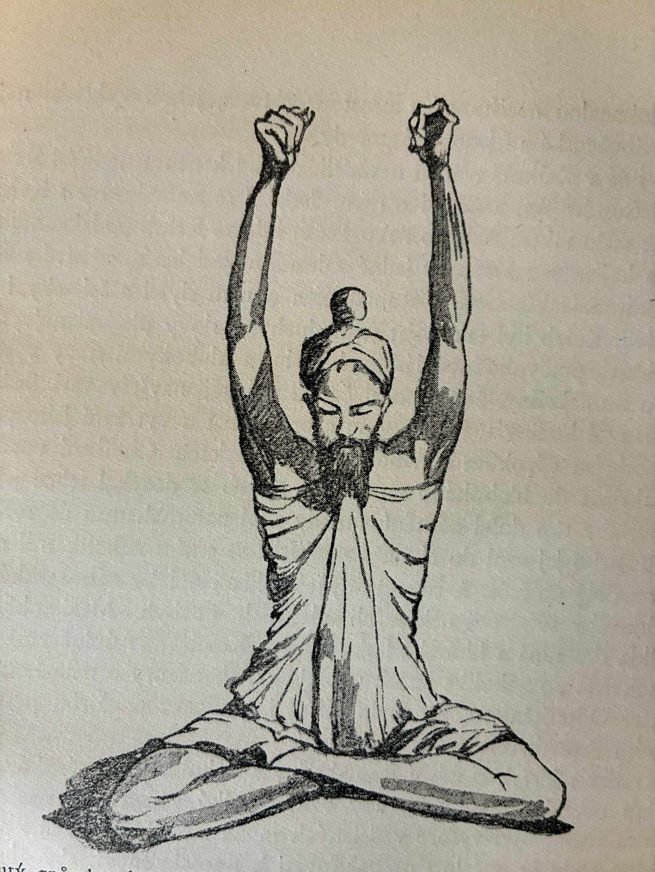
- Item Number
- 22
- Title
- Lampa k Hatha-jógu (The Lamp to Hatha-yoga)
- Author
- Karel Weinfurter
- Date
- 1936
- Country / region
- Czechoslovakia
- Source language
- Czech
- Time period
- 1920-1940
- Description
- Translation of a preface to the Hatha-yoga pradipika, by the Czech occultist, mystic, and writer Karel Weinfurter, originally published in 1936.
- Translated text
-
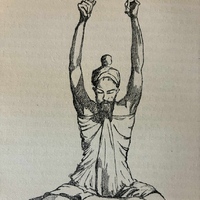
Hatha-yoga is an expression, surely well known to all my readers, for it concerns certain mysterious, or rather secret, Indian exercises, which are done by yogis, to achieve, on one hand absolute health, purification of body, and soul, and, on the other hand, to achieve so called Siddhis, i.e. the spiritual powers which, in our country, are called magical powers.
— That is, what is known about hatha-yoga. But, it is less known, that, in fact, in every yogic exercise, it is necessary to follow some of the rules stated in this ancient book. Even in royal yoga, which is considered to be the highest of all, it is not possible to continue without certain yogic position, as we will see later, and without pranayama, i.e., breath control.
And exactly these practices belong, in fact, only to hatha-yoga!
Yes, I can tell you that even our plain mystical exercise of concentration, or the phonic (mantric) exercises, are not devoid of the flavour of hatha-yoga. We can mention, for example, the disciple’s position during the exercise. Every practitioner who has been exercising for a longer time knows that practicing in an accustomed position is the best for him, while he is not able to practice equally well in other positions. Further, even here is breath control is involved. It does not concern holding the breath for a long stretch of time, as in other yogas, not even its regulation by blocking the left or right nostril. A different way of regulating it is present here. A disciple, who is fully engaged in the exercises, and is exercising regularly, and at the same time every day, is following the rules of hatha-yoga already in this way, and thereafter, he puts his breath into a kind of periodical circulation.
He who is unable to accomplish this cannot concentrate well because, in the process of stopping impressions, the breath also ceases mechanically, and when the disciple has to, after a while, breathe out more sharply it interrupts his exercises. It simply pulls him out of the concentration.
That is why the disciple must learn a regular, restrained, loose, and very light way of breathing, which his body does without his effort but still is forced by the inner activity of his soul.
Many scholars of Indian yoga are trapped in a major misunderstanding to this day. They think that yoga had been given to people just for the possibility of achieving mystical powers, siddhis. This is the reason as to why this practical form of yoga has been overlooked, and ignorant people — even in India itself — tend to look down on it.
And yet, even the title of this system indicates, that it is concerned with the connection of Spirit and Soul, i.e. the mystical wedding. In fact, the word ‘ha-tha’ means the sun and the moon. It means also their connection. I have on hand a translation by one Indian, who tells us, that ‘ha’ symbolizes prana, and ‘tha’ symbolizes apana, that is the upper and lower breath, which are to be connected.
Elsewhere, ‘ha’ and ‘tha’ means the left and right stream of breath – ida and pingala in Indian language. In reality, these terms are entirely mystical, well known to Indians, but we call them Holy Spirit and Soul. Indians have transmitted these mystical terms to the interior of a disciple by using names that could mislead an ignorant person to assume that they refer to some physical forces or fluid flow, etc.
In fact, it refers to purely mystical states, which take place in the disciple’s body and are then transmitted to his soul. This truth stands opposed to the opinions of pseudomystics, who are trying to interpret it in such a way that these mystical states can relate only to the soul. That is why, I am warning my readers, not to rely upon ‘interpretations and opinions’ of a church but to follow strictly the teachings, thousands of years old, established by philosophers and yogins. They experienced all this, and that is why, they could write about it authentically, and not according to speculations and random thoughts. Any external church has nothing in common with mysticism and yoga at all, because contemporary churches are just external, fully profane organizations, which are, first of all, interested in their profane power, and not in the spiritual progress of their believers.
Regarding the origin of this book, it is known only that it is very old. Its author was a great and famous yogi, and many legends about his life are circulating in India. That is why this work expresses so much wisdom and leads a disciple following its rules to the cognition of inner divinity, as we will see from the translation. For this reason already hatha-yoga is the perfect path, and a person who is able to do such difficult exercises will reach rebirth and salvation, and in that way, also eternal life, as through any other yoga.
Right in the beginning, the author out of modesty states that hatha-yoga is just a preparation for raja-yoga i.e. the royal art. Nevertheless, the concentration which is necessary to all yogism, regardless of any particular system, is recommended, and ordered even in hatha-yoga, for hatha-yoga also leads, as we can see from the text, to the highest psychic state, the man sanctified by God is capable, to paradisiacal extasy i.e. samadhi, which is explicitly emphasized in the text in many places.
However, I don’t want to say by this, that our disciples should pursue this yogic system – namely hatha-yoga. It is an immensely difficult path, and only the hardiest ascetics in India embark on this path, and know its difficulties. It is absolutely impossible to pursue hatha-yoga in our conditions, simply for the reason that the disciple needs to be materially independent to do his exercises without interruption. However, only men of great wealth possess such a level of independence – and as we know, wealthy men have totally different interests than reaching God as soon as possible!
So, why, in the first place, am I publishing this translation of a book, very practical indeed, and full of truthful and time-proven instructions, when it is impossible to practice them?
For two reasons. Primarily, as a lesson for our disciples, so they can see what kind of labour, and great exertion, disciples of other school have to pursue, and how their own Path, in contrast, is easy and free from great exertion. So, for them to compare our own Czech Christian mystical school, which leads them to the same high goal—slowly and easily but safely—with this Indian school, which is a short, but immensely difficult path, and in a certain sense even dangerous on specific levels. This danger lies primarily in the fact that by hatha-yoga, as by every ascetic exercise executed according to a time-tested, and not unclear*) plan, the mystical i.e. mental powers, Siddhis, will start to awaken inside the disciple. They could lead the disciple on the wrong path, if he misuses them. In other case, they could awaken desires and even psychic pride, which would be a forerunner of his fall.
*) Here, I have in mind mainly the religious exercises of Christian saints, who had neither a manual nor experiences in the sense of the yogic scripts that are very clear, and lead the disciple straight to the goal step by step. Even nowadays, we have no church that could take pride itself on practical mystical scripts, which might remotely resemble the accurate descriptions of the yogic literature. Some individual mystical prescripts may rarely be preserved in some monasteries, as on Athos Mountain, as I write in the first part of Burning Bush. That is, why Christian saints could reach the goal only after a long seeking, and terrible unnecessary suffering.
This danger is not present in our mysticism, because the disciple will obtain powers like this, when he is nearing the end of the journey, and is mentally fortified against all enticement – not sooner.
This is the first reason, why am I publishing this translation.
The second is more important though. During mystical states, as we have verified ourselves after long-lasting practice, experiences occur, which are equal to certain yogic exercises. This may appear to be unintelligible, but it will be explained immediately.
An Indian yogi pursues certain arduous exercises, for which he has to make detailed and long preparations. An example shows this. There is pranayama – i.e. the breath exercise that leads the yogi to a complete cessation of breath. As soon as he can do this for a longer time – a quarter or half of an hour – he is able to concentrate on the divine Self so thoroughly that he immediately enters samadhi. However, this is equal to the connection with God, and also to the salvation of his soul.
There is no description in any Indian script which kind of feelings the yogi has during this cessation of breath. Everybody would assume that it is connected with fear of suffocation, pressure in the lungs, or other familiar psychophysiological phenomena, which is well known to anybody who has tried to hold his breath as a young boy to stay under water for a long time.
But all of this is mistaken. The yogi does not feel anything of this sort when his breath stopped, when in reality his upper breath has connected with his lower breath. In that moment the yogi is absolutely calm, and does not have a single bodily difficulty – and yet, he is not breathing but also not suffering. Yogi, in fact, is not breathing the outer breath, but the inner etherical ‘air’ i.e. prana, of which Kerning speaks in his Testament.*
*) See Part II of Burning Bush
The reader could ask the question as to how we attained this knowledge, given that there is nothing written about it. The answer is: through experience! He who pursues mystical exercises for a long time attains experiences unknown to other people and to beginners in mysticism. Hereby, we came to the conviction that our mystical Path leads to certain states, which the yogi has to attain by means of special exercises, e.g. so-called mudras.*
*) What mudras are, and what are they for, will be explained later.
The cessation of breath arises in the mystic who pursues concentration or phonic exercises, without any struggle, so he is tremendously surprised by that. We can see from this, how great God’s grace is, and how our Lord Jesus Christ provides us with all that is necessary, without any special exercises, only by diligently focusing our mind on Him.
But, there are also other, even more surprising states that appear on the mystical path, and which an Indian yogi has to attain after great struggle. Consider, for example, khechari mudra, in which the yogi has to slowly cut the loop under his tongue, so that he can, after another long exercise (forcible pulling out his tongue), reach with the tip of the tongue to the back of the roof of his mouth, where the nose tube ends.
This state also emerges by itself in the mystic, without any external preparations, when he has reached a certain level. The reader will know, after reading the results of this mudra in the text, what immense things are connected to it.
Every mystic knows that it is not possible to speak, or write, about certain things publicly. The elders anxiously hid their mystical teachings in alchemistic forms. We don’t do that; but, although we have told a lot, we have to be silent about sacred things so they cannot be misused and profaned.
In hatha-yoga, and also in other yogic systems, many mystical states are described in the guise of external exercises. Because, it is my quest to instruct our disciples, I have translated this book in detail for a disciple to make sure that he would truly receive and experience certain mystical states, which shouldn’t be exposed publicly. If he finds something similar, it will be a great mental support and reinforcement for the further Path.
He who looks at this book from the point of view explained here, will find much information, and will benefit from it for many years. And that would also be a reward for the translator – he desires nothing more.
However, in the end, I emphasize again that the exercises stated in this Indian book are not suitable for a European unless he lives in India, and becomes a poor penitent, like those for whom the author intended this book.
At Král. Vinohrady in March 1936.
K. WEINFURTER
- Annotations
-
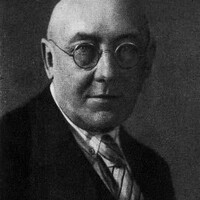
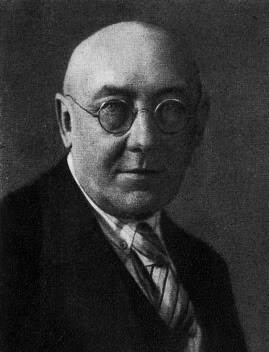
- Karel Weinfurter (1867–1942) was a Czech occultist, mystic, writer, and translator of spiritual and adventure literature, who dedicated his life to the study of mysticism. He wrote books about his experiences with various practices from occultism, hermetism, western mysticism, and eastern traditions. These elements are interconnected in his work, which (Weinfurter though) allowed him to see a universal mystery recognized by all religions in different forms. Thus, all religions lead, by different paths, to this one final truth – or mystery – God. His journey into spiritual literature began early in life with experiments in spiritism, later followed by occultism and mysticism. In his twenties, he joined the Theosophical Society, together with other well-known Prague personas, e.g. Gustav Meyrink (1868–1932) and Franz Leonhardi (1856–1908), and founded a section of this movement in Prague. Weinfurter and Meyrink left the society a few years later after an internal conflict and later, Weinfurter founded his own mystical society Psyché and published a review of the same name.
- This text is a translation of Weinfurter’s preface to Hatha-yoga pradipika (Czech translation: Lampa k Hathajógu, English: The Lamp to Hatha-yoga). It was published in 1936 by Zmatlík a Palička publishers and it belongs to many of Weinfurter’s translations of occult, hermetic or mystic literature of that time. As explained earlier, he considered Indian texts as mystic literature because they all lead us toward the connection with God. Apart from many works of adventure literature, he translated, for example, Zanoni by Edward Lytton-Bulwer, Das Buch vom lebendigen Gott by Bô Yin Râ, and books by H. P. Blavatsky, Swami Vivekananda, Paul Brunton, and Prentice Mulford.
- In the text, Weinfurter refers to his own book Ohnivý keř, one of the crucial works of Czech occultism, whose title translates literally as The Burning Bush. An English translation of this work was already published in 1930, but the title was changed to Man’s Higher Purpose (Rider & Co. publishers). I have decided to keep the literal translation of this book’s title because it has strong symbolic meaning for the author. He took inspiration from an old French book of engravings in which one of them represents Moses meeting Ruth on a cloud surrounded by symbols of the planets and the four evangelists. The burning bush is situated beneath the cloud, scaring away a snake that symbolizes Satan or evil. The fire itself represents the true nature of God.
- The words written in italics require additional explanation for two reasons: linguistic and semantic. The linguistic reason concerns two Czech words: the adjectives duševní (mental/psychic) and duchovní (spiritual). There is no suitable English equivalent to the word duševní because, in Czech, it linguistically refers to the soul (duše) and also to the mental or psychic part of man. Duševní could theoretically be rendered into English as the neologisms “soulish” or “soulical”. We can find the same, but functionally clearer, noun-to-adjective structure with the adjective duchovní (spiritual) which derives from the noun duch (spirit). In the case of duchovní (spiritual) this structure works both in Czech and English, whereas the word duševní does not have an accurate equivalent that would refer to the human soul and inner (mental or psychic) processes at the same time, as the word does in Czech.
The second, semantic reason is more important because the author himself is inconsistent in his use of these two words and sometimes uses them interchangeably. In some instances, I have used the word ‘mental’ or ‘psychic’ to translate the word ‘duševní’, as the context demands, and in one case, I have translated the word as ‘spiritual’ because the author is talking about the (spiritual) progress of believers. All these words are in italics in the text.
- Author details
- Karel Weinfurter (1867-1942)
- Date of publication
- 1936
- Dates of travelling
- n.a.
- Publisher
- Nakladatelství – Zmatlík a Palička - Knihkupectví
- Place of publication
- Praha - Letná
- Archival source or library
- n.a.
- Locations in India
- n.a.
- Keywords
- Yoga, mysticism, Christianity,
- Related literature
-
WEINFURTER, Karel. Ohnivý keř: odhalená cesta mystická. Knihovna šťastných lidí. Praha: Zmatlík a Palička, [1923].
- Translator and copyright
- Anna Vrkoslavová, 2025