
Brief aus Chochinchina (Letter from Cochin in India)
Item
- Item Number
- 25
- Title
- Brief aus Chochinchina (Letter from Cochin in India)
- Author
- Anonymous
- Date
- 1580
- Country / region
- Germany
- Source language
- German
- Time period
- 1560-1580
- Description
- A letter sent from Cochin in India, dated 1580, written by an anonymous author and addressed to a mr. Adelgais, probably Hans Adelgais, the factor of the famous Fugger company in Antwerp, Cologne, and later in Augsburg and Frankfurt. The letter relates the journey from Lisbon to India and discusses practical issues and aspects of a European trader’s life in India, but also makes claims about the local religion and customs.
- Translated text
-
[p. 37]
From Chochin in India on the 10th of January 1580
Honourable, particularly favoured, dear Signor Adelgaiß!
Before my departure from Lisbon, I have informed you how I have embarked with my companions. On the 4th of April 1579 all five ships simultaneously departed from Lisbon. However, we did not remain together for six days, but soon each ship took its own course or route, as each master [p. 38] or pilot believes to do it best and reach the destination first. Since these ships are big and mighty, they do not try to stay together. When we had been sailing for a month and reached the coast of Guinea and later the equinoctial line, we noticed that we had departed from Lisbon too late. We had to sail up and down the (equinoctial) line until we could pass it, and thus we lost forty-seven days of time. Because around this time the sun burned the strongest and hottest, we suffered great heat and pain. From there till the thirty-fourth degree in the other part of the world, towards the South Pole or Polo Antarctico to the Cape of Good Hope, we had good wind and good weather, but extreme coldness. From there on out there were several Tormentos (storms). To tell the truth, I would have preferred at that time to be anywhere else than on this journey. Thank God, we made it through. But it is an old practice in Seafaring, coming out or going in, that one has to deal with such storms.
[…]
Here in Chochin we are at nine degrees from this (equinoctial) line and on the same side as Europe. Lisbon lies thirty-nine degrees from the (equinoctial) line. Here it is quite warm, as we are just below the ninth degree. We arrived, God the Almighty be praised and thanked, on the 10th of October in India in the city Goa, which belonged to the king of Portugal and was the most prominent capital here in the country. Thus, we have travelled from Lisbon to there for six months and six days and have during such a time seen no land, neither little nor much, but only sky and sea. God the Lord grants for such journeys exceptional blessing and mercy, otherwise it would not been possible, to spend half a year between planks.
[p. 39] In [Summa], if you are well provided with a provisions chamber and a cook, as I thank God had all, you will find such a journey less difficult. However, the common people suffer a big need for food and drink, especially for water, which cannot be obtained for any money. In such a heat one cannot drink much wine, everyone craves only water, which I, Thank God, like all other foodstuffs had enough of. On our ship were around five hundred people, of whom on the journey from Portugal to India no more than twenty-five died in total. Some of us, who were well supplied with food and drink, have greatly helped the poor soldiers. In this half year we have travelled five thousand miles. Although one reckons the direct route from Lisbon to India to be no more than three thousand five hundred miles, one requires, when sailing around due to headwinds, for each journey almost always five thousand miles.
I have seen many kinds of seafish, about which much could be written, especially about those that fly over the sea and have wings. It will not be believed by many, but I have seen them fly a thousand times within gunshot range. What astonished me even more, are other big fish, that are in the sea, and who devour people alive, which I have also seen myself. When namely a man fell from our ship into the sea during strong winds, so that we could not wait for him nor could help him in another way, one would throw him a wooden block prepared for this purpose, attached to a rope, which he eventually caught and believed he would save himself with. But as soon as our sailors pulled this block with the man toward the ship and had brought it to half a gunshot from the vessel, came a large animal, called Tuberon, up from the sea below, leapt on the man, and tore him apart in pieces before our eyes. It was a miserable death.
There are also all kinds of birds on the sea, including many that never see land and live on the sea. They eat fish and are not afraid of the people on the ship. We have caught them with our hands. They are as large as ducks, but are not supposed to be edible because they taste too strongly of fish.[p. 40] I let our journey be recorded day by day and made a book out of it, which I, in time, when God helps me out again, along with many other fine things, will take with me. The crossing is of that nature, that he, who does not see and try it, does not believe that it is so difficult. Thank God, I and my men, four young Germans, have arrived fresh and healthy here in India. But as soon as we came ashore, from among my servants, four young Portuguese died. On the ship, there is disorder with the eating and excessive drinking of water, and then, on land, it is dangerous at the beginning because of the many fruits, such as figs and other foods. But also because of the women, who are abundant here, it is dangerous. From all the ships ashore, quite a number of people died. At the beginning, one must take care, until becoming accustomed. Thank God, I am already in good wellbeing.
All our five ships, and already three in Goa, and two directly from Lisbon, have arrived. Now all five ships are here in Cochin. I have been four weeks in the city of Goa and have built a house there. From there I sailed a hundred miles far across the sea to here. The journey can be made in ten to twelve days. The pepper is loaded here in Cochin, twenty miles from Calicut, which is why all ships have to come here. I will run my household, one in Goa, the other here. I haven’t yet decided, in which place I will live and reside permanently. Although Goa is the capital, where the viceroy from Portugal holds court, it is annoying, to travel every year from there to here and back, because I have to be there in person for our pepper trade. Such a pepper trade is a fine undertaking, it requires great diligence and zeal for that. It takes six weeks to receive the pepper here from the heathen king of Cochin, who is our friend, and to load it onto the ships. After the departure of those ships to Portugal, I, together with my people, have very little to do. The pepper trade is very profitable, when God the lord offers mercy, that those ships successfully and safely depart and return. Then those merchants will become rich people. With this shipping everything depends on travelling at the right time, [p. 41] namely in March from Lissabon to here, and from here in January to Portugal, and indeed, when it is possible, in both places not later than the 15th of the month. Then there is little danger. To depart later is dangerous, because one encounters great storms. Then one must take detours, so the ships do not perish completely. But this rarely happens if the ships do not run aground, break apart or are wrecked otherwise. One must pay great attention to this.
This year, in my opinion, we will not prepare more than four ships, carrying about twenty loads of pepper, even when we should send thirty loads. We have the money for this, because in any case we couldn’t borrow such a big sum. What is missing this year can, at a good opportunity after the departure of these ships, be bought for next year. As for other spices, such as cloves, muscat blossoms and nutmeg, cinnamon, mace, and all other drugs, this year's demand will go from here to Portugal. As for gemstones few were sent because of the wars, which the heathen kings (of which there are many in this land) wage against one another. Therefore, the gemstones from the country cannot come to our city, as they all lie out by the sea. That which lies inwards, all of it belongs to the Indians, heathens and Moors. We have two or three such kings as friends. The others, given their great numbers, are all our enemies. Our fleet has to constantly battle them at sea. The king of Portugal is, with his might, too weak for this big country. The king of Spain, if he took possession of Portugal, would be the right king for this country. All of India, all kingdoms and provinces as far as China, where it borders Tartary, would be taken over by him and unite his Spanish India with those Portuguese municipalities under his rule, which he could achieve with fifty thousand men. Even though the Indian kings have a big number of warriors, and there are many such kings, this people is not warlike. One Christian is worth more than six Indians. Furthermore, these kings are constantly at war and in dispute with one another. This country itself is bad, it has plenty of grain, rice, and meat, but no wine and no olive oil, and it also lacks five or six types of fruit. Wine, [p. 42] oil, and Dutch cheeses one brings from Portugal. The country has the same temperature in summer and winter, throughout the entire year. There is no difference between the seasons. Winter is as hot as the summer, only in winter it rains thoroughly, which does not happen in summer. The days last twelve hours the entire year, they neither become longer nor shorter. The trees and grass stay green the whole year. We have figs here that are a span long. They stay fresh on the trees all year, and one can pick them every day, they are the most important fruit and the most common foodstuff for rich and poor people. Then there is also another fruit that the people live on. It grows on beautiful tall trees that are called palm trees. They bear a fruit the size and shape of a melon, which has a lot of water inside. Whoever does not know or see, they cannot believe, which things one makes from such fruit. You can believe me completely, because I have good knowledge of it.
From this fruit one makes wine, which is good to drink, also oil, which is good for eating and burning, also milk and fat and especially paper, on which one writes. One also stores the fruits in rooms. The shells are made into wooden tableware, bowls and other things. In addition, from such a tree one makes everything needed for seafaring, namely the ship, sails and sailing cloth, nails, string, rope, fibre, or wooden tiles to cover the houses with. So no other stuff besides this tree is involved. These ships bring provisions of food and drink, which also come from this tree. Such ships I have already seen myself. It is a strange thing; I did not want to refrain from mentioning it, along with other oddities found here. With God’s help, I will write to you in the coming year about more peculiarities of local customs and oddities. But I am still new to it myself, even though I have already been in this country for three months. I see new customs every day, of which a big book could be written. I will try to gather many strange things over time and take them with me after five years, if I stay with my current intentions. God willing, I will take another route for my home-journey, namely by land. One sails from here [p. 43] across the sea to Ormus (Hormuz) in Arabia, then to Persia and from there one has a good opportunity to travel through the Sophoner land and Turkey. As I learned from those who travel in and out of Italy and use this route, it is a very good opportunity, since this route is used frequently. From Ormus (Hormuz) to Italy, one finds people in Ormus (Hormuz), who will give assurance and guarantee to bring one safely through. It should be a very common thing. I want to inform myself about everything beforehand, I have enough time for that. On this route, from here to Italy or Germany is less than two thousand miles, which can be covered in six months, and moreover one can also see the Promised Land, such as Jerusalem and all other such places. I therefore have a greater desire to see more of these good countries than to travel by the sea, where one is every hour in danger that the ship suffers distress or even perishes.
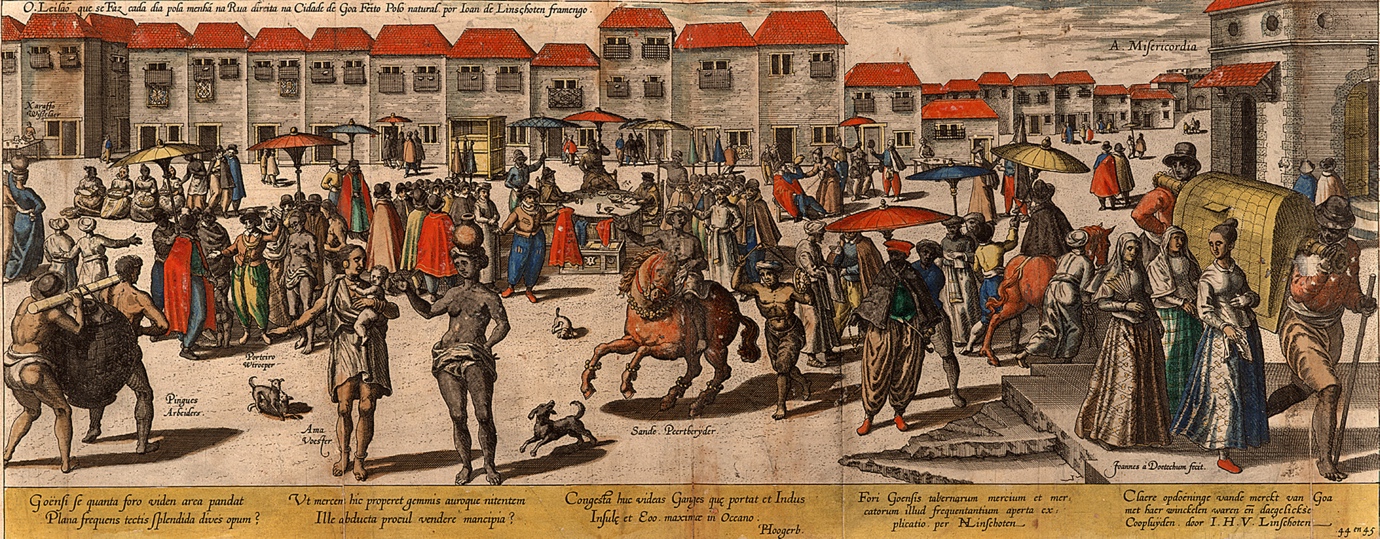
I should write to you about many other strange things, but which is not possible now. In the coming year, I will send you a portrait showing how everyone here is dressed, namely bare or naked, man and woman. Both the king and nobles, as well as the common people, cover only their private parts. The Portuguese go clothed, but only very lightly, only in linen or silk. Woolen cloth cannot be endured because of the heat. The people here have many different beliefs and ceremonies. But, among the Indians, more and more are converting to Christianity over time, while others remain heathens. The Moors and the Jews, however, stick to their faith. There are therefore all kinds of beliefs around here, but in the cities occupied by the Portuguese, the heathens or Indians have mostly been converted to Christianity and go to our churches. I cannot refrain from telling you about another local custom. The local kings always have thirty, forty, even a hundred wives, as many as they please. When such a king dies or is killed in war, these wives of his must throw themselves alive into a fire and burn. In many places outside of here, it is the custom among the common heathen people that the wife of a deceased heathen man must also be burned alive. When not, she is mocked and despised. There is also another custom. When a noble maiden from [p. 44] nobility or good lineage marries, her relatives attempt to ensure that the king sleeps with her on the first night. For this, he is given much money. Otherwise, she cannot marry. Such things are much more common here.
Otherwise, I let you know that the five ships from Portugal were sent to our lord. You should know that wine, oil, Dutch cheese, fish, paper, and other goods, from which there is usually the greatest gain, this time there is no profit at all. All this has yielded no more than twelve to fifteen percent, and the cash brought in from Lisbon has yielded twenty-five percent profit. The country is no longer as it used to be, and moreover, our viceroy is imposing many new tariffs, thereby reducing all trade. If he were to remain here, nothing good would come of it. I believe however, that the King of Portugal will send another viceroy here once he learns of this. There are now no goods to send from here to Portugal that would yield a profit.
As for gemstones, there are none available this year. In Summa, this country is not what people generally believe it to be. It requires just as much effort here to earn money as in other places. It is no longer like it was twenty years ago. Buying and selling here yields more profit than sending a lot to Portugal. German goods have no demand here, they are also not suited to this country. The writing desks fall apart in the intense heat, clockwork, or anything else made of iron, is ruined at sea. This year there is nothing to send from here to Portugal, because pepper, ginger, muscat, coconut fat are all bought for the contractors, as is cinnamon for the king. This time, one really does not know what to invest money in. Fischer has brought in Dutch cheese, but will not make any profit from it, as much of it was stolen from him on the ship. This also happened to us with our supplies. In addition, we have had poor demand for it. Five ships bring in a great amount, and as a result, everything becomes inexpensive. The Portuguese are an even more industrious people here than in Lisbon. The Pietras de Bezoar (Bezoar stones) are always very expensive and not good. I will try, after the departure of these ships, to obtain some that are good under the table and send them to you in the coming year.
- Annotations
-
- This letter is part of a collection of letters written to members and collaborators of the famous House of Fugger, a family of international mercantile bankers and traders based in Augsburg, Germany, which was particularly successful during the 16th century.
- The letter’s addressee is most probably Hans Adelgais who represented the Fugger company as a factor working in Antwerp, Cologne, and later in Augsburg and Frankfurt. Adelgais was also a major collaborator in the compilation and translation of the Fugger newsletters.
- As for the author, we can possibly identify him as Gabriel Holzschuher, who was sent to Cochin by Konratt Rott from Augsburg, who took up the Indian spice contract in 1579. He would remain in India as Rott's main agent, and after 1586 as the agent of the Fugger, Welser & Rovallesca company in Quilon (Malekandathil 2006). The editor of the volume has given the titel “Brief aus Chochinchina” to the letter, while it was sent from Cochin in India.
- Complete title
- “Brief aus Chochinchina: Aus Chochin in Indien vom 10. Jänner 1580,” in Fugger-Zeitungen : ungedruckte Briefe an das Haus Fugger aus den Jahren 1568-1605
- Author details
- Anonymous
- Date of publication
- 1923
- Dates of travelling
- 1579-1580
- Publisher
- Victor Klarwill
- Place of publication
- Vienna
- Archival source or library
- n.a.
- Locations in India
- Goa, Cochin, Calicut
- Keywords
- sati, warfare, heathen kings, Moors, weather, food,
- Related literature
-
- Pius Malekandathil, “State and Entrepreneurs: An Analysis of the Trading Scenario of Kerala,1500-1650,” in Charles Dias (ed.), Kerala Spectrum: Aspects of Cultural Inheritance, K. J. John Felicitation Volume, Cochin: Indo-Portuguese Cultural Institute, 2006, pp. 113-157.
- Old English translation: The Fugger New-Letters, transl. by Pauline de Chary, London: John Lane and the Bodley Head, 1925.
- Translator and copyright
- Tibo De Rijck, February 2026
- Media
 image003.jpg