‘Verpletterende armoede in de Indische jungle’ (‘Crushing poverty in the Indian jungle’)
Item
- Item Number
- 27
- Title
- ‘Verpletterende armoede in de Indische jungle’ (‘Crushing poverty in the Indian jungle’)
- Author
- Aster Berkhof
- Date
- 29.01.1956
- Country / region
- The Belgian Congo
- Source language
- Dutch
- Time period
- 1940-1960
- Description
- An article from a Belgian colonial newspaper published in the 1950s and written by a well-known journalist and novelist. In a series of articles that contain some of the typical clichés on India popular in Europe at the time, he reports about his journey through the Subcontinent.
- Translated text
-
Hungry boys, left to fend for themselves, roam the wilderness
He was standing at the edge of the jungle: a small, sweet boy of about eight, with a shiny brown body covered by a loincloth, a beautiful, dark face, and a shaved head. He shyly smiled and held out his hand. When a coin was placed in it, his smile became radiant. I entered the jungle.
Ten minutes later, I heard footsteps behind me: the boy was standing at a distance, looking at me timidly. When I beckoned, he came hopping over cheerfully. He stayed with me for the rest of the day, slept on the floor next to the bench at night while I slept on a bench in a small jungle station, and went on journeying with me again the next day.
It had a family in one of the remote jungle villages, but it only went there occasionally, not even every month. There was nothing for it to do there; there was no food for it in its father's hut. Sometimes it met its brothers in the wilderness, and they would wander around together until they lost sight of each other again. The little boy could not read or write, knew only his first name, and was always hungry.
All of India is full of such abandoned, destitute children, little boys and girls, scrawny little people to whom, as they say, the India of the future will belong. Let us enter India, the real India, and see what awaits the unforeseeable masses of hungry boys there.
About the Indian jungle villages, poor groups of huts lost in the vast tropical wilderness, one should not say: they are in India; one should say: the Indian villages are India. There are 558.089 of them, home to 82% of the Indian population. The number of Indian farmers is twice the population of the United States, and this teeming rural population, numbering around 300 million, represents, destitute as it is, malnourished, exhausted by disease and regularly hungry, the most miserable and tragic mass of people I have ever seen anywhere in the world.
The platform in the jungle
Visiting Indian villages is no easy task. A renowned journalist once calculated that if one wanted to see them all and stay in each for only twenty minutes, it would take seven hundred years to finish. One can only take random samples. But even that is far from simple.
Around the major cities of Bombay, Delhi, Calcutta, and Madras, there is a belt of countryside that can be reached from those cities in such a way that one can return the same evening. However, it is precisely because of this easy accessibility that these belts are no longer interesting: the city dwellers also go there. One has to go so far into the wilderness that one cannot return, precisely because one cannot return and because there is nowhere to stay and nowhere to find uncontaminated drinking water, the city dwellers do not go there (…)
One solution that I have found to be effective is [by speed train, which passes through the jungle once a day]. The first time you [step off the train in the middle of the jungle], you are afraid. Hesitantly, uncertainly, you leave the train compartment, which after ten or fifteen hours of travel has become so familiar that it has almost become your home. Now you have to get out and the train continues without you. Your fellow travelers, whom you had already met, chatted with, and eaten with in the dining car, are leaving on the train, and you are left alone with all your suitcases on that deserted, dusty platform, lost in the jungle, which is blazing under the white, glowing sun. If you're not careful, you'll rush after the train at the last moment, overcome with homesickness, and climb back on. It takes all your energy to say no, and when you do, you watch the train pull away and disappear into the jungle at a bend in the track.
I remember that first time, in the middle of the state of Bihar, about halfway between Benares and Calcutta, very well, and I confess that my heart was in my mouth. Oh, you don't have to be afraid in India that someone will hurt you, why would they, but it's the loneliness, the desolation, the immeasurable vastness all around, the crushing heat, the dark brown figures here and there, the eyes that look different from ours, the skinny arms and legs, the grayish-white loincloths of the men, the frayed, colorless saris of the women, and as far as the eye can see in all directions: India, the ancient India of the Vedas and the Upanishads, the India of famine, floods, and plague, the India of Brahmins and pariahs, the wise gurus and the holy sadhus, the ancient India of the large, eerily dark temples and the monstrous statues of Kali or Shiva, the India that people in Delhi say no longer exists, but which you now stand in the middle of and which is so real and so vast and, in its desolation, yet so immensely grand and eternal that it frightens you.
No lodging and no water
Not being able to stay overnight - you can't do that because the huts, where you can be offered hospitality with open arms, are swarming with vermin. - you solve this by indeed not staying overnight, you wander around the villages during the day, come to sleep on a bench in the little building on the platform in the evening, and start again the next day until the train arrives. Not being able to drink – you can't do that, because practically all the wells in the jungle are contaminated and you may be vaccinated against cholera and typhus, but not against dysentery. You solve the drinking problem by not drinking either, but by taking a small bag of oranges with you on your wanderings and sucking them out one by one at regular intervals.
You entrust your suitcases to the train conductor. You don't have to look for him. He is the man who, as soon as you step off the train with your suitcases, comes running up excitedly and tries to make it clear to you with grand gestures that you are mistaken, that you should not get off here, because Calcutta or Bombay are still very far away. You fend the man off, but he persists and tries to push you back onto the train. You then ask one of your fellow passengers on the train to explain to him that you have to get off here, because you want to go to the villages. According to him, it is unthinkable that a white man should get off here, on his little platform in the middle of the jungle, with all his suitcases.
But in the meantime, you have managed to get out and you point to the suitcases, then to the small building on the platform. If the man doesn't understand immediately, you pick up half of the luggage, request him to take the other half, walk to the building and place the suitcases inside, then explain with gestures that he must guard the suitcases and put a few rupees in his hands. Those rupees always work wonders. The man closes his eyes, puts his hand on his heart, and says that your suitcases are completely safe with him. By that time, you already have some experience in such matters and know that your suitcases are not safe at all, because if you are gone for even half an hour, he will no longer think about the suitcases and will walk away from the building so that anyone can take them.
However, your experience has also taught you that you have no choice but to be optimistic and hope that no one will do that: after all, the suitcases are very heavy and Indians don't have suitcases, so anyone who takes them will be recognizable as a thief from miles away. That, you have to think, will deter them. I don't know if that's true, but on the three occasions I've done something similar, I haven't lost my suitcases.
(…)
I had drawn a few houses in the sand with a stick for the train conductor and then pointed with my fingers to three of the four cardinal directions. The man, still suspicious, confirmed the second direction. He took me to a sandy path a few hundred meters from the platform and pointed again with his hand: there are houses in that direction, and then he stood there shaking his head, watching me go. He couldn't understand why I didn't, like the Americans who visit India, drive straight to the Great Eastern Hotel in Calcutta and drink whisky in the bar, why I didn't then fly to Bombay and drink whisky in the Taj Mahal Hotel, then do the same in the Connemara Hotel in Madras and then fly back home. I am almost certain that he suspected me of being crazy. When the road disappeared at a bend in the jungle, he responded to my wave with an awkward gesture and a painful, distrustful smile.
(…)
Where do you live, little boy?
After walking for an hour, the path split and there stood the little boy, who had been following me from a distance after receiving a coin. When I called him over, we rested together in the shade of the bushes beside the path. I tried to ask the boy where he lived by means of gestures, but all he did after my picturesque pantomime was laugh cheerfully. I thought: I have a teaching degree, I should be able to figure this out.
I drew a little man in the sand and pointed to myself. The boy laughed heartily. Then I drew a smaller little man and pointed to the boy. The little man clapped his hands happily. Then I drew an airplane next to my figure in the sand. Yes, yes, yes, nodded the little head excitedly. Airplane: that was where I belonged. Now, I thought, if I draw a little house next to the little man, he will feel the same connection. I drew the house, looked up hesitantly and... Hooray! The boy clapped his hands again and pointed in the direction where he lived. Long live visual education!
We set off together (…) After half an hour, we reached a village, but the boy shook his finger and we walked on. The village consisted of only six houses. Another half hour later, the jungle opened up again and there was a second village. Here, he pointed.
The village in the wilderness had fourteen houses, and outside I could see a few more in the fields. I later learned that there were twenty in total. The jungle surrounded it like a green ring. There was a dusty square in the middle with a well, above which was a beam with a wooden pulley and a rope hanging down into the well. The well was very deep, because when I looked into it, I couldn't see the water.
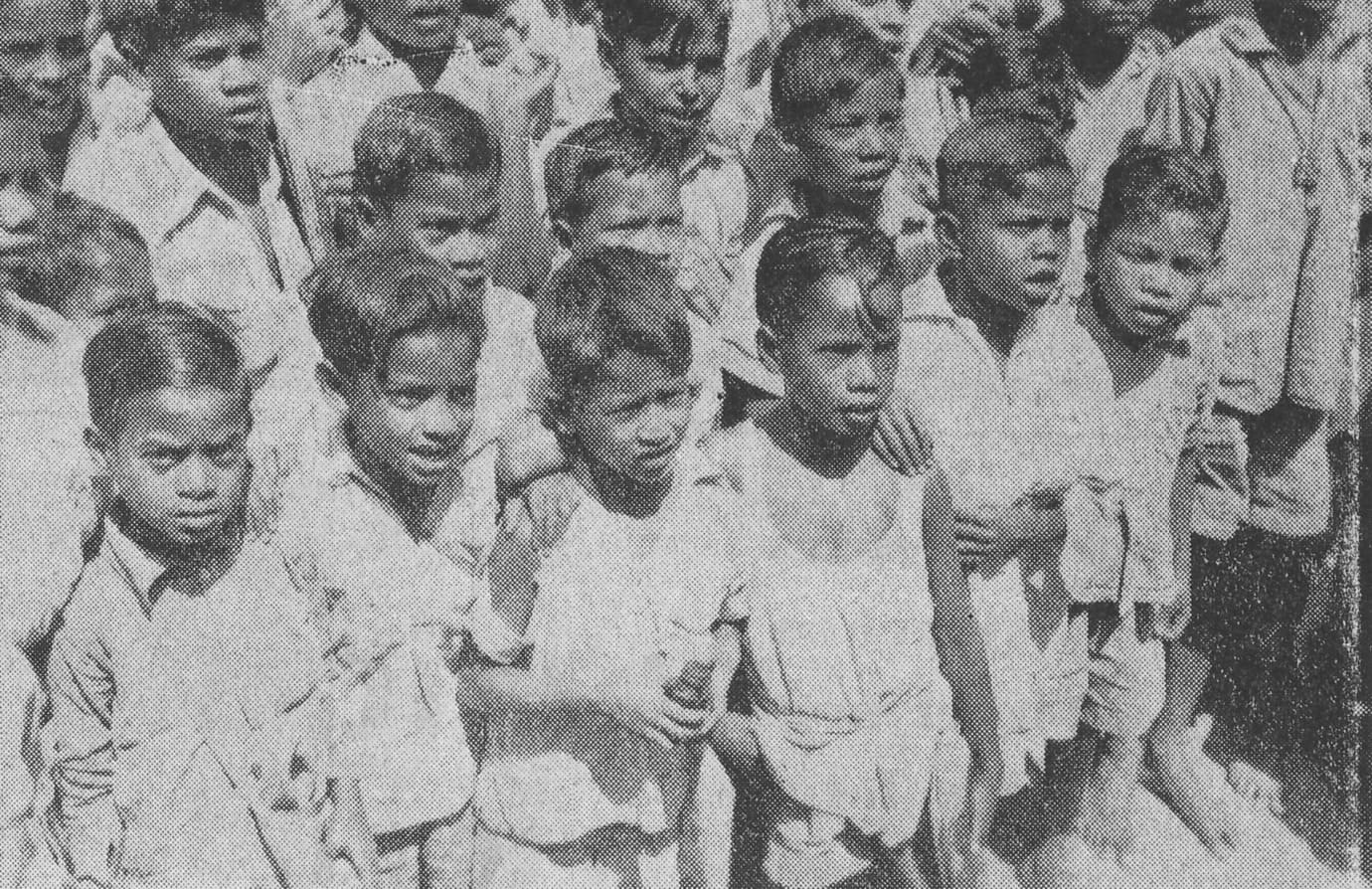
In the blink of an eye, I was surrounded by a cackling gang of children, many of them completely naked. They were very beautiful children, with dark skin, sparkling black eyes, blue-black, wildly tangled hair or bald heads, and supple, shiny brown bodies. A few skinny cows, a couple of sheep, and some ghastly thin dogs with bristly gray hair and glowing eyes roamed the dusty square. Three women in faded red saris walked to the spring with earthenware jugs on their heads and began to draw water with primitive leather buckets. I had already sucked on six oranges, but with my curved claws, I would have thrown myself on that leather bucket if the water in it had been clean!
At first glance, such a jungle village evokes such a peaceful, familiar image. The houses are clustered close together, a few farmers are plowing the fields with a buffalo: dark brown figures, naked except for a loincloth and a turban, behind the wooden plow a trail of reddish-brown dust. There is a pool of water where boys give their buffaloes their daily bath while urinating. In the shade of the houses, women sit peeling rice or making chapatis; their red and yellow saris are dusty and discolored, but they are draped around their heads with extraordinary taste. Toddlers romp everywhere in the dust, a boy drives a herd of sheep across the square, an old man limps along the edge of the jungle, there in the lush greenery, a thousand invisible creatures rustle and wriggle, the hot, shimmering air buzzes in the square, and black-gray vultures sit on the roofs of the houses.
It all belongs together, a spot of pleasant, rural life in the immeasurable, scorching-hot wilderness. Men live and work here, women grow up here, supple, slender women who move with dignity and calm, dressed like princesses in veils and adorned with silver bracelets.
There is a small stone temple, inside which stands a brightly colored, stern-looking statue of the god Vishnu, and in the darkness of that small space that smells of curry and incense, moves the figure of an old Brahmin, the man who teaches that after death the soul of man returns to another man and who recites prayers at weddings and funerals that are as old as India itself. Two old beggars with long, unkempt hair sit motionless in the sand in front of that little temple, staring straight ahead, next to their emaciated legs a tin bowl covered in dust, in which weak, searching fingers have drawn lines. A little piece of the world unto itself, where time passes without changing it, and where peace reigns. But I say: at first glance... we will now take a second look.
Father and son
The little boy, proud of his friendship with the white man, scattered the swarming gang of children with shouts and pulled me by the hand to the little house where his family lived.
Like the others, it was built of small trees covered with reddish clay. The roof consisted of bundles of branches and grass. In front of the hut, a man was scraping an animal skin. He stood up and gave the traditional greeting, which consists of bringing your hands together in front of your chest, slightly tilted next to your chin, then bowing your head slightly and smiling.
It is the sweetest greeting in the world. It expresses: I am so glad to see you. Welcome. It is a very old greeting, called namaste, and the usual way in which Hindus greet each other. When you see the greeting, you immediately know that the person belongs to the Hindu religion and not to the Muslim religion. Prime Minister Nehru always greets people in this way.
The man did not understand English, but when I made it clear to him with gestures that I wanted to see his house, he kept motioning for me to come in. Then he cast an inquiring glance at the boy. As I ducked under the low doorway to enter, I noticed out of the corner of my eye that the man was opening his son's hands. The boy resisted and wanted to go inside too, but the man held him by the arm and fumbled in his loincloth. He found the coin, looked at it, and tucked it away in his dhoti.
That's how it is in India: boys aren't allowed to come home empty-handed; when they come, they have to bring something. Be patient, little man, you and I will sort it out later.
(…)
Good heavens, how quickly the charm and familiarity of the first impression disappears. It is almost impossible to live in a more primitive way than in these Indian jungle villages. None of the houses I have been in had furniture, no table, no chairs, not even benches. The interior walls of the living room were covered with clay, just like the exterior walls, crumbling in many places and decorated nowhere. Hindus have little sense of beauty: their temples, even the largest ones, which tourists are led to visit, are grotesque and dirty. They completely lack the subtle charm and wonderful harmonies of Muslim palaces and mosques.
This lack of good taste is also evident in the houses: nowhere are they painted, there are no flowers, nothing hangs on the walls, no effort has been made to make the house beautiful in any way. It is a bare den, like that of an animal, everything one owns lies on the floor and one sits or lies on the floor as well. The windows are open holes, the wind blows through the house and everything is covered with a thick layer of dust.
These people are never clean, they cannot be clean: everything they touch or eat is dirty. Dusty cobwebs hang throughout the house and vermin crawls everywhere. The earthenware dishes are clumsy and shapeless, people eat with their hands and don't even bother to throw the leftovers outside, they throw them into the square hallway, where they rot and stink. In one of the houses, I saw a man urinating on the sandy floor of his living room and, in the outer hallways of three other houses, I saw human excrement next to the animal excrement.
(…)
I have never seen anything like it anywhere else. I have been in native American tents, but they were much cleaner and, although primitive, often beautifully decorated with images of animals. The nomad tents in the Sahara have hanging carpets, a separate area for the women, and the bronze pottery in those tents is exceptionally beautiful, decorated with arabesques. In the mountain caves of the Berbers in the Atlas Mountains, the walls were similarly decorated with arabesques, there were colorful rugs on the floor, embroidered cushions, and here and there a small table inlaid with mosaics. The huts of the Maya in Central America had colorful serapes on the inside and flowers. In the gloomy houseboats of Hong Kong, delightful Chinese drawings hang on the walls and mats lie on the floor, so clean that one would not want to step on them with one's shoes.
(…)
Why is that?
Why is there not even the attempt to make the houses clean and, above all, beautiful, regardless of the results? Of course, there is the inhuman poverty of the Indians. That does not explain everything, because the Mayans and the Berbers are also poor, but what poverty in India! (…) When one considers that Indians have many children, five, six, or more, how can one expect these people to do anything else besides survive?
Then there is this: the soil in India, apart from the eroded areas, is very good, but it depends almost entirely on the monsoon rains. These rains are very irregular. One year they do not come, and the harvest withers; the next year they pour down and the harvest rots. Only 17% of Indian agricultural land is irrigated, i.e. canals supply water when there is a shortage of rain, and dikes keep the floodwaters at bay when there is too much rain. All the rest is at the mercy of the monsoon. If there is a surplus, famine follows and we are back where we started.
A very small piece of land and not even the certainty that anything will grow on it: that is what the Indian farmer has to live on.
The statistics for 1951, the latest available, show that a rural inhabitant in India spends an average of 3,000 francs per year, or 250 francs per month: from this he must feed himself, clothe himself, maintain his house and his tools, feed his animals, and sow his fields. We immediately say: no one can do that with such a small amount of money. The Indians can do it, they have to, but that is only half of their tragedy, because they do not earn 3,000 francs per year. They spend it, but they do not earn it. The same officially organized statistics show that the average income of Indians is only 2,500 francs per year. In order to keep his meager household running, he has to incur an annual debt equal to one-fifth of his income.
The terrible thing about this degrading poverty is that for centuries there has been no hope of a solution. The land remains the same, as does the monsoon, but what about property? No, that does not remain the same; it becomes smaller and smaller. Traditional Hindu law requires that the father's land be divided among his sons. Since every father now had many sons, this meant that, as the centuries progressed, the farms became more and more fragmented, until they finally became so small that they could barely produce enough food to keep people from starving to death.
I believe this helps explain why the atmosphere in the Indian villages is so gloomy. All that the Indian can achieve through hard work is to fall behind. There is indifference in the Indian villages, lethargy, listlessness. After all, what is the point of it all?
Could this listlessness not also be one of the main reasons why there is no beauty to be found anywhere in the Indian villages? Why the houses are not kept clean, not decorated, no flowers placed, the interior walls not smoothed and brought to life with colorful drawings? Beauty is excitement of the mind, it is creative drive, a challenge to inert matter, shaping and molding that matter according to one's own will. Indians have as much energy as anyone else, but for centuries it has been dormant because they have learned to see themselves as useless.
What will become of it?
I spent the entire afternoon in the village: in the cottages, on the square among the boys, the dogs, and the sheep, in the fields with the plowing farmers, next to the pond with the buffaloes, in the little temple with the old Brahmin, who, on closer inspection, was completely obtuse. I tried to picture the lives of these people: you are born and as soon as you can walk you are sent into the jungle. To stay alive, the boys beg or steal. When they grow up, they return home to work on their share of their father's field, start a family, and suffer hunger with that family. Then they grow old, like the man who is now crouching among the bushes, sitting with his hands in his lap, staring ahead.
There was no school in the village, no radio, no newspaper. Only the Brahmin had a few books, which, as I would hear the next day in another village, he could not read. There was no inn and no shop, only a dingy little store where an old man kept some clothes, crockery, and sewing supplies. The only entertainment was the festivals: the festival of sowing, of rice planting, of harvesting, and weddings. Then they made rice beer and the whole village, I am told, was drunk. The only reason people left the village was to go on pilgrimage, if possible to the holy Ganges River.
After death, people were cremated. They disappeared. For a short time, there were memories, but then those disappeared too. People disappeared completely.
An immeasurable piece of land, where people rise from the dust in waves, then become one with the dust again... In India, 300 million people live, doing nothing but fighting hunger for a while and then disappearing. What a life! What a prospect!
- Annotations
-
- This is a translation of an article titled “Verpletterende armoede in de Indische jungle” (Crushing poverty in the Indian jungle), which was published in the Belgian Catholic newspaper De Week voor Belgisch Congo, on January 29, 1956.
- The article is part of a weekly installment which ran from November 1955, to June 1956, wherein the well-known Flemish writer Aster Berkhof (1920-2020; pseudonym for Lodewijk Paulina Van Den Bergh) recounted his trip around Asia, which he undertook in the summer of 1955. A significant part of this series is dedicated to India, on which 14 articles were published in 15 weeks. This is most of article 2/14.
- The series of articles was later compiled in the form of a book titled Haveloos India (“Ragged India”), published in Antwerp in 1960, wherein this article is titled “Verpletterende armoede in de Indische jungle” (pp. 17-30).
- All emphases are original to the text.
- Complete title
- Met Aster Berkhof de wereld rond: verpletterende armoede in de Indische jungle
- Author details
- Aster Berkhof (1920-2020)
- Date of publication
- 29.01.1956
- Dates of travelling
- 1955
- Publisher
- De Week voor Belgisch Kongo
- Place of publication
- Leopoldstad (Kinshasa)
- Archival source or library
- KBR (Royal Library of Belgium), DIGIT J.B. 1509
- Locations in India
- Bombay, Delhi, Calcutta, Madras, Bihar, Benares
- Keywords
- India, Society, Jungle, Poverty
- Translator and copyright
- Jaro Demetter, March 2026