
Excerpts from the manuscript diary of GIC (Ostend Company) Ambassador Jacques-André Cobbé, Bengal, 1723-1724
Item
- Title
- Excerpts from the manuscript diary of GIC (Ostend Company) Ambassador Jacques-André Cobbé, Bengal, 1723-1724
- Author
- Jacques-André Cobbé
- Date
- 1723-1724
- Country / region
- Belgium
- Source language
- French
- Time period
- 1720-1740
- Description
- A translation of excerpts from a diary written in French by J.-A. Cobbé, a diplomat and emissary of the Ostend Company, a chartered trading company established in the Austrian Netherlands. The translated excerpts from this unpublished manuscript focus on aspects of ‘heathen religion’, the deity Krishna, and the ‘faqirs’ encountered in India.
- Translated text
-
[9th September 1723] We are now in the four days of the Heathen gentile and Banyan feast Kallidagon Jattra the here assembled god Kisnon Bolleram and Sidam and Soedam by the mother’s wrath, because he had run away from her, was hung with a rope from a tree, so it is that under the triumphal arch before our house said monkey game was displayed in dance (p. 29)
[…]
What I understood from the life of Kisnon god of the gentiles benjaans &c.: He was a Son of Jedsodha, the eightborn, his highest Honor name is Cowhandler, he had 17 000 female shepherds with him, they say that he has changed himself once into a horse and once into an elephant and bull, in short he is the gentile god (and as they depict in the dance he was an Extreme Lover of the Female sex, and above that very desirous to make another man’s Good into His, concerning all of which I will give further teaching on some other year (p. 31-32)
[…]
I passed the sepulchur of the Moor saint named Jaffer Khan, next to his two sons and women with the father, in the place named Dinga, next to this gravesite is a hospital for all Fachiers (Bedelpaapen’) who maintain themselves through the offerings coming in daily (p. 42)
- Annotations
-
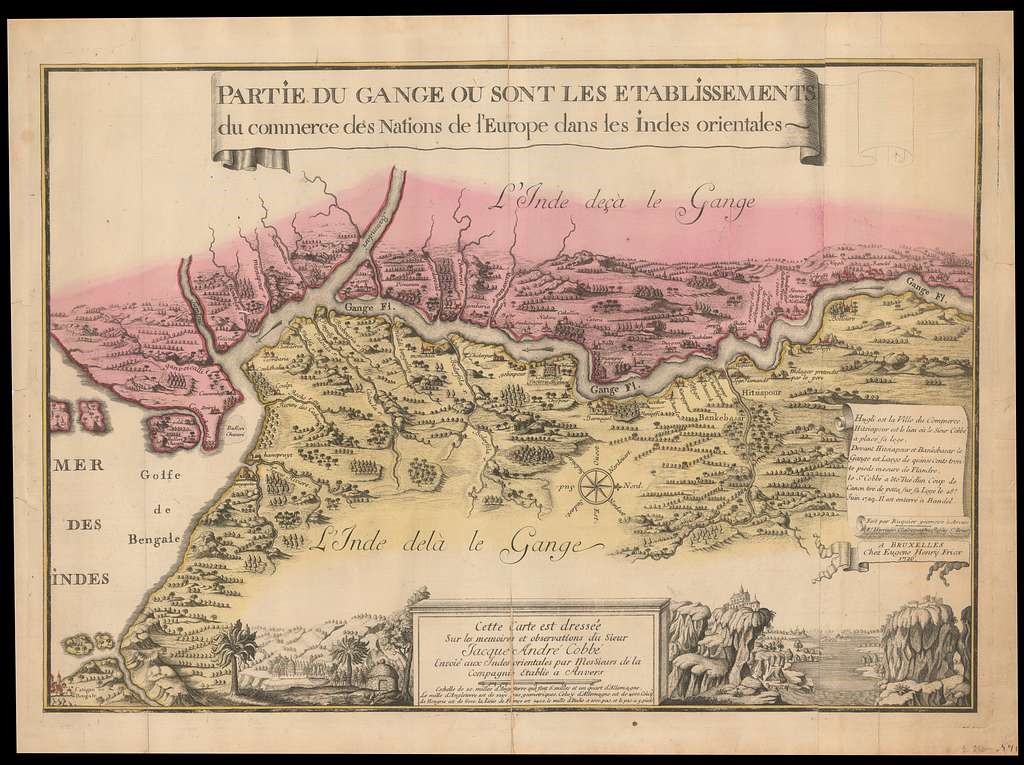
- In 1722, Jacques-André Cobbé was sent as diplomat and emissary on behalf of the Ostend Company (a joint-stock trading company similar to the British EIC or Dutch VOC) in order to engage in diplomatic negotiations with Murshid Quli Khan, the Nawab of Murshidabad (in Bengal). Behaving like a pompous general rather than a negotiator, he caused a local conflict (a skirmish which some Belgian historians labeled as a ‘War’) in which he lost his life.
- Due to his premature death, Cobbé was never able to send his diary to Europe, or to potentially rework it into a published travelogue. Possibly a Dutch local secretary-assistant, Martinus Van Schaar, could have been involved in its notation (according to historian Floris Prims).
- The diary is more extensive, included here are its main relevant descriptive paragraphs. This is the only point in his diary where he takes a ‘learned’ position from which he descriptively attempts to explain something about so-called ‘heathen practices’. The rest of the diary only concerns diplomacy and commercial transactions.
- He uses the word ‘bedelpaapen’ or’begging priests’ to designate muslim Fakirs, which holds a Dutch connotation closely connected to a (pejorative) view of Catholics in Dutch-language ‘early modern’ Europe.
- Complete title
- [manuscript diary]
- Author details
- Cobbé, Jacques-André, 1682-1724)
- Date of publication
- n.a.
- Dates of travelling
- 1722-1723
- Publisher
- n.a.
- Place of publication
- n.a.
- Archival source or library
- SAA (Antwerp City Archives), GIC 5772 ‘Dagboek en klad van M. Cobbé’.
- Locations in India
- Bengal
- Keywords
- Hindus, Hinduism, heathen, Gentoo, Krishna, God, Islam, banyan, Balaram, Sita, Yesodha, festival, sex, theft, fakir
- Related literature
-
Prims, Floris, and Maurice Pauwaert. De Oorlog Van Mijnheer Cobbé: Geschiedenis Van De Reis Van Luitenant-Generaal Cobbé, Van Zijn Onderhandelingen Met Den Nabab En Van Zijn Oorlog Tegen De Mooren, 1722-1724. Antwerpen: Leeslust, 1927.
De Winter, Wim. 2020. “The Ostend Company’s Worlds : Courtly Interactions and Local Life in Eighteenth-Century Bengal.” In An Earthly Paradise : Trade, Politics and Culture in Early Modern Bengal, edited by Raziuddin Aquil and Tilottama Mukherjee, 157–85. Delhi: Manohar.
De Winter, Wim. 2020. “European Perceptions of Religion and Society in 18th Century China & Bengal, and Their Subverted Gaze in Local Art and Encounter.” RELIGION 50 (2): 278–98.
De Winter, Wim. 2021. Worlds of the Ostend Company In Qing China and Mughal India (1717-1744): A Comparative Approach of the Gic's 18th-Century Trade Communities, Cultural Interactions and Foreign Exchanges. [PhD. diss., Ghent University]
- Translator and copyright
- Wim De Winter, 2025
- Media
 1.jpg
1.jpg