
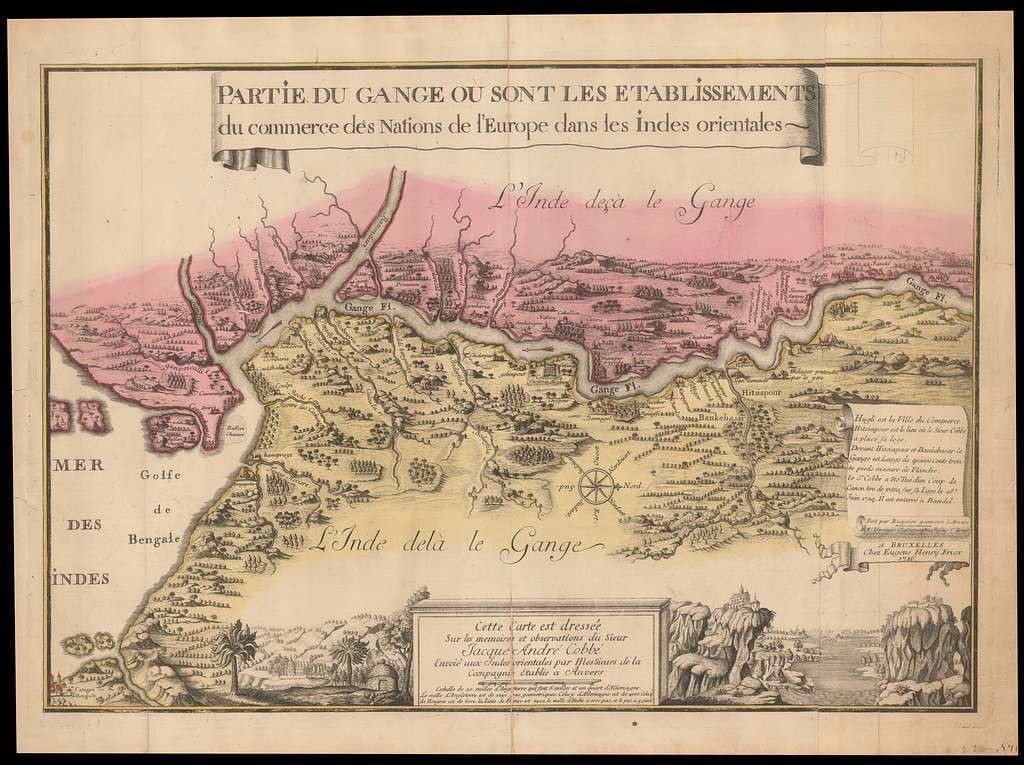
Letter by GIC (Ostend Company) Ambassador Jacques-André Cobbé to the Marquis de Prié, Hughli, 1 September 1723
Item
- Title
- Letter by GIC (Ostend Company) Ambassador Jacques-André Cobbé to the Marquis de Prié, Hughli, 1 September 1723
- Author
- Jacques-André Cobbé
- Date
- 1723
- Country / region
- Belgium
- Source language
- French
- Time period
- 1720-1740
- Description
- A translation of an early-18th-century letter written in French by a diplomat and emissary of the Ostend Company, a chartered trading company established under the auspices of the Holy Roman Empire in the Austrian Netherlands. The letter illustrates the dismissive attitude of its author towards the people he encountered in Bengal; behaving like a pompous general rather than a negotiator, Cobbé provoked a local conflict in which he lost his life.
- Translated text
-
The houses of Hughli are of earth and straw, with doors so low like the stables of pigs in the Low Countries: they are spread throughout the land without order and without streets, having only narrow pathways for their communication. […]
it seems incomprehensible to a stranger who comes here to conduct trade, as nowhere do we see people working, nor any other shop but those where pipes, tobacco or betel are sold, which is a green leaf, which being chewed with a nut (strongly resembling the color of nutmeg) this drug makes the teeth black as charcoal and saliva red as blood, which is hideous to those unaccustomed to it. These betels are given as great treats in the visits of moors.
The men here are like monkeys, never upright, but when they walk, always sitting on their heels in almost all their work: their toes serve as their hands; they have difficulties to conceive of the work which we order them to do, even though they are craftsmen, they are not capable of invention.
As regards the beauty of the female gender, against which his Excellency the Marquis de Prié has deemed to give me fatherly advice. It is so rare, even though I have seen more than 3000 women daily bathing naked in the Ganges, to which their Religion obliges them daily, there is not one which has seemed worthy to engage as concubine, they are so preciously and richly ugly that they would be horror to the most tormented man in the most obscure night.
- Annotations
-
- In 1722, Jacques-André Cobbé was sent as diplomat and emissary on behalf of the Ostend Company (a joint-stock trading company similar to the British EIC or Dutch VOC) in order to engage in diplomatic negotiations with Murshid Quli Khan, the Nawab of Murshidabad (in Bengal). Behaving like a pompous general rather than a negotiator, he caused a local conflict (a skirmish which some Belgian historians labeled as a ‘War’) in which he lost his life.
- This letter was Cobbé’s first “report” to the Marquis de Prié, Hercule-Louis Turinetti (1658-1726), at that time Governor or ‘prime minister’ of the Habsburg Netherlands or Austrian Netherlands, the territory and official government supporting the ‘Ostend Company’, which sent Cobbé to Mughal India as their official representative or ambassador. Cobbé and Turinetti were personally acquainted through Cobbé’s patron, the Count of Mérode. Hence the descriptive detail in Cobbé’s correspondence.
- Complete title
- [letter]
- Author details
- Cobbé, Jacques-André, 1682-1724
- Date of publication
- n.a.
- Dates of travelling
- 1722
- Publisher
- n.a.
- Place of publication
- n.a.
- Archival source or library
- SAA (Antwerp City Archives), GIC 5772, ‘Papieren en Brieven Cobbé’ – ‘1 7bre pres de Hughli, au Marquis de Prié’
- Locations in India
- Hooghli, Bengal
- Keywords
- Bengal, Ostend Company, religion,
- Related literature
-
Prims, Floris, and Maurice Pauwaert. De Oorlog Van Mijnheer Cobbé: Geschiedenis Van De Reis Van Luitenant-Generaal Cobbé, Van Zijn Onderhandelingen Met Den Nabab En Van Zijn Oorlog Tegen De Mooren, 1722-1724. Antwerpen: Leeslust, 1927.
De Winter, Wim. 2020. “The Ostend Company’s Worlds : Courtly Interactions and Local Life in Eighteenth-Century Bengal.” In An Earthly Paradise : Trade, Politics and Culture in Early Modern Bengal, edited by Raziuddin Aquil and Tilottama Mukherjee, 157–85. Delhi: Manohar.
De Winter, Wim. 2020. “European Perceptions of Religion and Society in 18th Century China & Bengal, and Their Subverted Gaze in Local Art and Encounter.” RELIGION 50 (2): 278–98.
De Winter, Wim. 2021. Worlds of the Ostend Company In Qing China and Mughal India (1717-1744): A Comparative Approach of the Gic's 18th-Century Trade Communities, Cultural Interactions and Foreign Exchanges. [PhD. diss., Ghent University]
- Translator and copyright
- Wim De Winter, 2025
- Media
 2.jpg
2.jpg