
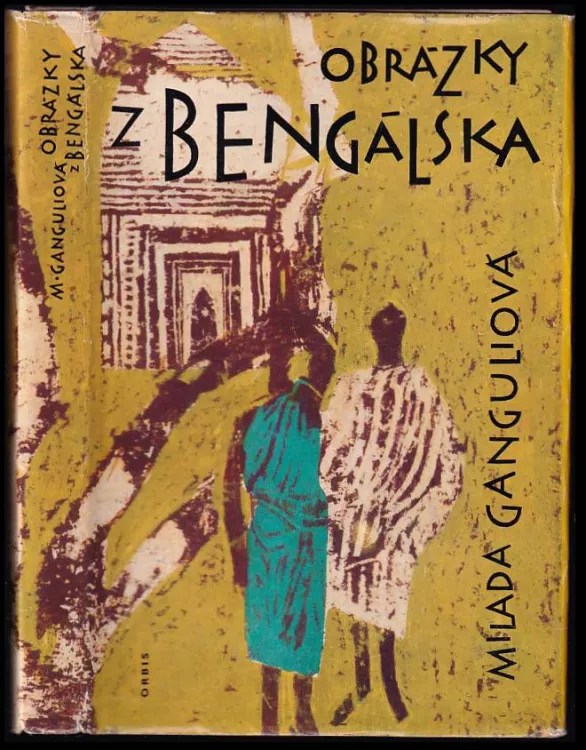
Obrázky z Bengálska (Pictures from Bengal)
Item
- Item Number
- 5
- Title
- Obrázky z Bengálska (Pictures from Bengal)
- Author
- Ganguli, Milada
- Date
- 1943
- Country / region
- Czechoslovakia
- Source language
- Czech
- Time period
- 1940-1960
- Description
- The text is a translation of excerpts from a work by the Czech scholar and writer Milada Ganguli, where she relates her experiences of the Bengal famine of 1943, during which she worked as a volunteer. Née Milada Sýkorová, the author left Czechoslovakia for India in 1939, accompanied by her Bengali husband, and passed away in Calcutta in 2000.
- Translated text
-
“India went through many famines. It suffered from famines twenty three times during 170 years of British rule, if we do not count numerous cases of ‘serious problems’. Bengal experienced seven famines in the years 1770, 1783, 1866, 1873-74, 1892, 1897 and 1943. However, the catastrophe of the year 1943 was not declared a famine by the government, although the situation was more critical than during all the previous crop failures.
Although Bengal has very favorable natural conditions, the yield of the soil was much smaller here than in other countries. The government was simply not interested in agriculture; it did not have any plan as to how to increase the fertility of the soil or how to use large swamps for agriculture. Bengal did not have an agricultural school until 1940. Good soil, the main source of sustenance for the majority of the population, remained neglected. The government was satisfied when it got its regular income from the soil. The taxes did not depend on the measure of the yield, because peasants had to pay the fixed amount of money even in the times of poor harvest. Therefore, they were in debt all the time.
Apart from rice, fish is the main food of Bengali people. In this case, the government also did not show any interest in the use of rivers and ponds for the systematic creation of fisheries. There was no state organization for fishing in the sea, although Bengal has a long coastal line and there is lots of fish in the Bay of Bengal.
The question of nutrition of the population became critical in the first years of World War Two. The import of rice from Burma was stopped. A strong cyclone damaged large seaside areas and destroyed the harvests in many districts of Bengal in October 1942. Although the Indian political leaders warned that there was a danger of a famine break-out and attempted to stop the export of rice to other countries, the government kept exporting rice in huge amount. The army in the Middle East and in other posts of the British empire was supplied with Bengali rice.Crowds of Indian refugees fled from Burma, which was occupied by the Japanese, to Bengal in the winter of 1941-42. The shortage of food got worse. The government was afraid of the Japanese invasion and started to panic. In April 1943, it ordered the destruction of tens of thousands of river boats in the eastern areas. For East Bengal, which is interwoven with many rivers, the boats were the only means of transportation. The villagers were also bereft of the many sea-boats which they used for their commuting to the many small islands of the Bay of Bengal, where they cultivated land. The massive destruction of the boats not only disabled fishing and cultivation of rice in the Ganges delta, but it also isolated many villages from the outer world and took away from people the means of transportation for agricultural products.
The government did not want the Japanese invaders to seize local food; therefore, it released a new decree several days later, ordering villagers to give up all ‘surplus’ amounts of rice. The situation became very serious. General Wood, who was in charge of food supplies, admitted in his announcement on 13 May 1943 that 30,000 tons of rice had been confiscated. The food committee spoke about 40,000 tons in its report.
As during other disasters, also in this case, the landless were most seriously affected, one-third of the agricultural population. Peasants were forced to sell their rice for a terribly low price of 5 Rupees per man (around 37 kilogram). The governmental agents threatened them that all their storage would be confiscated if they will not give up their rice, and also evoked the images of looting Japanese. The villagers could keep much less rice than prescribed by the government on paper, for the period of one year. In these difficult times, food speculation began to flourish. Countless agents, army suppliers, and other profiteers profited enormously. Corruption spread quickly and reached the top-level governmental circles.
It was possible to foresee and prevent the outbreak of the famine, but the government showed unbelievable indifference and laziness in its approach to problems regarding food supply. It was too busy with issues related to the war. The political leaders of India were imprisoned; therefore, they could not prevent the coming catastrophe.
Thousands of people, mostly women, children and old people, started to pour into Calcutta from the villages. Many came on foot from very distant districts, or arrived in the overcrowded trains. There were few younger men between them. Some of them could find some work, but this could feed just them, not others. The price of rice, which the villagers had to sell to governmental agents for 5 Rupees per man, was raised to 42 Rupees. Only the rich could buy it, and there was no other substantial food in the market. When some charitable organizations pointed out the acute shortage of food out, the government denied the reality and tried to divert attention from it. Later, when the suppression of this reality had become impossible, it admitted ‘a mild shortage’ of food in Bengal. Press censorship suppressed all the news about the famine.
The authorities admitted that the ‘situation became serious’ only when the starving villagers started to die in the streets of Calcutta. However, the measures necessary to deal with the crisis were implemented neither by the government of Bengal nor by the central government of India. When some help was sent, after pressing requests, lots of grain got lost on the journey. The lack of organization of transports caused further delays in food supply. The governmental committees created many projects and plans which existed only on paper, never materialized. Many volunteer groups had to take up relief work instead. Under their pressure, the government authorized a large plan for the establishment of food-providing centers in different quarters of Calcutta, later also in the villages. They should have provided food for the crowds of starving poor. The government contributed by supplying rice of the lowest quality, for a slightly lowered price. This rice was often full of worms. From this rice and some legumes, a sparse mash was prepared.
...The members of Atmaraksha samiti, the volunteer organization of Bengali women, did invaluable service for saving the starving people. Without their super-human sacrifices and lots of wit, the catastrophe would have reached yet another scale. I helped them until the day I got dysentery after our work in the Medinipur district.
...The most terrible view was to see exhausted mothers who sought salvation for their children in the city. They were dropping at the food-providing center entries with beggar’s bowl in their hands. It must have been very humiliating for them—women of the peasant middle class who used to live in relative prosperity and comfort! Their children swallowed eagerly a sparse mash, and when they finished the small ration, they used to run to another queue in front of another center. Many children disappeared, those who were older than five or six years. Only few mothers lamented when their small sons and daughters disappeared. They knew that it was impossible to feed them, and hoped their children would find food more easily alone.
Once I saw a young mother with a child skinny to its bones on her lap in the Gariahat food-providing center. The child died while she was eagerly eating, but the woman did not stop eating. Only when the last remnants of the mash were scratched out of the bowl by her skinny fingers, the mother came to her senses. Quietly she left, holding her dead child.
...In the time of famine, I often saw women and children in the streets, who pushed the wandering dogs away from the garbage in order to get some kitchen remnants for themselves.
...When I came back home after hours spent with the starving poor, I felt ashamed of eating my own food. But how many starving people could we help? There were lines of exhausted, emaciated bodies lying on the dirty pathways, hardly covered by their meagre clothes. People were exhausted by many days of hunger, lying here day and night, exposed to the scorching heat, to rain, to diseases. Some of them were already dead, with their motionless eyes staring directly in the sun. Some were helplessly expecting inevitable death. They knew that there was no hope for them. Several spoons of the sparse mash once a day was not enough to survive. They were dying by one of the most horrendous deaths, the slow death from starvation.
I will never forget the moment when I saw a dying women at a corner of our street. She kept her emaciated body covered by a piece of sackcloth by one hand, and pressed the clay bowl, her only possession, to her chest by another hand. She was lying unconsciously, barely breathing. Many people were passing by, but nobody stopped to help her.
According to data from the Department of Anthropology, University of Calcutta, there were 150,000 starving people who wandered through the streets of the city in the months of famine. Bengal was destroyed, family life scattered to pieces. Many children were stillborn....We heard that one American company exported human skeletons from Bengal in the time of the famine, allegedly for study purposes.
...Many speculators got enormously rich by trading food and medicine, which were stored in secret warehouses. Their fantastic profits meant death and diseases of thousands of other people. The contrast between rich and poor, between people well-fed and those who were starving was never so striking as in the summer of 1943, in those terrible months of famine. The rich did not suffer. They ate, drank, and organized parties as before. I was shocked to experience the lack of human feeling, when I heard sounds of jazz music and laughter of the jolly company from the European Saturday Club garden party. Who cared that behind the wall, many people are dying from hunger?
...The picture of the deserted village of Gabra, one among many thousands of the tragedy’s witnesses, is deeply and painfully carved into my heart. The last rays of the descending sun lit up the tops of the bamboo thicket, the leaves sparkling with drops of rain. We were returning on the muddy road in silence, shaken by the awwareness of our own helplessness. In silence we tried to overcome the pain and deep hatred towards the people who were responsible for the death of three and a half million of Bengalis."
- Annotations
-
- The Czech scholar Milada Ganguli was born in Přerov, Moravia, in 1913. Her family name was Sýkorová. In the time between the wars she studied in Prague and London. She married Mohan Lal Ganguli, a relative of the famous Rabindranath Tagore. She left Czechoslovakia with her husband for India in 1939. Milada Ganguli became later known as author of several books summarizing her experiences, such as A Pilgrimage to the Nagas. She died in Calcutta in 2000
- The translated text is a selection from Milada Ganguli’s experiences of the famine in Bengal in 1943, during which she worked as a volunteer
- Complete title
- Obrázky z Bengálska
- Author details
- Ganguli, Milada, 1913-2000
- Date of publication
- 1963
- Dates of travelling
- 1939-2000
- Publisher
- Orbis
- Place of publication
- Prague
- Archival source or library
- n.a.
- Locations in India
- Bengal, Calcutta
- Keywords
- famine, 1943, Bengal, colonialism
- Related literature
-
n.a.
- Translator and copyright
- Martin Fárek, 2025
- Media
 image_10.png