
De worgers van Kali (The stranglers of Kali)
Item
- Item Number
- 6
- Title
- De worgers van Kali (The stranglers of Kali)
- Author
- Daan van der Vat
- Date
- 16.5.1968
- Country / region
- The Netherlands
- Source language
- Dutch
- Time period
- 1960-1980
- Description
- A translation of a 20th-century Dutch newspaper article on the thugs or stranglers-cum-robbers of India, originally published in 1968. It discusses thuggee as a violent form of worship of Kali, which was a downside of a religion where female deities were (and are still) worshipped.
- Translated text
-
It is a well-known phenomenon that as woman catches up with man in society and has gained the privilege of working outside the home in addition to her domestic work, manners have deteriorated in both sexes. Recently at Amsterdam's Central Station, I saw a pretty, fashionably dressed lady using all her elegant elbows to make her way through the crowd to get a seat on a tram vehicle. When a man protested, the lady said, “In Amsterdam, you learn to push.” She spoke with a Hague accent, which also has its connotation.
Religion does not help much, as witnessed by the past position of Japanese and Chinese women, and the many Christian bullies who in the past considered their wives to be nothing more than reproductive employees and unpaid housekeepers. But there has been one religion whose male members considered it a duty of honor on religious grounds to hold their women in high regard and to treat them with great tenderness. However, this religion had some downsides.
The divine triumvirate at the top of Hindu mythology consists of Brahma, the creator, Vishnu, the preserver, and Shiva, the destroyer. Brahma has lost stature and the worship of Hindus focuses mainly on Vishnu and Shiva. Shiva is not only the god of destruction, but also the god of reincarnation. His symbol is the phallus. He has three eyes, wears a necklace of human skulls and carries a snake as a belt. He is worshipped mainly in Benares. Shiva is married to Durga, also known by the names Devi and Uma, but mostly by the name Kali. Kali is a bloodthirsty goddess: a woman with a black body. Like her consort, she wears around the neck a string of skulls. She sticks out her tongue. The tongue is smeared with blood.
Kali’s bloodlust has a cause. Kali was violated by a devil. She has never been able to forget or forgive this incident. She declared war on the male species. Her male servants on earth were her tools. It was their first duty to avenge Kali by killing men with great fervor.
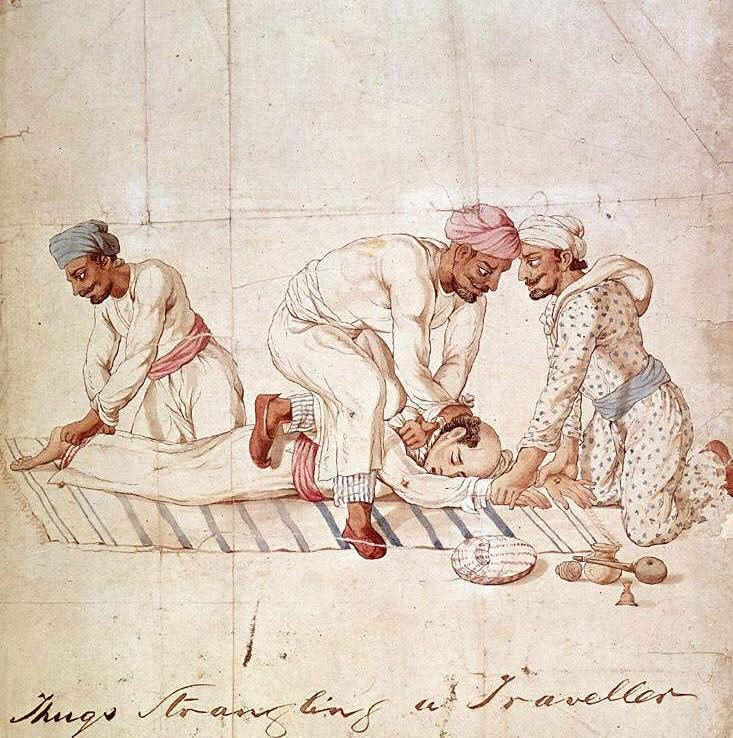
Kali worship is called Thagee, from the Hindi word “thag” which meant trickster, but took on the meaning of “strangler” in the Thagee religion. (From this Hindi word, English derives the word “thug,” meaning murderer or bandit). Thags came from all Indian castes and, as a rule, this form of religion was handed down from generation to generation. The servants of Kali excelled in piety and in the great loyalty with which they fulfilled their primary religious duties. And the main duty was to avenge Kali on men. The Thags were stranglers. They developed strangulation into a fine art. But they were also devoted husbands and fathers. According to expert estimates, as late as the first decades of the last century, an average of forty thousand people were murdered every year. Their religion prohibited the Thags from ever harming a woman, even if on their religious outings they saw an auspicious omen, such as a pregnant cow or a horse in the process of giving birth to a foal.Kali was demanding in her vengeance, but she made exceptions. Certain men whom Kali looked down on with contempt were not eligible for the honor of being strangled by a Thag. These fortunate exceptions included blacksmiths, but also silver, gold and copper smiths. Carpenters likewise were not allowed to be strangled, as were sculptors, laundry workers, potters, pariahs, lepers, the blind, and the maimed. Men who drove a cow or a goat along the paths were also not to be strangled. Officers of the British army were to be left unmolested, but Indian soldiers in British service were welcome as strangled sacrifices.
At the beginning of the last century, it became clear that Thagee was beginning to degenerate. The Thags were permitted to rob the sacrifices they strangled of the possessions they carried. This was their main source of income; it was also the cause of the beginning demise of the Thags’ religion. Non-Thagee bandits followed the Thags’ pious example and went on a strangling spree, not to avenge Kali but to rob their victims. The strict orthodoxy was lost. And it happened more and more often that a man was strangled even though he was driving a cow along the road, and even women were strangled here and there in India. Not the least remarkable was that the Governor-Generals of India and the heads of the British East India Company closed their eyes to what was happening around them throughout India. One reason was the stance that British authorities should leave the native religions alone.
But there was one Englishman who could not reconcile himself with the distinctly un-English customs of the Thags. This was Captain William Sleeman, an officer in the British-Indian army. Sleeman wanted to put an end to the religious customs of the Thags. But his superiors refused to give him permission to do so. Nevertheless, Sleeman began an intense study of the Thagee, to which he devoted years. He soon came to be impressed by the Thags’ intelligence, dignity and sophisticated good manners. He came to know them as good husbands who honored and respected their wives, and as good family men.
Sleeman noted the family trees of all the prominent Thag families in India. On a huge map, he pinned pins to all places where he had discovered thriving bands of Thags or secret graveyards where victims of the Thags lay buried. Sleeman finally got his chance, when he was able to convince his superiors that Thagee had taken a turn for the worse and that criminals and robbers were beginning to follow the example of the pious Thags.
Sleeman was granted permission to suppress the Thagee. With a number of employees, he went to work. He had the law left out of it. If he found a Thag, he hanged him from the first tree he could find. Hundreds of Thags were hanged without trial. Others were deported. Many thousands were sentenced to life in prison. One of the captured Thags confessed to strangling 931 men in the name of Kali. Sleeman also established a model prison for the Thags, where prisoners were allowed to provide for their women and children by weaving carpets. The Thags soon achieved as high a degree of skill in weaving carpets as they had previously shown in strangling people.The fascinating history of Thagee and of Sleeman’s successful attempts to put an end to the religious customs of the Thags is described by George Bruce in a recently published work The Stranglers. It is one of the most extraordinary histories of religion I have ever seen.
- Annotations
-
- This is a translation of an article titled “De worgers van Kali” (The stranglers of Kali), which was published on page 3 of the Amsterdam-based newspaper De Tijd, on May 16th, 1968. The text is written by Daan van der Vat (1909-1977).
- The author writes about the so-called ‘thags’ or ‘thugs’, who allegedly were part of a religiously motivated criminal collective, known for their specific modus operandi. According to (often British) colonial sources, they deceived, strangled, and robbed unsuspecting travelers on desolate travel routes, thereby following divine instructions from Kali. Systematic persecution and suppression of the thugs came about in the 1830s, resulting in the creation of the Thuggee and Dacoity Department, led by General William Henry Sleeman (1788-1856). In 1839, he declared that thuggee as an organized system had been effectively eradicated.
- It is likely that most of the article’s content on the nature and organization of the thugs is taken from Bruce’s work – in turn referring to both W.H. Sleeman and J.L. Sleeman – as evidenced by the author’s reference at the end of the text.
- Complete title
- De worgers van Kali
- Author details
- Van der Vat, Daan, 1909-1977
- Date of publication
- 16.5.1968
- Publisher
- De Tijd
- Place of publication
- Amsterdam
- Archival source or library
- Delpher
- Locations in India
- Benares
- Keywords
- Thug, Thuggee, Thag, Thuggism, Hindu, Hinduism, Kali, Durga, Sleeman, Strangler, Brahma, Vishnu, Sacrifice, Women, Cult, Crime, Criminal
- Translator and copyright
- Jaro Demetter, April 2025
- Media
 unnamed.jpg