
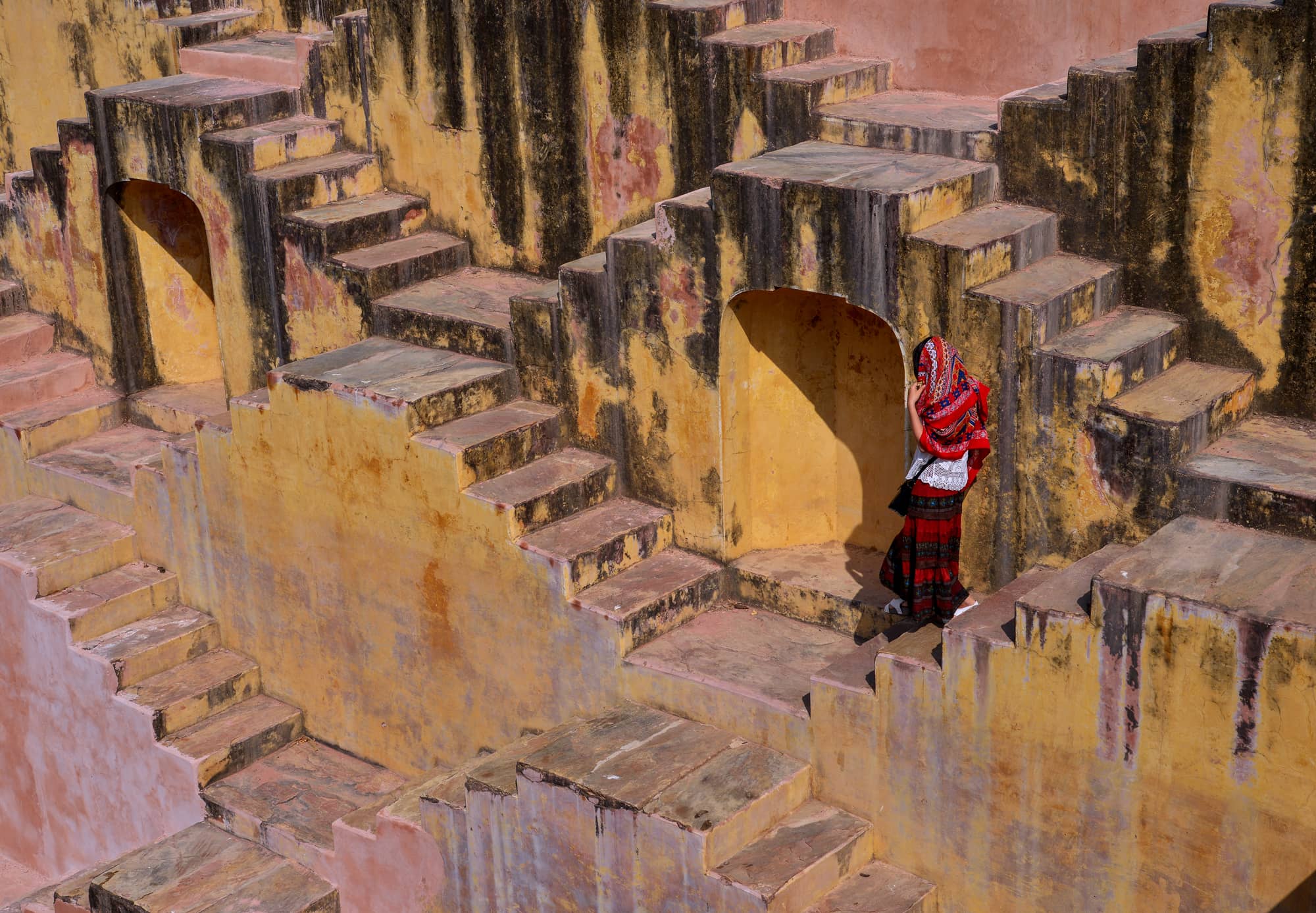
Britsch-Indië’s geheime maatschappijen en godsdiensten (Secret societies and religions in the British East Indies)
Item
- Item Number
- 7
- Title
- Britsch-Indië’s geheime maatschappijen en godsdiensten (Secret societies and religions in the British East Indies)
- Author
-
P.B.
- Date
-
6.12.1935
- Country / region
- Belgium
- Source language
- Dutch
- Time period
- 1920-1940
- Themes
- British India
- Caste
- Colonialism
- Europeans in India
- Hinduism and Hindus
- Religion
- Society
- Stereotypes
- Description
- A translation of a Belgian article from 1935 on secret religious associations and cults in British India, especially including that of ‘the thugs’. The article was originally published in Dutch in a periodical controlled by Christian labour organizations and based in the Flemish city of Ghent.
- Translated text
-
The religious movements in the British East Indies, one of the four giant states and nations of Asia, are not only characterized by the great national religions of which everyone has probably heard: Brahmanism, Buddhism, Mohammedanism, Christianity.
In order to get to the true essence of some parts of this vast empire, as far as religious movements are concerned, it is necessary to examine the role played by some religious confraternities as well as by some cults dedicated to certain false gods.
In the historical library of the Payot firm in Paris, we found two original works on this subject, one by Colonel Sleeman on the secret sect of the Thugs, the other by Arthur Miles on the worship of Shiva.Sleeman, the author of “Thug; or, a million murders” is none other than the grandson of General Sleeman (1809-1856) who succeeded, during his military administration in the British East Indies, after decades of relentless struggle, in eliminating the notorious secret murderous sect of the Thugs.
This monograph on the Thugs gives us the full description of this secret confraternity that played a dominant role among some castes of British India for 300 years. The Thugs worshipped the goddess Kali who in Brahmin idolatry represents the principle of destruction and total obliteration. Another major idol was Bhagwan or Bhowani as seen on the cover of the work and represented in the temple of Bindachun.
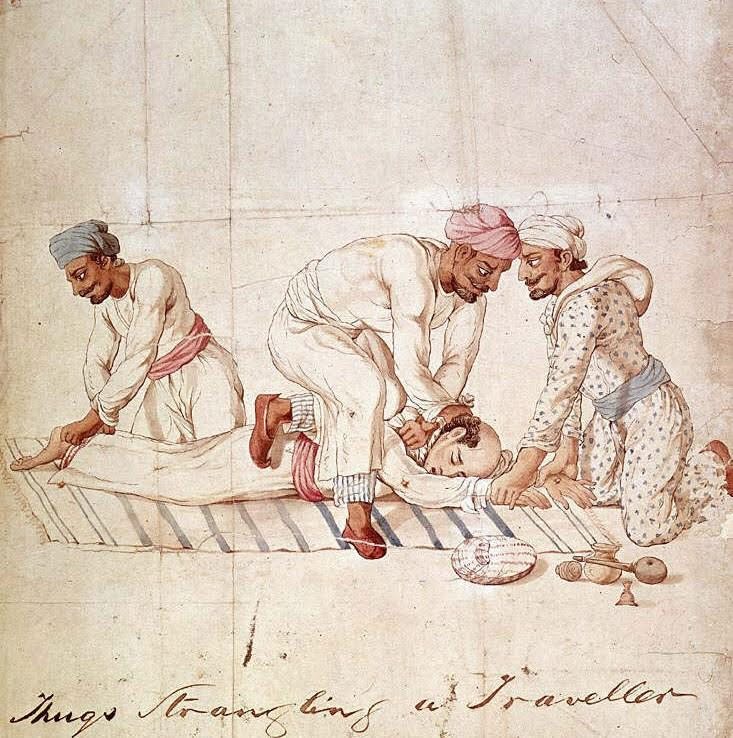
The Thugs practiced what is called “ritual” murder or human slaughter according to certain rites: blood was not allowed to flow; one was only allowed to strangle the designated victims by means of a collar specially intended for this purpose.
In Hindustan, at one time, there were a million followers of the cult of the Thugs. Even when the English settled there, the fight against the Thugs was carried on with a persistence as if it were a hunt on wild animals or a fight against famine.
When General Sleeman finally succeeded in eliminating the sect of the Thugs, the Hindus themselves were so grateful to him that they gave him the title of “Sleeman of the Thugs” and that even today his memory lives on in many a folk song.
This study on the Thugs is drawn from the general's family archives; it gives all sorts of marvelous details about this sect, about the mysterious organization of the Thugs, and gives accurate data hitherto never provided. Nor is it an exaggeration to state that the eradication of Thuggism by Great Britain in its vast British-Indian Empire is, in the eyes of the Hindu people, truly equated with a great benefaction rendered to the community.
Arthur Miles, author of “The Land of the Lingam,” leads us in this work to a thorough knowledge of Hinduism, this complex of superstitions, corruptions, abominations, and fable-like sayings that make us better appreciate the exalted value of our Catholic religion.
The Hinduism that dominates the lives of millions in the British East Indies is but the story of successive reforms and apostacies. From the epoch of the [Scrouti], when the sacred books or Vedas were still regarded as the emanation and lesser knowledge of heavenly truth, the creed soon came under the yoke of superstition and sorcery, to later fall into even deeper decay. The Caste system, this system of social stratification that created uncrossable boundaries between citizens of the same country, raised the confusion even higher.
Hinduism as a creed, after all, is but a form of the pride that robbed the first human pair in the Earthly Paradise of its glorious pre-Fall state. Selfishness and Greed are the two giant pillars of this building of unbelief where even the gods can be bought out. This worship of oneself inevitably brings with it the contempt for all that lies outside oneself and consequently the disdain of society. Hence only I and my peers, that is, those who belong to the same Caste or social class will qualify. All other people, institutions and religions are of no value, and thus it is to be explained that the conversions to Christianity and to Catholicism with its exalted teaching of mercy have so few followers in the British East Indies, as far as adults are concerned, and that a thousand years of Mohammedan rule were not allowed to succeed not only in not eradicating Hinduism, but even in affecting it.
Miles' work is additionally an outline of the most frequent castes in contemporary British Indian society: the four great castes and the numerous subordinate castes.
We hope that thanks to an evolution of Hindu thought it will be clearly understood that India is condemned to live in isolation and that all adaptation to modern civilization will remain a utopia as long as the caste system persists.
In the critical period through which British India is now living in its political evolution, its social and religious currents can also be closely followed.
- Annotations
-
- This is a translation of an article titled “Britsch-Indië’s geheime maatschappijen en godsdiensten; de godsdienstige konfrerie der thugs en de eeredienst van Çiva” (Secret societies and religions in the British East Indies: the religious confraternity of the thugs and the worship of Shiva), which was published on December 6th, 1935, on the front-page of Het Volk, a periodical based in Ghent, controlled by the Christian labour organizations.
- The author writes about the so-called ‘thugs’, who allegedly were part of a religiously motivated criminal collective, known for their specific modus operandi. According to (often British) colonial sources, they deceived, strangled, and robbed unsuspecting travelers on desolate travel routes, thereby following divine instructions from Kali. Systematic persecution and suppression of the thugs came about in the 1830s, resulting in the creation of the Thuggee and Dacoity Department, led by General William Henry Sleeman (1788-1856). In 1839, he declared that thuggee as an organized system had been effectively eradicated.
- Complete title
- Britsch-Indië’s geheime maatschappijen en godsdiensten; de godsdienstige konfrerie der thugs en de eeredienst van Çiva
- Author details
- P.B.
- Date of publication
- 6.12.1935
- Publisher
- Het Volk
- Place of publication
- Gent
- Archival source or library
- KBR (Royal Library of Belgium), DIGIT 785
- Keywords
- Hinduism, Hindu, Superstition, Cult, Sleeman, Miles, Thuggee, Thug, Shiva, Caste, Brahmanism, Bhowani, Kali, Christianism, Missionary, Conversion
- Translator and copyright
- Jaro Demetter, April 2025
- Media
 unnamed.jpg