
De thugs in Indie (The thugs in India)
Item
- Item Number
- 9
- Title
-
De thugs in Indie (The thugs in India)
- Author
-
D. Broek
- Date
-
6.8.1872
- Country / region
- The Netherlands
- Source language
- Dutch
- Time period
- 1860-1880
- Description
- Translation of a Dutch article on the Indian ‘thugs’, originally published in 1872 in a periodical of the Dutch Reformed Church. Written by a reverend of this Calvinist church, it was meant for a Protestant-Christian public and sought to illustrate the ‘horrors’ of heathen religion.
- Translated text
-
In the latest issue of the Missionary Herald, we find a description of a class of people in India called Thugs, found nowhere else on earth. These people deal in blood, killing is their regular occupation, and they even practice it as a religious duty. The Thugs have mocked human nature and compassion for centuries.
Their organization is perfect; they are bound together by oaths and vows, strong as death. The worst of all classes join them. The epitome of evil becomes a Thug. Each of them becomes a murderer; and a murderer not driven by hot temper, or vindictiveness, nor under influence of strong liquor, but a cold-blooded, composed, impassive dealer in human lives, whose conscience knows no remorse; for he considers his actions as performing the highest service to his chosen deity.
Sixty years ago, these people could carry out their cruel trade almost unimpeded. The government of India was incapable to prevent them. They occupied the public roads, disguised as merchants, travelers or Fakirs (hermits), but always in troops, and each knew his part when it was time to act.
Hindu Thuggism has even managed to secure the approval of an idol over these cruel acts; for their heinous confession has a patron goddess, who accepts the secret and agonies of their unfortunate victims, and rejoices in them. Her name is Kalee. She is the most celebrated goddess of the Bengalis. The origin of the name of the great commercial city in India is derived from her name and altar, – Kalee and Ghat, a place of cleansing – Kalee’s-Ghat – hence Calcutta.
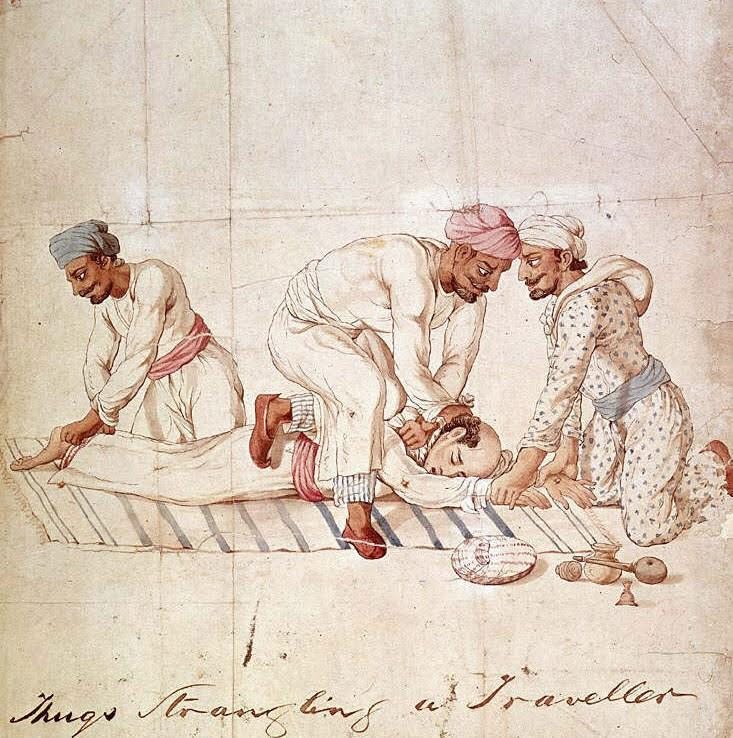
She is the patron goddess of these Thugs – these regular assassins, who, when their victim lies on the ground in the agonies of strangulation under their knees, engage in sending up prayers, and sacrifice the life that is extinguished to Kalee. To this abominable goddess, of whom it is said that she feeds on human souls, mothers in India have sacrificed their daughters for centuries.
So famous are she and her worship, that even the English government cannot keep the places of public affairs open, during the time of “Durga-Puja” or holy days from the 1st to the 13th of October; for all Calcutta is then enamored with this idolatry. I have seen that her statue, larger than a human being, painted in blue, with her tongue dripping with thick blood on her chin, and her body covered with a wreath of human skulls, and each of her many arms holding a murderous weapon, was carried in a great procession through the streets of Calcutta, during these holy days, accompanied by music and tens of thousands of frenzied followers.
Because of the discovery of thirty dead bodies in several wells at Doal, Thuggism was first brought to the attention of the English Government in 1810; and so decided were the measures, taken to its suppression, and so faithfully have they been followed ever since, that the Thug has had to remove itself from the roads in the British East Indies, and confine its ravages within the limits of the States of the Natives [“Staten der inboorlingen”], where English law could not get through. Hundreds were cuffed and are now confined within the walls of secure prisons. The English government strongly urges the government of the States of the Natives to follow the English example in this respect. But while they are willing to follow the friendly advice of the higher government, they lack the courage and resilience of the Anglo-Saxon to achieve their entire extermination.
Many are often surprised that the Gospel isn’t spreading more rapidly among the heathens, but considered from the human side, it is rather a miracle that so many victories have already been won – that the light has already penetrated so many dark places.
- Annotations
-
- This is a translation of an article titled “De thugs in Indie” (The thugs in India), which was published on August 6th, 1872, on the front-page of Wekstem, a periodical of the Dutch Reformed Church, based in Leiden. The text is written by a reverend and meant for a Protestant public.
- The author writes about the so-called ‘thugs’, who allegedly were part of a religiously motivated criminal collective, known for their specific modus operandi. According to (often British) colonial sources, they deceived, strangled, and robbed unsuspecting travelers on desolate travel routes, thereby following divine instructions from Kali. Systematic persecution and suppression of the thugs came about in the 1830s, resulting in the creation of the Thuggee and Dacoity Department, led by General William Henry Sleeman (1788-1856). In 1839, he declared that thuggee as an organized system had been effectively eradicated.
- Complete title
- De thugs in Indië
- Author details
- (Rev.) D. Broek
- Date of publication
- 6.8.1872
- Publisher
- Wekstem; J. H. Donner (chief editor)
- Place of publication
- Leiden
- Archival source or library
- Delpher
- Locations in India
- Calcutta, [Doal]
- Keywords
- Thug, Thuggee, Thuggism, Kali, Kalee, Durga, Calcutta, Hindu, Heathen, Sleeman, Cult, Sect, Crime, Criminal
- Translator and copyright
- Jaro Demetter, April 2025
- Media
 unnamed.jpg