
De thugs, eene sekte van moordenaars, in Indië (The thugs, a sect of murderers, in India)
Item
- Item Number
- 12
- Title
- De thugs, eene sekte van moordenaars, in Indië (The thugs, a sect of murderers, in India)
- Author
- Anonymous
- Date
- 4.5.1837, 11.5.1837 and 30.5.1837
- Country / region
- The Netherlands
- Source language
- Dutch
- Time period
- 1820-1840
- Description
- Translation of a Dutch 19th-century newspaper article on the so-called ‘thugs’, robbers who were allegedly motivated by their religious beliefs and followed a specific modus operandi: they strangled and robbed unsuspecting travelers on desolate travel routes and claimed to follow ‘divine instructions’ from Kali. The article was published in three parts in the regional newspaper Vlissingsche Courant in 1837.
- Translated text
-
------------------------------------------------------4.5.1837----------------------------------------------------
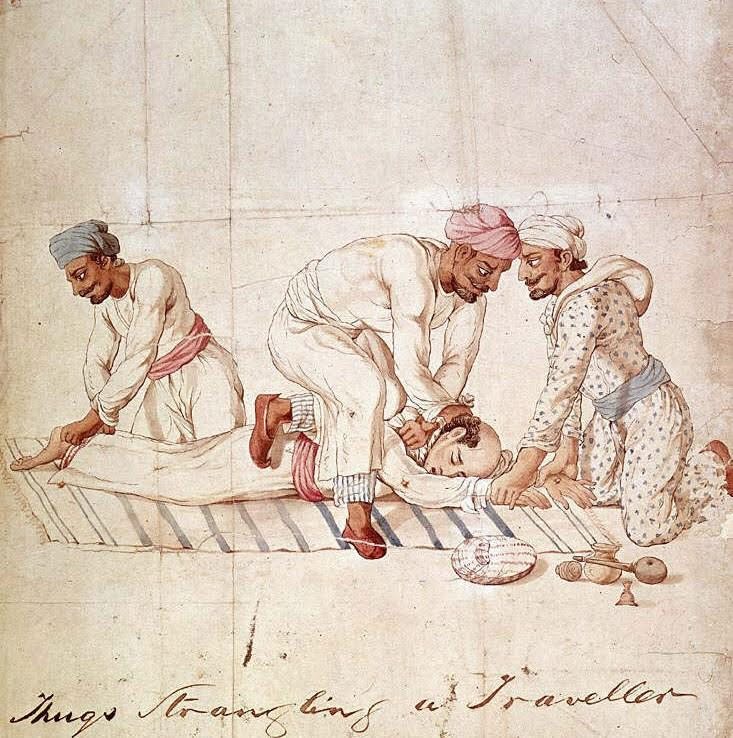
Already Europe had heard with terror of this nation of murderers, a brotherhood with countless members, spread all over Hindustan, honored by the native authorities, rooted in the customs, sanctified by religion, and built on systematic principles. But one had hitherto obtained only incomplete and fragmentary reports of it. The organization of that society, dedicated to the extermination of mankind, has finally become known, thanks to the efforts of Lord William Bentinck, Governor of the English territories in India, and there is no longer any doubt as to its existence, branches, and deep-rooted foundations in the customs of the country. The proofs are numerous, and the incentives for its action are publicly known.
From Cape Comorin to the mountains of the Himalaya, a large association on land, in forests, villages and cities, reaching the most prominent citizens, subject to strict, customary laws, has no other means of livelihood, no other fame, no other recognized purpose, no other religion, than murder. They kill without hesitation, without remorse, according to a certain reasoned system. The murderers, or thugs (1) are not only priests, but also artists; they strangle the traveler in a regular, considered manner; there is solemnity, discretion, dignity, a sense of duty among this hellish sect, which has flourished peacefully among the Hindus, the Mahomedans and the English. These devils delude themselves to be angels; they die quietly and proudly; they sleep in peace; when the British court lays hands on them, they show themselves unashamed, and go to their deaths without disgrace. They openly develop the doctrines of their caste, claim the excellence of it, and attribute the most hideous acts to a higher, divine necessity, of which they are but the praiseworthy executors.
(1) This word, of Indian origin, actually means seducer
The religious ideology, from which the ancient civilization of India flowed, is the unlimited assembly of all that is power, ability, inclination. English and German scholars have exhausted themselves to bring the widely scattered and countless branches of Indian mythology to an impossible unity; but India possesses not one mythology, it possesses a thousand. Alongside the power of creation represented and offered in Vishnu, one finds the power of destruction, which also has its altars. Shiva isn’t it, destruction; consequently, death. Shiva is the devouring fire, necessary no doubt but terrible in its igniting life at the torch of death. Enter into the Shivaitic myths; read its odes, its hymns, its sacred lore, you will find nothing there that hints at the patriarch-like simplicity, nothing of the pure contemplation, nothing of the higher exaltation that imbues the other Vedas.
Devi is the wife of Shiva. In her is worshiped the cruel instinct, the ferocity of Shiva, to her service is devoted, as we shall see, the sect of systematic murderers called thugs. All the interrogated thugs caught by the English authorities give the most precise clarifications. Every murder they commit is, in their eyes, a religious act—the book of law, which contains the precepts of thuggism, is recognized by them as sacred. It is impossible to erase the fundamentals of doctrine, prescribed by Devi, from the heart of the thugs. “I have known some,” says Captain Sleeman, "who spent twelve years together with the Europeans; they knew English perfectly; they remained convinced of the divine origin of thuggism. Those whom we held captive at Joubelpore belonged to all the provinces of India: there were from the Carnatic, from the riverbanks of the Indus and from those of the Ganges; they spoke of their sacred activities, as a priest of Jupiter or Saturn would have spoken of the oxen and heifers slaughtered at the altars of his God.
The thug despises the murderer, who, having committed the murder not according to the rules, without consideration of the prescribed instructions and oracles of Devi, deserves death.
“So you believe,” a judge asked the thug Saïb, "that a man who commits murder, without conforming to the omens and regulations, is punished in this world and the next? -- Severely punished; the lineage of the murderer perishes; his name even disappears from the earth. The thug, who kills without the ceremonies, loses the children he has; God gives him no other. -- And respecting the ceremonies, he fears nothing? -- Never. -- And the ghosts of those you kill do not come to pursue you during your sleep? -- No, this is impossible! cried another thug named Nazir. -- It is said, that the ghosts of the murdered come to the bed of the murderers? -- This is true, a murderer is always haunted by the ghosts. He sometimes has fifty of them on his trail. -- And you escape this punishment? -- Without a doubt! Those, who die by our noose, are not killed by us, but by Devi.
In vain one reasons against such a delusion, which has passed into the life of an entire people. All that those people respect, all their ideas of morality and religion are mixed with their thoughts of murder and destruction. Eight or ten thousand people, who consider themselves saints, think only of strangulation! To find a good victim, a well-filled purse, and send a soul to heaven, such is their dream, which they too often realize. Gangs of thugs, from 50 to 100 persons, traverse India in all directions, and sometimes slaughter about thirty sacrifices in one single evening. In a country, where the roads are hardly paved and the cities have few trade relations with each other, one considers it good fortune, to be able to travel in caravans to some destination. One usually carries a lot of gold or silver; the traveler leaves before dawn in order to avoid the great heat: no inns; one rests under a tree, in a valley with lots of shade; one prepares one’s own food and sleeps. Every one gladly meets another traveler, a companion in the midst of the wild peaks, the solitary plains or forests that one has to traverse. One particularly likes to join a caravan, and often it consists only of killers. All these circumstances contributed to developing thuggism, and made this great establishment of murder indeed terrible. It loses itself in the night of antiquity; it is worshipped!
----------------------------------------------------11.5.1837----------------------------------------------------
Thus, all natural feelings corrupt and numb; all notions of humanity. One has appalling examples of this hardening. Neuouallsing, djemadar, or colonel in the service of the Nizam, an honorable man, and mutilated in one arm, which therefore (according to the thugs of the south) should be spared by the assassins, had the misfortune to fall into the hands of the thugs of the north. The question whether he would be killed was hotly disputed, in the bosom of the society itself, part of which insisted on the fulfillment of ancient traditions. While traveling, some members of the caravan quarreled with the toll officials; others were arrested as arsonists, others again as thieves, indeed they illegally traded in silk. The djemadar took them into his protection. His two young daughters, one aged twelve, the other thirteen (an age equivalent to 21 years among us), when the officials came to examine the bales, had sat down on the bags of illegal silk belonging to the thugs. However, when these were caught and thrown into prison, the djemadar vouched for them. Showered with his favors, saved by him, they traveled with him and his daughters two hundred English miles away, and argued among themselves only one point, not whether gratitude forbade them to shorten his days, but “whether Devi permitted them to kill a maimed one.” The unfortunate Djemadar was strangled along with his daughters.
We do not wish to tire our readers further with the recounting of such sad and horrible scenes, and the ceaseless treachery of these learned murderers. Often, above the very corpse of the murdered parents, they adopt their children to raise them according to the teachings of their caste. If those children scream enough to make them a threat, they kill them, one of these poor little ones was buried alive by the chief Gaauboukhat with his father and his mother. Sometimes, too, the thugs of the north spared the girls and women, which they assign to themselves or their sons to be husbands.
The apprenticeship of the thugs was systematically arranged. The newcomers are called Kuboula's: these are not yet initiated into the secrets of the enterprise. It is the duty of a Bourka to train and instruct those who seem suitable for the brotherhood. One reaches the rank of Bourka only step by step. First you are used as a spy, you are sent on reconnaissance; then you become a gravedigger, then Choumsie or “holder of hands and feet during strangulation,” and finally Bourthod or strangler. The newcomer, wanting to become Bourthod, puts himself under the special guidance of an old thug who then becomes his Gourou, teacher, and takes him on as Cheyla, apprentice. To practice one uses travelers whose appearance does not indicate much strength, and from whom one therefore does not expect much resistance. A divining sign decides whether the traveler will be killed; a second, whether the new initiate will be the sacrificer.
Among the main divining signs one counts the Bouraôk or the oracle of the wolves, the Tehirrayak or the oracle of the owl, Douhie, the oracle of the hare; finally the Dounteroue, the oracle of the donkey. The howling or complaining of the wolf Tchimmama is enough to make the Thug abandon a venture. “The cry of the hare, is of great value,” said a Thug; “when the General Doveton was pursuing us, a hare ran ahead of us across the road. The animal screamed, we neglected the oracle, and the next day 17 of us were captured.”
But above all oracles, they set that of the donkey. Soupoukhero ekadounrou, pouuterou, “a donkey, as far as the oracle is concerned,” they say, “is worth a thousand birds.” Captain Sleeman, who has made himself a dictionary of the Thugs’ language, and who has had all the oracles given up by the prisoners' heads, confirms the high value which the Thugs of the north and of the south place on divination. “On May 30, 1835,” he says, "I gathered together twelve heads from Hyderabad, Behar, Aoude, Douah, Rajpoutana and Bauudelcound; I made them look over all the words of my dictionary. They acknowledged that they were correct, and that the art of divination decided everything. As long as we observed them faithfully, none of us perished. Our families flourished. From generation to generation, we remained free from the curse that rests on murderers. Always Devi surrounded us with signs, clearly predicting danger or victory, booty or death; but our religious fervor waned, and the Goddess decided our fall.
----------------------------------------------------30.5.1837----------------------------------------------------
This life of laziness and enterprise, of travel and rest, of pleasures and adventures, exerts a true magic power on them; there is no example of a thug who has abandoned his enterprise: he esteems it, he honors it. Those, who escape the vengeance of the laws, soon, after having seen their comrades hanged, resume their cherished activities.
One meets thugs on all roads and under all disguises; in the garb of Sepoys, as pilgrims, as merchants, or as princes, with numerous retinues. Their gangs unite at times and form armies of three or four hundred, sometimes of a thousand men. When danger approaches and they know that they are being pursued, they divide and scatter far and wide, only to find each other again at well-defined meeting points.
The thuggism, however, diminishes noticeably. "How could it sustain itself? Said Dourga. The English drums chase away the deities and the evil spirits."
However, it makes much difference that all the rajahs of India, would have lost their ancient reverence for the formidable Devi. In 1834, Maon Singh, rajah of Joudpore, offered sanctuary to all the thugs, and he refused to extradite those who were holding up in his states to the Governor-General. It was necessary, that Lord William Bentinck had an army sent out, and threatened him with violence.
It is difficult to explain the indifference which a brotherhood of that kind instills in the upper classes and particularly in the rajahs. The thugs impose their blood tithe only on the traveler and the merchant, the Indian officer and the artisan, in a word, on the bulk of the people; they are little to be feared by the English authorities, who never travel but with an armed escort. The eradication of thuggism having to contend with national unwieldiness, with religious prejudice and the nature of the country, is a slow and difficult work, which deserves all the more praise if it finds cooperation. One cannot attribute too much esteem and gratitude to so thorny an endeavor: to appreciate all its merits, it must be remembered that in India human life is held in low esteem; a murderer has scarcely any prosecution to fear; the natural customs of man to man are almost unknown. The feelings of humanness are confined to the circle of the household, or at least do not go beyond the boundaries of caste. No one cares if a traveler or a caravan of travelers is killed. In the province of Aoude the farmers find freshly murdered corpses in the wells every day; they are used to it and do not pay the slightest attention to it.
Time confirmed that societal condition without bond that family mores without fatherland, that institution of caste without civil relations. Gifted with a remarkable obedience, a great gentleness, a far-reaching cleverness, an ancient respect for decency and established laws, the Indian lives on, without suspecting the possibility of another social condition, than that in which he leads his plantlike life. National dignity, civic duty, so highly esteemed with us, is entirely unknown in those countries. There man lies kneeling before the altar of his gods, shackled in the precepts and formalities of his caste to which he alone attaches value, and which constitute the whole of his moral existence. The reform of education, and that of the religious system, the mingling of the European races with the Hindu and Muslim, must therefore be the only means not only of eradicating thuggism, but also of curing the other endemic diseases, which for centuries have been consuming that ancient and degenerate nature. Already the school of Houghly has admitted fourteen hundred Indians; of that number eleven hundred are devoted to the English language. No doubt this source of new knowledge, working its way into Indian society, will bring about a considerable improvement.
- Annotations
-
- This is a translation of an article titled “De thugs, eene sekte van moordenaars, in Indië” (The thugs, a sect of murderers, in India), which was published in three parts in the Dutch regional newspaper Vlissingsche Courant, on May 4th, May 11th and May 30th. The article is not original to the Vlissingsche Courant; it was also published from April 25th, 1837, onwards in the Arnhemsche Courant, which suggests that the article might have been widely spread among Dutch regional newspapers in these months.
- The author writes about the so-called ‘thugs’, who allegedly were part of a religiously motivated criminal collective, known for their specific modus operandi. According to (often British) colonial sources, they deceived, strangled, and robbed unsuspecting travelers on desolate travel routes, thereby following divine instructions from Kali. Systematic persecution and suppression of the thugs came about in the 1830s, resulting in the creation of the Thuggee and Dacoity Department, led by General William Henry Sleeman (1788-1856). In 1839, he declared that thuggee as an organized system had been effectively eradicated.
- In addition to the first annotation, it is worth mentioning that the contents of this article are often directly taken from W.H. Sleeman’s book Ramaseeana (1836), which illustrates the popularity of the book, and the perceived authority of Sleeman on the matter. The conversation between Sleeman and the thugs Saïb and Nazir (Sahib and Nasir in Ramaseeana), as well as the story about the hare crossing the road, are taken from the first pages of Sleeman’s chapter “Conversations”. The comparison with priests of Jupiter and Saturn, too, is taken from pages 7-8 in the book. More examples can be found.
- All emphases in the text (by use of italics) are preserved from the original text. I have not added nor removed any emphases. As the reader will undoubtedly notice, there are many inconsistencies as to when the author uses italics, but the emphases used in this translation are true to the original Dutch article. The same goes for (the inconsistent) capitalization of certain words. Finally, the annotation used in the second paragraph, is also a preservation of the original.
- Complete title
- De thugs, eene sekte van moordenaars, in Indië
- Author details
- Anonymous
- Date of publication
- 4.5.1837, 11.5.1837 and 30.5.1837
- Dates of travelling
- -
- Publisher
- Vlissingsche Courant
- Place of publication
- Vlissingen
- Archival source or library
- Delpher
- Locations in India
- Cape Comorin, Himalaya, Jabalpur [Joubelpore], Carnatic, Hyderabad, [Aoude], [Douah], Rajputana, Bundelkhand [Bandelcound], Jodhpur [Joudpore]
- Keywords
- Thug, Thuggee, Thuggism, Devi, Shiva, Vishnu, Hindu, Sleeman, Bentinck, Sect, Cult, Crime, Divination
- Translator and copyright
- Jaro Demetter, April 2025
- Media
 unnamed.jpg