
‘Op bezoek bij een Indisch Zamindar’ (‘Visiting an Indian Zamindar’)
Item
- Item Number
- 29
- Title
- ‘Op bezoek bij een Indisch Zamindar’ (‘Visiting an Indian Zamindar’)
- Author
- Aster Berkhof
- Date
- 12.02.1956
- Country / region
- The Belgian Congo
- Source language
- Dutch
- Time period
- 1940-1960
- Description
- A Belgian newspaper article from the 1950s reporting a visit to an Indian zamindar or landowner. It is part of an extensive series of articles, published in a colonial newspaper and written by the author Aster Berkhof who would become well-known in the subsequent decades. Like the other articles, this piece reveals much about its author’s attitudes towards a society and culture foreign to him.
- Translated text
-
Visiting an Indian zamindar; usurers and large landowners; living in tasteless castles, while the tenant farmers starve
Wandering through the tropical jungle on foot is exhausting. Above the vast, gray-green wilderness, which stretches from horizon to horizon in jagged rows of hills, stands the white-glazed Indian sun. It is hot and dusty, the paths are so dry that the sand under your sandals kicks up in reddish-gray clouds. That reddish-gray dust lies on the bushes, on the trees, on the huts scattered here and there among the bushes, on the filthy little temple, where, in a smell of incense, sandalwood, curry, and urine, poor pilgrims sit in the sand. The scorched greenery around you is full of chirping and rustling, you hear strange birds calling, vultures and ravens circling above you, the whole sky is filled with the thin buzzing of millions of insects, the brown-burnt grass trembles, wherein snakes fly away like lightning.
That thin, obsessive noise torments your nerves and the heat tortures you. There is nowhere to hide: even in the shade, the air is as hot as an oven. Your sweat immediately evaporates on your hot skin, you dry out, your mouth is parched and hard, your throat becomes hoarse and that heat weighs heavily, very heavily. You long to lie down and sleep, to sink into a bottomless depth, to know nothing more, to cease to exist. You drag yourself along, weighed down by a lethargy unknown in cool Europe. There! At last! On a bare, gray, withered hill stands the house I had despaired of finding for an hour.
A large stone house, in the middle of the desolate, scorching heat of the wilderness. It is large and unsightly. In this wilderness, it looks like a haunted house, the dwelling place of a ghost.
The facade was adorned with balconies and columns, there was a magnificent bronze door, a large church portal, and on the left a round, crenellated tower with murder holes. The whole thing was a grotesque combination of a Victorian palace and a Norman castle, designed by an architect with terrible taste and built by local masons.
On the steps decorated with bluestone balustrades stood a fat man wearing a white European shirt and underneath it a huge, shapeless dhoti hanging between his legs.
(…)
When I arrived on the steps with the boy who accompanied me on my wanderings through the jungle, exhausted by heat, thirst, and fatigue, he called out in English:
“Hey! What's New York doing in this godforsaken wilderness?”
He shook my hand and asked generously, “Is it New York? Or Los Angeles? Or Texas?”
He laughed boisterously. I said hoarsely that I lived in Antwerp.
“Antwerp? Where is that?”
“Near Brussels.”
His eyes looked at me questioningly.
“Belgium,” I added.
“Oh yes! Of course!” he beamed. Curious, somewhat doubtful, he asked: “Belgium is more in the west of the United States, is it not?”
Exhausted, knowing that in Asia it is completely useless to try to pass for anything other than an American when you have short blond hair, I said, “If you travel west from New York long enough and veer slightly north along the way, you will eventually end up in Belgium.”
“Exactly!” the man exclaimed exuberantly. “And I know what you're doing here: you let the train run in the distance to take pictures in the jungle, you're dying of thirst, and you came to me for something to drink that isn't full of bacteria. Right?”
“Do you have a Coca-Cola?” I asked imploringly. I had run out of oranges, peppermints, and the nuts that the boy kept bringing from the jungle had started to make me queasy.
“A whole refrigerator full!” the man exclaimed. “Come on in!”
I could have embraced the fat man, although, Coca-Cola aside, I had little reason to, for this was the zamindar, the usurer to whom all the farmers in the surrounding area were indebted, the man who had driven the old farmer I told you about to commit a horrific suicide and whom I would have loved to throw headfirst down the steps with his flabby face.
The white woman
I have never seen a more terrible interior in my life than this man's. It looked like an antique shop. Furniture of all styles was scattered everywhere, pushed together and piled on top of each other. Now you had to squeeze your way through. On the walls, next to two or three decent paintings, hung a whole series of horrible copies of European masterpieces, square meters of terrifying canvases. In the salon, three colossal chandeliers hung side by side with enough lamps to light a cinema. There was a Breton fireplace and in front of it a small open space where, despite the countless visibly unused sofas, we sat down on cushions on the floor.
“What do you think of my furniture?” the man asked proudly. “I love beautiful things! All style, real antiques! Extremely expensive!”
(…)
The man introduced me to his daughters, two tall, thin girls who looked so English that the man must have had a white wife.
“My wife is British,” the man said proudly.
“Did you meet her in London?” I asked from a distant place.
“Er... no...” said the man, somewhat nervously. “My wife,” he added with unnatural cheerfulness, “was an artist. She was in the theater in Delhi.”
Oh dear, I knew that type: third-rate cabaret girls who were no longer wanted in Europe and who came to India to perform indecent shows for hungry-eyed Indians in a dingy, dimly lit restaurant on the first floor.
“Is the lady in Europe now?” I asked as politely as I could.
“Yes, in Cannes,” the man said proudly. “I send her there when the hot season starts here.”
He hadn't sent her there. She had gone, and he would never see her again. The women from those cabarets stayed until they caught a rich Indian who wanted to show off that he had a white woman, and then they took his money and moved to the Côte d'Azur. The man usually didn't care that they didn't come back; he had his white woman, and the Hindu religion allowed him to have other Indian women.
To appear modern, the man kept his daughters there and constantly involved them in the conversation. I noticed that the girls were annoyed by their father's exuberance and vanity. He said that he would move to England with his daughters in a few years. “That's where they belong, isn't it? Look how light their skin is! Mine is light too, isn't it? People say I could be Italian. Right?”
“Yes, indeed,” I said reluctantly.
If he did what he said, he would return defeated a few years later. His skin was indeed light, but no one would mistake him for an Italian, and Indian mixed-race girls were not welcomed as “homecomers” in England. We will have to return to that painful problem of the “Anglo-Indian.” What struck me everywhere was that when the British were still in India, they were hated and it was considered inappropriate to imitate them. But now that they were gone, everyone made every effort to resemble them. They spoke like them, moved stiffly and awkwardly like them, drank their gin and scotch, patted their friends cordially on the shoulder, called them “old boy” and said goodbye with a lighthearted “bye-bye.”
(…)
So innocent!
The man sitting opposite me, fat and beaming, belonged to the zamindars. I asked him how big his estate was.
“Oh, but I don't have an estate,” he said, surprised. “I'm a businessman.”
He shifted back and forth a few times on his cushion and said it was roughly like our banks. He provided money for the farmers in the region. They didn't know what to do with it, so he collected it and made sure it yielded a profit for them.
If I hadn't been so tired, I would have burst out laughing. The man could see from my face that something was wrong.
“Yes, yes, yes,” he said, "that's how it is. Oh, I know, our farmers are very poor and I often have to advance them money, but I do so at a reasonable interest rate. There is a law, you see, that sets a maximum interest rate. During the British era, we mustn't hide it, there were abuses, but now it's different. India now takes care of itself, and we all need to work together."
He jumped on that interest rate so quickly – without me even asking – that it would even have been obvious to a child that, despite the law that was indeed on paper, there was definitely something fishy about that interest rate. On top of that, I was annoyed by his attempt to blame the British for everything. Certainly, Britain's policy in India has not been a fortunate one. Their goal was to collect taxes without shock or resistance and to govern without disturbance. They probably did not foresee that the means they used to achieve this would have such dramatic consequences. But not all the blame can be placed on the British, because many people who currently hold leading positions in free India are worse than the British, and I cannot tolerate the malicious gossip about England that they constantly babble on about.
The man continued, somewhat bitterly: "In all states of the Indian Union, attempts are being made to pass laws to destroy the rights of the zamindars and the ryots. But that is foolish! Our farmers cannot do it alone. Nehru keeps asking India to produce more food, but how can our people do that! They know nothing, they cling to ancient working methods, they squander their money on jewelry. I advise my people, tell them which seeds to choose, how to plant rice, how to improve their soil through fertilization. I have had a project drawn up for a road that cuts through this jungle. I have bought two breeding bulls to improve their cattle. I have instructed my advisor in Delhi to recruit an expert to study the drilling of wells in this region. I am raising funds to establish three schools. It will be difficult to attract teachers here, but I am making an effort. Isn't that right? You in America also have large agricultural estates. Everyone says that the future of agriculture lies in large estates, right?
I ask my readers to bear all these things in mind for a moment (…) When I got up, the man insisted excitedly that I stay for dinner, his daughters would play the piano, they had had a private teacher in Calcutta. No, boss, no, I needed your Coca-Cola, I also like your rice and curry, but yours would make me vomit.
(…)
The other side of the coin
Now I must recount a conversation I had a few days later with a trade union propagandist who was touring the state of Bihar and whom I met in Jamshedpur, the Indian industrial city. He knew the zamindar in question. He did not laugh when I told him what he had said to me. He said gloomily:
“They are rich, those zamindars, but most of them are also stupid, so stupid that they make themselves ridiculous.”
“How far has the anti-zamindari legislation progressed?”
“Very far and not far at all,” said the man. "Delhi takes little interest in such domestic affairs. You know that India is a confederation of states; foreign policy, national defense, and finances are Delhi's business, while everything else is practically left to the local parliaments. They make laws against the zamindars. Assam has them, as do our Bihar, Bombay, Madhya Pradesh, Madras, Orissa, Mysore, Saurashtra; you find something almost everywhere, but in India it is a long way from a law to its implementation. The big problem is this: it is absolutely necessary to take the land away from the big lords; our farmers cannot live properly on one hectare and the land will never feed itself abundantly unless large-scale irrigation and soil improvement are carried out. But India does not like violence. It refuses to put the zamindars out on the street. It asks for their land, but it wants to buy that land. There is no agreement on the amount of compensation. The zamindars and ryots know this, and they are using all the influence they have to delay discussions on the matter.
(…)
“Are there states where the land has been taken from the landowners without paying them compensation?”
“Yes, two: Jammu and Kashmir, which do not yet officially belong to the Indian Union. In all the others, it is a painful problem, doubly painful because the zamindars and ryots everywhere are opposed to it. They do not want to be expropriated; they want to continue living as they did before. Now, apart from the cotton kings of Bombay and the steel magnates of Jamshedpur, they are the only people in India who have money, so they are automatically the only ones who have influence in Delhi. Just imagine: most of the people who are in politics and have to vote on the anti-zamindari laws are zamindars themselves! You understand that this is a difficult situation. Eventually, they will have to vote on the law, but then they will have to enforce it! Most of those who are responsible for this are also zamindars, or have zamindars as family members and friends."
The immeasurably long road
Isn't it painful? India is almost purely agricultural, it is the world's second largest producer of rice, jute, tobacco, and cotton, and the largest producer of tea and peanuts, and yet it is starving. The proceeds from this fabulous agricultural reserve go into the pockets of a few, and those few have the power to keep things as they are.
What is being done about it? First and foremost, irrigation. One of the information brochures I was given in Delhi states that the great Indian rivers carry enough water from the Himalayas to the sea each year to flood the whole of India by more than half a meter. Since time immemorial, India has been trying to make good use of that water. The British deserve credit for having built several very important irrigation systems in India. Now the method of channeling water from the rivers to the fields is almost exhausted. What India can still do is store the water that falls during the rainy season in large reservoirs and use it during the dry season. With this in mind, huge dams are currently being built, several of which have already been completed or are nearing completion (…) This irrigation project in India is truly impressive. But equally impressive, in a somber way, is the length of the road still to be traveled. In the past, India used about 5% of the water that flowed through India. When all the dams are completed, it will still use no more than 14% of that water (…).
I also had to think about the cows. For Hindus, cows are sacred animals that they are not allowed to kill. India has 155 million cattle, skinny, skeletal animals that roam around hungry, in the jungle, in the cities, looking for food, the food that people need. Exhausted by hunger and disease, this monstrous herd, which I am told is the largest in the world, produces only one-tenth of the milk it would normally produce in Europe. In the best countries, such as Switzerland, a cow produces thirty times as much milk per year as in India. Now India is focusing on what are called “key villages,” centers through which the government provides farmers with healthy bulls to improve and strengthen the cattle breed. I read a lyrical article in a newspaper in Bombay, which joyfully announced that there were already 350 such key villages. It is something, certainly, it is quite a lot, but there are more than 500,000 villages in India...
(…)
With their back against the cart
The union representative grimaced bitterly as he said:
"As a union propagandist, it is not my place to praise our government, but I will do so anyway. People are working hard, very hard, but we are still so far from home. And what makes me furious,” he said through clenched teeth, “is that those who could bring about improvement: the rich, the only ones who are more or less educated, refuse to cooperate. On the contrary, they stand with their backs against the cart. The zamindar told you that he has a project for a road through the Bihar jungle. Well, that's a lie. The government has that project, but he is doing everything he can to thwart it."
“Why is he doing that?”
"Where there is a road, people come. People have eyes. Eyes see what he is doing. He does not want those eyes. The man spoke of two breeding bulls, yes, they will come, but not for the farmers' cattle, but for the cattle he has taken from the farmers. If the farmers want to use those bulls, they will pay an outrageous price for them. He has spoken of an expert who is to come and see if wells can be dug. That expert will probably come, but he did not ask him; we asked him, and he has done everything he can to keep him away. The farmers must not be allowed to have water, because then they will harvest more, be able to pay off their debts, and no longer be dependent on him. He won't be able to stop us digging the wells, because our people do that themselves, but the pumps have to come from Delhi, and if he puts his big hand in the way, they'll be a long time coming."
“And the schools?”
“Ha, the schools,” said the man grimly. "We have been working for years to get them, but I say again: we, because he, the zamindar, is to blame for the fact that we have not yet got them. You understand why: if the schools come, our people will learn to read and write, newspapers will come to the villages, and letters will leave those villages. That puts him in danger. The jungle must remain isolated so that he can rule over it."
“There was some truth in his views, that the future of India cannot lie in fragmented lands.”
“Certainly! Certainly!” said the man. “A large estate can yield more than the same area divided into hundreds of small plots. But then that estate must be run as an estate; there must be management, a production plan, a unified irrigation system, tractors to turn the soil, fertilizer to enrich it.”
“None of that exists?”
"None of that exists! The zamindar's estates are not estates. There is no management, no production plan, no fertilizer, no tractor. And that is intentional! The estate must remain composed of small separate plots, so that the people who work on them remain small, isolated starving peasants. What he says about the large agricultural operations that exist in the United States and the Soviet Union is pure deception. The Indian estates have nothing in common with them. Delhi knows this and is working on it: it recommends not only setting a ceiling for large estates, but also a floor, if I may say so, for small properties. Laws stipulate that a piece of land of such and such a size – the figure varies from state to state – may not be further divided among the children. The existing small plots of land are now being grouped into cooperatives, without infringing on property rights, whereby the farmers, supported by government subsidies, would purchase agricultural machinery, fertilizers, and selected seeds together. However, all this is happening very slowly: our farmers are not developed enough to see the importance of such initiatives; they cling to their old individual privileges and thus often prevent the emergence of such organizations, which would be very advantageous for them."
(…)
The little boy on the platform
The train that was supposed to take me away from the jungle of Bihar was late. It didn't arrive until after dark. I had waited for hours in the little building on the platform. The little boy had been sitting with me the whole time. When the train finally emerged from the darkness with its headlights glowing, groaning to a halt, and a coolie had carried my suitcases into one of the carriages, the boy also hopped into the carriage and sat down on one of the benches. At first, I didn't realize what he was up to, but he refused the money I offered him and shook his head vigorously when I tried to lead him outside by the arms. A sudden fear gripped my heart.
The boy wanted to come with me! When I picked him up to carry him outside, he struggled and started crying. He was very agile and kept escaping my grip. I was at a loss; there were no other passengers in the compartment, and the gong announcing the train's departure had already sounded. Then the conductor who came to close the doors saw what was going on. He jumped into the compartment, gave the boy a resounding slap, lifted him off the ground, and threw him outside. Over the shoulders of the eagerly bowing man – who apparently wanted money for his work again – I saw the boy fall onto the platform. He scrambled to his feet and rubbed his knees. Then the train departed.
It may sound grotesque, but if I had actually taken all the boys and young men who wanted to come with me from India, I would now be a father with many children.
Oh, let those elegant, eloquent gentlemen from New Delhi, dressed in white tuxedos, hurry up and make sure that the boys in India no longer choose the first stranger they meet over their fathers after a few days and then have to return to the jungle alone with their sadness.
- Annotations
-
- This is a translation of an article titled “Op bezoek bij een Indisch Zamindar” (Visiting an Indian Zamindar), which was published in the Belgian Catholic newspaper De Week voor Belgisch Congo, on February 12, 1956.
- The article is part of a weekly installment which ran from November 1955, to June 1956, wherein the well-known Flemish writer Aster Berkhof (1920-2020; pseudonym for Lodewijk Paulina Van Den Bergh) recounted his trip around Asia, which he undertook in the summer of 1955. A significant part of this series is dedicated to India, on which 14 articles were published in 15 weeks. This is most of article 4/14.
- The series of articles was later compiled in the form of a book titled Haveloos India (“Ragged India”), published in Antwerp in 1960, wherein this article is titled “Op bezoek bij de Zamindar” (pp. 42-58).
- All emphases are original to the text.
- Complete title
- Met Aster Berkhof de wereld rond: op bezoek bij een Indisch Zamindar
- Author details
- Aster Berkhof (1920-2020)
- Date of publication
- 12.02.1956
- Dates of travelling
- 1955
- Publisher
- De Week voor Belgisch Kongo
- Place of publication
- Leopoldstad (Kinshasa)
- Archival source or library
- KBR (Royal Library of Belgium), DIGIT J.B. 1509
- Locations in India
- Bihar, Jamshedpur
- Keywords
- India, Society, Zamindar, Ryot, Ryotwari, Poverty, Landowners, Economy, Five-Year Plans, Jungle
- Translator and copyright
- Jaro Demetter, March 2026
- Media
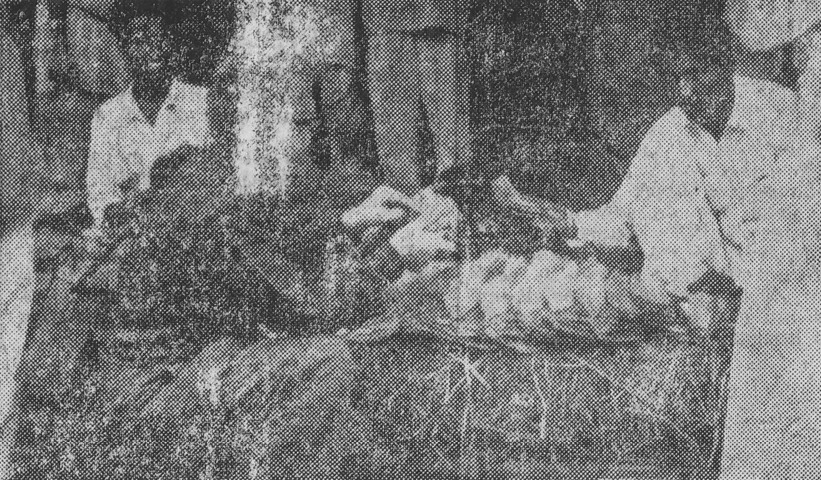
 The writer at an Indian market. The leaves he holds in his hand are filled with pieces of tobacco and spices, then folded and placed in the mouth. People chew and suck on them like they would chew tobacco. The juice from this mixture, called “pan,” is dark red. Anyone who opens their mouth while chewing gives the eerie impression of having a mouth full of blood. Women also chew pan and make sure their teeth turn red, which they consider beautiful. (Why not? Whether you make your lips red or your teeth...)
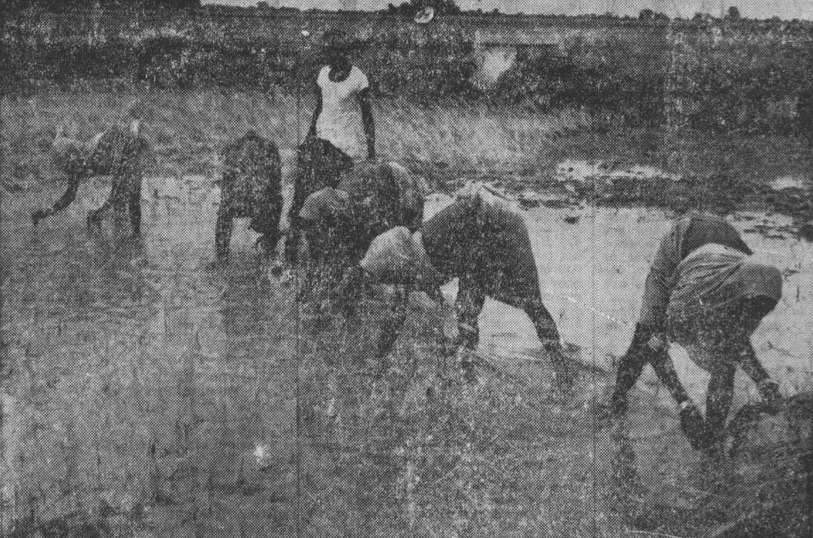
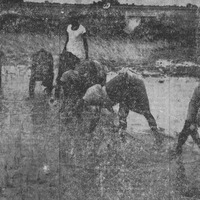 For women in India, there is little joy: living in a hut, managing a large family, and working in the fields all day long.