

The Prologue of Long Nose the necromancer to the comedy ‘Dundo Maroje’
Item
- Item Number
- 34
- Title
- The Prologue of Long Nose the necromancer to the comedy ‘Dundo Maroje’
- Author
- Marin Držić (Marino Darsa)
- Date
- 1551
- Country / region
- Croatia
- Source language
- Croatian
- Time period
- 1540-1560
- Description
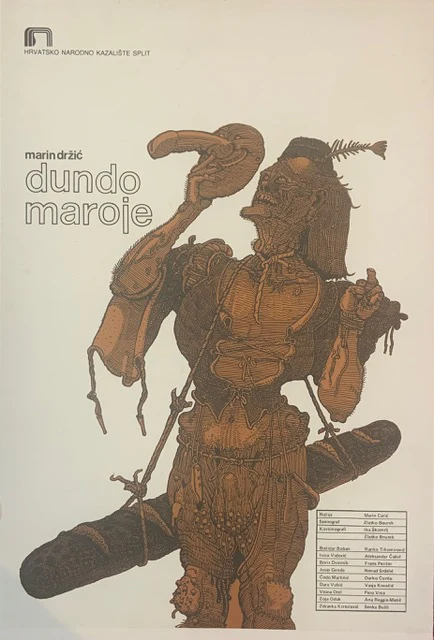
- Long Nose’s Prologue serves as an introduction to the comedy ‘Uncle Maroje’ (Dundo Maroje) by the Dalmatian playwright Marin Držić (Marino Darsa), which was first put on stage at Dubrovnik in 1551. In the prologue India is imagined as a land of magic, that can only be reached through magic. At the same time it is depicted as an earthly paradise, a country of everlasting spring, in which no one ever suffers any hardship, and in which like in so many protosocialist utopias of its time, the words ‘mine’ and ‘yours’ are unknown. Everything is shared with everyone, and all people are equal. This perfect harmony of life is, however, thrown off balance by greedy magicians coming from outside and by the country’s women, who ask the former to bring to life the effigies they brought along. Thus carnivalesque chaos and fun, the essence of comedy, take hold of the earthly paradise.
- Translated text
-
I, Long Nose1, necromancer of the Greater Indies, bid a good day, a peaceful night and a pleasant year to the noble citizens of Dubrovnik, and salute as of old: men and women, old and young, great and small, the people with whom I stand in peace and watch war from afar, the war that is the scourge of human nature. {…} You know that in the three years that I was separated from you, I immediately set off for the Great Indies2, where donkeys, herons, frogs and monkeys speak each in their language. From there I turned my course to the Lesser Indies3, where human effigies4 and little men wage war with cranes. From there I stretched my legs towards the New Indies5, where they say dogs are led on leashes made of sausages, and that children play with golden marbles on their laps, where the frogs' croaking on the stage was as familiar as the song of warblers among us. Into the Old Indies6 I then sought to press on, but I was told that further progress was no longer possible. They said that the Old Indies lay there, and that no one could go into the Old Indies, saying: ‘In the way stood an icy sea, which cannot be sailed, and a fierce, eternal winter, which turns the flesh of living men to ice’7; and on the other side they said that a blazing sun and a scorching summer, with days without night, not only would not allow a living man to approach, but would not let the land bear fruit from the heat. And they said to me: ‘Only by necromancy can one pass into these parts.’ When I heard this, I opened my book of necromancy—what else could I do? In a trice, I found myself in the Old Indies.
There I found true life, a joyful and sweet season of spring, where the cold winter does not trouble it, and where the rose and various flowers are not scorched by the blazing summer, and where the sun, from the east, leads a tranquil day, from dawn to sunrise and from sunrise to dawn; and the bright morning star does not hide as it does here among you, but at every moment its shining face on the white window proclaims itself; and the dawn, which is adorned with crimson and white roses, does not leave the sight of those who gaze upon it; and the sweet murmur of various birds from every side brings eternal joy. I must also not forget to mention the clear, cold waters, flowing from every side, that give eternal nourishment to the green grass and the dense woods; and the rich fields do not fence in the sweet, beautiful, ripe fruit with thorns, nor do they selfishly withhold it from people, but stand open to all.
There the names “mine” and “thine” are unknown; all is common to all, and each is lord of all. And the people who enjoy these lands are gentle, peaceful, wise, and reasonable. Nature, having adorned them with wisdom, has also refined them with beauty: all are raised together; they are not troubled by malice, nor is their life ruled by greed; their eyes look straight ahead, and their hearts do not deceive; they wear their hearts on their sleeves, so that everyone may see their good thoughts; and, to spare you from my lengthy discourse, they are people who truly deserve to be called human.8
And to tell you all that I saw, and so that you may understand me better, I saw in those parts, in a great, tall and splendidly adorned building, an inscription and little figures very finely made of stone, with features of monkeys, of parrots, of bearded puppets9 and of hunch-backs; people with heron's legs, frog-like in build; jesters, gluttons, actors, scum of the common folk. I asked who these figures were and what such coarseness, such utter disregard for human countenances, could mean. They told me that necromancers in ancient times, like me, by necromancy coming to their lands and bringing diverse wares to carry away gold from there, for great gold is found in the rivers there, they brought amongst other things hunch-backs, dwarves, bearded puppets made of wood with faces of parrots, of monkeys, of frogs, of asses, of goats and of every kind.
And the women from those parts – like our own, who are quicker-witted than men – on seeing those faces began to laugh as if at something they had never seen before, and said, ‘You'd be in for a laugh if these people could walk and talk!’ And they said to the necromancer: ‘You are necromancers; if you want to take away this gold, by your necromancy make these little men live again, and let them begin to walk and speak, for then they would be truly funny, and as dead men they are of no use.’ The necromancers, for the sake of the gold, gave spirit to hunch-backs, dwarves, bearded puppets in the likeness of parrots, monkeys, frogs, asses and goats, and to such like creatures. These little folk, having been given a spirit, began to walk, to speak and to perform jests in such a way that no feast or revel was ever held where they were not invited. {…}.
- Annotations
-
- 1: The necromancer’s Croatian name Dugi nos translates as ‘long nose’, identifying the necromancer as a fool, jester or trickster. A necromancer is commonly understood as a person that practices magic by way of communication with the dead. In the present case, the term seems to refer more generally to a magician.
- 2-3: In accordance with medieval practice the geographic denominators ‘great’ and ‘little’ indicate the relative geographical proximity of the region in question in relation to the location of the region of the readership being addressed. Thus Croatian Indija velicijeh ‘Great India’ would refer to the more remote region of Hindustan whereas Indija malijeh ‘Little India’ should be identified with the area that corresponds to modern Pakistan, roughly speaking.
- 4: In the Croatian original pigmaleoni, i.e. ‘Pygmalions’ in reference to the Greek myth of Pygmalion who fell in love with a perfect effigy of a woman, he had himself created. This classical story by Ovid has an intriguing parallel in the Buddhist tradition of the Puṇyavantajātaka, as it has come down to us in a Tocharian rendering (see Nina Beguš, “The Typology of the Pygmalion Paradigm.” In Gianna Zocco (ed.), The Rhetoric of Topic and Form, vol. 4, 319-330. Berlin-Boston: De Gruyter). We doubt, hoever, that Marin Držić, writing in the 16th century could have been aware of this parallel. It cannot be excluded that an additional reference to pygmies is also intended, which would fit the repeated reference to dwarves. The reference to Pygmalion is taken up and further elaborated in Dugi nos’ account of the necromancers giving life to effigies of animals of all kinds. The Pygmalion motive addresses general questions about the relationship between mind and matter, material object and subjective self. Within the context of the comedy it may also be expected to refer – as did Ovid – to the act of creating life out of poetry.
- 5-6: The New Indies ought, of course, to be identified with the Americas. The exact reference oft he Old Indies is n ot entirely clear. It seems not to be identical with the Great and Little India mentioned above (note 2-3).
- 7: The idea of humankind being separated by an enormous sea or ocean is reminiscent of the notion of the antipodes that are separated from us by an impassable ocean.
- 8: Držić’ description of India as an earthly paradise is founded on medieval notions of India, and is in line with Thomas Morus’ locating his Utopia of 1516 in the vicinity of India. In more recent times, the literary sujet of an earthly paradise in India, or for that Tibet, has been made into a novel by James Hilton, viz. Lost Horizon (1933), the plot of which unfolds at the mystical place Shangri-la in the Kunlun mountains of Tibet.
- 9: In the Croatian Original barbaćep , i.e. ‘a wooden puppet with a long beard, dressed in black, once a demonic creature, a monster with a large human beard’.
- Complete title
- Novela od Stanca Tirena. Skup. Dundo Maroje
- Author details
- Marin Držić, 1508-1567
- Date of publication
- 1962
- Dates of travelling
- n.a.
- Publisher
- Matica hrvatska
- Place of publication
- Zagreb
- Archival source or library
- n.a.
- Locations in India
- n.a.
- Keywords
- necromancy, utopia, magic, women
- Translator and copyright
- Dieter Stern (Croatian to English; June 2026)
- Media
 image2.png