Fleeting Images from India
Item
- Item Number
- 34
- Title
- Fleeting Images from India
- Author
- Josip Suchy
- Date
- 1934
- Country / region
- Yugoslavia
- Source language
- Slovenian
- Themes
- Europeans in India
- British India
- Hinduism and Hindus
- Islam and Muslims
- Jains and Jainism
- Parsi
- Language
- Race
- Caste
- Religion
- Stereotypes
- Women
- Art and architecture
- Description
- This is a diplomat-researcher’s account of the first impressions of India upon landing in Bombay in the 1930s. This is a diplomat-researcher’s account of their first impressions of India upon landing in Bombay in the 1930s. These chapters form part of the first secular, book-length, personal account of the subcontinent to be published by a Slovenian. Teeming with ‘facts’ and impressions related in rich, poetic language, the following excerpts reveal a mind at work that strives to make sense of things against all odds. The voice tends towards all-knowingness and the tone is a mixture of surprise, indignation, derision and, occasionally, admiration and joy.
- Translated text
-
Bombay
The last night on the steamboat! I had barely fallen asleep when I was awakened by the nervous wandering and clattering of passengers, the slamming of doors, and the creaking of stairs as passengers from the lower ship's quarters jostled their way onto the deck. No more sleep. We were getting closer and closer to the coast.
Another half hour, I thought. But how wrong I was. It was not until six in the morning that the siren began to whistle and finally howl, so that we had to cover our ears.
The Bay of Bombay is teeming with masts and steamboats from all over the world, with a semicircle of hills in the background, alternating between light green and blue colors.
When we finally landed at the terribly dusty pier, I was – disappointed. This was supposed to be the belvedere of Asia! The dust and the pier, full of sacks and crates piled up like mountain peaks, the shouting of warehouse workers and porters, the clatter of cranes and the hum of ship engines made you feel all your misery in a foreign world. No houses, no minarets, no pagoda domes.
No sooner had we pushed our way through this chaos to the cyclopean customs houses and warehouses than we were besieged by porters [orig. fakin, derogatory] who snatched our goods from our hands. They paid no attention to the shouting English policemen [orig. policemen] who stood in the middle of this jostling crowd.
It was a veritable Tower of Babel of mixed languages, from which the words ‘sahib’ and ‘mem-sahib’ were most often discernible. ‘Lord’ and ‘lady’ also rained down on the stunned travelers. Well, what to do.
Above us, the fiercely glowing and burning surface of the Indian sun at six in the morning, so that you could only gawk from the hot flashes and rays that spread lavishly over our cork hats-helmets, a closed world in front of us and in the midst of the crowd! God have mercy! After a three-month rainy season, the second summer had just begun, which lasts here from October to April, so it’s no wonder that, even though we had no load on our hands or shoulders, we were all wet and sweaty before we even reached the customs office.
The porter who took my two suitcases literally shoving me along in front of him so that we could finally reach the official building. The procedure was over in an instant. A few more steps and on the other side of the huge customs office we were suddenly standing in a big city boulevard.
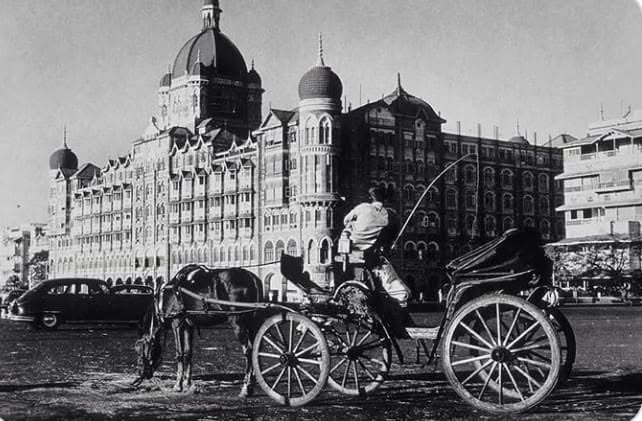
All the hustle and bustle of Europe embracing me here. All black, with coachmen, interpreters, guides. They tried their luck in all languages, from the usual sahib, monsieur, signor, Herr, to lord, in all shades and sounds, that my head was spinning. The interpreter I chose spoke fairly good German, and we agreed on three rupees (about six pre-war crowns) for him to take me to the hotel in a carriage. Although the ride on the macadamized road took almost three quarters of an hour, the time passed quickly. One picture followed another: boulevards, palaces, palm trees, churches, spacious squares, ‘traffic islands’ with the usual policemen, European strollers and passers-by, only sporadically a turban or mitre, which had somehow found their way from Asia to Europe.
We stopped almost at the end of the European part of the city, in the immediate vicinity of Black Town, the black metropolis of Bombay. In front of the hotel, a Malaysian groom greeted me with a deep bow and the words: ‘Good morning, lord!’ Again, I thought, how much will this cost? Well, it wasn’t so bad. A Malabar servant, or in our parlance a porter, stood at the door wearing a turban and scarlet-red knee breeches. He was as majestic as a maharaja. With a hieratic gesture, he opened the door for me. Albeit in India, waiters and servants are exclusively descendants of the Portuguese – Goans, who are considered to be an inferior, dirty, sleepy, lazy, and greedy tribe, but in our hotel they were apparently an exception.
I felt revitalized in the cool lobby. The transition from the previous hustle and bustle gradually settled me into the quiet morning idyll of the Indian hotel. A sleepy world. But it was barely eight o’clock. The dining room yawned emptily, and only the kokila (Indian nightingale) chirped its morning hymn in honor of the Indian gods. The groom and the Malabar pseudo-maharaja had retired to the doorman’s hut, and I would have fallen asleep had I not been awakened by a half-voiced but energetic: sahib! They had prepared my room.
I had enjoyed such a beautiful view as from this room at most in Naples, where the old Vesuvius lulled me to sleep and woke me up. Over the roofs and terraces of the European part, I gazed at the Indian world: next to Turkish mosques and Brahmin shrines – pagodas next to pagodas, jain temples, fire temples, churches, synagogues. Far in the background lay Malabar Hill, the cottages of the English gentry and the towers of silence.
The mosquitoes, which had been lurking outside the room all the time, suddenly attacked my poor skin with great fervor. I didn’t think I would encounter them in broad daylight. So there was nothing else to do but head outside! It was too early for lunch, there was no café, so off to the city! I looked at all the beautiful buildings, especially the imposing university, strolled along the sidewalks, watching girls and ladies, English dignitaries and Portuguese Creoles. Nothing Indian, everything so banally European. I bought a mosquito net, got into a car and drove home to the hotel.
After dinner, most of the guests set off with their interpreters to visit Black Town. Soon we were in the midst of a restless, silent crowd of Indians and Malays.
Following the main flow of the colorful, bustling crowd of locals, through countless markets, alleyways between houses, and bridges over canals, we arrived in the Muslim quarter, then the Parsi section, bazaars, among sacred cows bearing the sign of Shiva between their horns and moving unhindered among the people, close to the vegetable and fruit venders, carpet sellers, women in impenetrable veils, Brahmin priests, Lao Tzu and Confucius bonzes, into a mixture of all races and castes. It was almost evening, even though the sun had barely set. The first lights appeared in the streets. Fearing I would lose my bearings, I followed the second wave of people back to the Muslim quarter.
In the middle of the vast square, look, Arab cafés! A mass of turbans, hookahs, narghiles, patriarchal beards, and the aroma of thousands of cups of coffee. I sat down on a kind of taburet and barely had time to look around before a bearded man offered me a hookah and a Benares cup of coffee. Fine. I didn't see anyone staring at me, but I subconsciously felt that they were looking at the sahib, wondering how the giaur would sip his coffee and smoke his hookah. But I already knew how to do both.
Kind fate had brought me here. A sea of races and castes stretched out before us. A veritable phantasmagoria: tall, slender Tamils with the mark of Shiva on their bronze foreheads, bearded Brahmins from beyond the banks of the Ganges in white tunics, interspersed with spear-armed cepays [sepoys?], Malays from Ceylon and Singapore, Chinese in azure blue, Indo-Chinese in green, Siamese in yellow trousers, Burmese with colourful and Parsis with black turbans, all castes, each with its own mark: Gopas and Gurmis [Murmis?], Pariahs, Gorkhas and Sikhs, worshippers of Brahma, Buddha, Mohammed, Confucius, Moses. Mahariva, Zoroaster – sun, fire, water, and earth. And again fakirs, dervishes, prophets, and devadases. Silently the natives ebbed and flowed. I did not see a single European woman here, only deeply veiled Muslim women, Indian girls with large gold rings in their left nostrils, small, cute Japanese women in kimonos and with chrysanthemums like Madame Butterfly, Chinese women, Portuguese Creoles – sacred cows and elephants.
A flock of Brahma pigeons and Zoroaster vultures flew across the still blazing sky. Gongs rang out from all the temples, muezzins called Allah, bonzes shouted the names of gods, and Parsis drummed on the towers of Fire. And to make the noise and commotion even greater, trumpets sounded from behind the English barracks. Allah illalah! Brahma vedas! I returned late at night. The fires were still burning on the Parsi towers, and in the Bombay red-light district – Kamatipuri – Hetaera, temple dancers [orig. bayaderae], and nautch girls beckoned. The breath of the night...
Towers of Silence
Beyond Bombay, the Malabar Hill peninsula rises gently, bordered by the Indian Ocean on the right and Back Bay on the left. From here, there is an enchanting view of the city and the surrounding islands. It is no wonder that over the course of ten years, the English dug and plowed through this entire territory, which had previously been inaccessible due to countless poisonous snakes. Today, in the late afternoon hours, it is bustling with joggers and elegant carriages. The entire route is a cinematic display of styles and architecture. Right next to a classic English villa stands an oriental palace with domes, owned by a wealthy Muslim. And next to the fabulous Parsi Palace, built in the traditional shape of a Zoroastrian pyramid and shaded by palm trees of all types and sizes, stands the spacious residence of the Maharaja, decorated with all the symbols of Hinduism, Brahmanism, and Buddhism: elephants made of stone and cows made of marble, statues of gods from Maya to Durga, from Krishna to Shiva.
The promenade has just begun. There is a crowd on the footpaths, traffic jams in the middle of the twenty-meter-wide road, where five rows of carriages can drive side by side. Traffic is regulated by English policemen in white gloves and turbans like nabobs. On the carriage section of the road, English officers, Indian horsemen, and British amazons ride around. Every now and then, an Arab from Muscat appears on a purebred Arabian horse. His head is adorned with a green turban over a blue burnous.
In their carriages, each with two splendidly liveried coachmen and footmen in scarlet tunics, Bombay millionaires drive the treasures of their wardrobes and – harems on display: Muslim women with veiled mouths, mysteriously and superficially dressed in Istanbul ‘charshaf’; beautiful Indian women with Brahmin shawls in European dress; English beauties and ugly women, almost all of them blondes; Persian women in jewels like madonnas; a Portuguese Jewess in braids and lace, followed by the wife of an Armenian billionaire, almost buried under peacock feathers. Palm trees and locals everywhere: an abundance of vegetation and the luxury of servants. India of nabobs, maharajas, plutocrats, pashas, lords, sirs, and baronets, officials with royal appanages, all-powerful merchants, and the oligarchy of the viceroy.
In the beautiful setting of the Malabar Hill, gilded by the sun with golden rays, luxurious villas, haughty carriages, and women of beauty laden with pearls and jewelry sparkle. In cafes shaded by palm trees and luxurious awnings in the shape of giant umbrellas, the colonial crowd now spends its carefree and chatty hours: British officers in Indian service and Brahmins educated at Oxford compete in politeness among ladies and misses, sipping cocktails and whisky from sparkling crystal glasses kissed by the dying sun. On the plateau at the end of the Malabar Hill, the horses turn back towards the city. The sun is just beginning to set. It seems as if its immense circles of embers, unusually enlarged by the clouds, are hovering uncertainly above the fluidity of the sea, wondering whether to sink their lights into the sea or not. From all the islands and the mainland, Christ’s bells greet the dying day. From the heights of the minarets, the muezzins cry out all twenty names of Mohammed, and Zoroastrian priests light night fires on the towers.
Only British officers and their ladies remain in the cafés. Brahmins who no longer believe in Brahma and Oxford Muslims who have forgotten Mohammed have left the tables and—flirting, so as not to reveal their unbelief to their servants, coachmen, and society in general.
Allah Illalah... Mohammed rasul Allah...
While the Mohammedans bow down to Mohammed, raising and lowering their hands in their unchanging ritual, the Parsis walk in crowds to the melancholy waves of the sea to bid farewell to the setting sun. When the sea and the sun become one, a single trembling light, they scoop up water to wet their foreheads and eyes with movements that have remained unchanged since the times of Alexander and Darius. The promenade has emptied. The last sounds of music from English cafés die away and trumpets from the barracks can be heard in the distance. Fires flicker on all the Persian pyramids, gloomily illuminating the contours of those five towers on the hill at the end of the promenade road – the Parsi cemetery. Three funeral processions are approaching from the outskirts of the city. Mitre by mitre. The stretchers on which the dead lie have no decorations; the bodies are covered only with sheets. Four Parsis take turns carrying them the entire long way. The stretchers are followed by relatives and friends, a long line of people who do not sigh or cry. As soon as they reach the hill, where the towers of silence rise in the dark horizon, the funeral activities are over. The mourners return to the city. The Parsi interpreter, whom I had met a few days earlier, and I agreed that we would attend the final ceremonies at the first opportunity. And today we had that opportunity. As soon as the Parsis left, we climbed up to the first wall surrounding the vast, wildly overgrown plateau. The tower guard joined us there. During the day, it would be impossible to cross the plateau because it is teeming with snakes. Even at night, considerable caution is required. Well, we scared off the vermin with torches.
We thus reached the second wall. Thirty steps before the first tower, guarded by a large raven, we stopped. Meanwhile, the porters brought the corpses here by another route. Without further ado, they threw the corpses into the gaping mouth, holding the stretchers at an angle. We could hear the corpses sliding down the long tunnel into the tower.
And already the funeral feasts had begun. The ravens, which were becoming more and more numerous on the walls and towers, rose screeching into the air, where they circled for a while, then threw themselves into the depths with loud screeches – to their supper.
According to Parsi teachings, everything dead is unclean and must not be combined with fire or earth, both of which are considered the purest elements. In other words, the dead must not be burned or buried.The same ritual applies to the rich and the poor, the great and the small, the benefactor and – the murderer.
As we returned, the Indian night enveloped Malabar Hill in almost impenetrable darkness. Only the fires on the towers of the Parsis still burned.
Elephanta Island
The sun beats down fiercely on the Indian capital, on the islands of Trombe and Salsette, on countless bays, beating and scorching: you feel as if you are at the center of hundreds, even thousands, of spotlights aimed at you. In this great glare of sunlight, it seems as if all the iron parts in the harbor are made of copper and brass, all the windows of silver and crystal, and even the water glitters with the brilliance of platinum.
Our little ferry boat bravely cuts through the sea. We have been sailing for an hour and the contours of Bombay’s houses, fortresses, mausoleums and ruins are still visible, reflected in the metallic sea. Indian boats and Chinese junk ships look like giant birds that have descended onto the water.
Gradually, Elephanta Island comes into view. Everywhere the eye can see, ruins, broken pillars, collapsed pyramids, and decaying shrines stand out, an indelible image of past generations. This sacred peace is disturbed only by the seagulls, the only survivors of the Elephanta catastrophe.
The path leading to Mount Garapura, which has a huge underground temple carved into its interior, is shaded on both sides by mango and fig trees. The temple was built by Buddhists, destroyed by the Portuguese, and rededicated by Brahmins. At every step, you see statues of the smiling Buddha. Here, too, crows and parrots disturb the peace.
Let’s step inside the temple! If there were no tunnels carved into the walls, all the cyclopean structures of the temple would remain without light. But now, wherever you look, you can see mystical bas-reliefs made of porphyry and granite, carved with precision in every detail, every centimeter. Here you can see countless cohorts of elephants, all identical, entire regiments of identical storks, long rows of rhinos, all with their trunks in the same direction, fleeing rows of bats and crows, row upon row of palm trees and ferns, all bent in the same direction.
You see the same uniformity in the repeating doors and corridors, in the chapels and recesses. Side by side stand statues of Brahma with the same eyes and noses, entire processions of identical Kalyas and Vishnus, thousands of stone elephants and marble cows, porphyry crocodiles, eagles, and bronze tripods with the same ears and tails.
We walked through a whole series of corridors and finally stopped in front of the doors that were the conclusion of the gigantic sanctuary. Brahma in a white tunic opened the doors for us, removed the cashmere curtain, and we entered the temple of Shiva.
Sixteen columns and twenty-six granite pilasters divide the sanctuary into three dark sections, illuminated by alabaster lamps. At first, I couldn't make anything out, but once my eyes adjusted, I saw a double row of colossal statues of Shiva and Parvati stretching all the way to the end, where stood a mammoth group of Shiva in his triple capacity as creator, preserver, and destroyer, as Brahma, Vishnu, and Kali. A monstrous idol with three heads and three bodies joined together – the Indian Trimurti, a triple and inseparable being, the highest embodiment of divinity. A multitude of fantastic animals carved from basalt stare at this group.
Close to Trimurti, I had my first opportunity to witness the phallic cult of lingam. In front of the indecent statue of the progenitor of tribes stood a beautiful Brahmin priestess amid gardenias and tuberoses scattered on the ground by the worshippers. There were quite a few fresh flowers and even more wilted ones. The intoxicating scent of roses and cedar, from which the cult objects were made, filled the entire spacious area.
One after another, worshippers of the deities arrived, mostly women, each rushing to their own deity. Trimurti and Brahma had few worshippers, but the crowd of barren women around the phallic statue was large. It was disgusting to see them caressing it, kissing it, and showering it with flowers. When we stepped out of the temple, we were almost blinded by the sun, which was now at its zenith. Quite a few people had already gathered outside, waiting for their turn.
I had had enough of Bombay and its surroundings.
- Annotations
-
Josip Suchy (1861-1941) was born into a wealthy trading family of Czech descent in Kamnik. He abandoned his vows as a Franciscan monk to study law, graduating from the University of Vienna in 1907. He had already worked in the export department of the Vienna Chamber of Commerce, Industry and Crafts. Thanks to his knowledge of several languages, including Turkish, Arabic, Hebrew, and Sanskrit, he quickly rose through the ranks. He served as a consular attaché in Alexandria, Istanbul and Tehran, and also spent several years in Bombay and Cairo. In 1910, he was posted to Ceylon (now Sri Lanka), where he met Nyanatiloka Mahathera (1878–1957), a German-born monk who was a leading proponent of Theravada Buddhism in the West during the 20th century. Suchy also met Karl Friedrich Neumann, a renowned Pali translator and professor in Vienna. The outcome of his interests, diplomatic travels and encounters was the publication several texts on Buddhism, as well as his Bežne slike iz Indije.
- Complete title
- Bežne slike iz Indije, Josip Suchy (1869–1941)
- Date of publication
- 1934
- Dates of travelling
- Early 20th century
- Publisher
- publisher unknown
- Place of publication
- Ljubljana
- Archival source or library
- Mestna Knjižnica Ljubljana, COBISS-ID: 32657665
- Locations in India
- Bombay
- Keywords
- Bombay, Europeans in India, Black Town, Hinduism, Islam, Towers of Silence, Parsi funeral rituals, Elephanta, Shiva temple, Trimurti
- Related literature
-
Ana Jelnikar, Helena Motoh, Pot v Indijo: Misijonarska potopisa, konteksti in analize (Koper: Annales ZRS, 2021)
- Translator and copyright
- Ana Jelnikar, 2026