Тамо амо по Истоку (Here and There Across the East)
Item
- Item Number
- 35
- Title
- Тамо амо по Истоку (Here and There Across the East)
- Author
- Milan Jovanović Morski
- Date
- 1894-1895
- Country / region
- Serbia
- Source language
- Serbian
- Time period
- 1860-1880
- Description
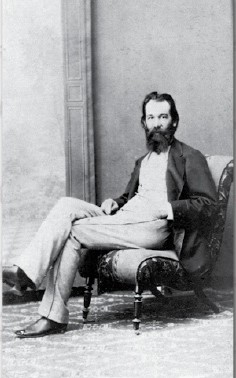
- The translation consists of parts of a travelogue by the Serbian doctor and academic Milan Jovanović Morski, which discusses the similarities he sees between Brahmanical and Christian practices. After getting his degree in medicine in Leipzig in 1867, Morski travelled for some time as a cruise-ship doctor for the Austrian company “Lloyd” and wrote accounts of his visits to India, China, and other Asian countries.
- Translated text
-
Treading on this Brahman soil, many a time have I been surprised by the similarity of Brahman and Christian rites. On the streets of Hindu dwellings one can often see small fenced chapels. At their most distant part is an icon with a vigil lamp in front of it, a feast on a rich table cloth under it, chalices and bells on it, and at the entrance a sizable bell is hung—in a word, the same chapel as can be seen all over Italy and other southern European parts. Brahman fakirs, who roam the land and make their living by begging, swindling, and even by collecting fines, were used as an example for the middle-aged wandering monks, who also lived mostly by begging. Those people have the same long hair and beard, the same tall kamilavka, the same loose and long clothes, and in their hands is a stick with a cross handle made of ivory, carved in the shape of a snake, just like the “crutch” of Christian church elders. Huge conic towers are erected next to Hindu pagodas; they have main and side altars just like in Saint Peter’s Basilica in Rome; walls are lined with heavy silk standards like in our churches, and they are sometimes carried in the streets as it is customary among our people. In a nutshell: a Christian, and in particular an Orthodox Christian, must stop at some points and observe this similarity between their own religious rites and—the Brahman ones in amazement. Even the Christian clergy’s “garments” are actually Hindu samples which are used there for excellent civil attire. It is said that an English missionary came across a manuscript in a Brahman monastery, in which it was narrated that a young boy from Nazareth had spent a long time in that very monastery. The description of his face—it is said—matches exactly the face of Christ which is known based on a discovered Roman cameo. That would explain both Christ’s long absence from Palestine and the similarities between Brahman and Christian rites. This book—it is said thus—vanished from the monastery, and since a Roman missionary had dwelled at the monastery at the same time, it is suspected that he had bought that book, for which the English missionary had been haggling, from the “brethren” for a very good price. I see the greatest similarity in this between the Brahman “brethren” and a certain one of our own which sold monastery srbuljas for good money…
- Annotations
-
The translation consists of parts of a travelogue by the Serbian doctor and academic Milan Jovanović Morski. After getting his degree in medicine in Leipzig in 1867, he travelled for some time as a cruise-ship doctor for the Austrian company “Lloyd” and wrote accounts of his visits to India, China, and other Asian countries.
- Author details
- Jovanović, Milan (1834–1896) called “Morski” (of the sea)
- Date of publication
- 1894, 1895
- Dates of travelling
- 1878–1882
- Publisher
- Srpska književna zadruga
- Place of publication
- Belgrade
- Locations in India
- Bombay, Calcutta
- Keywords
- Brahmansm Hinduism, Christianity
- Translator and copyright
- Danijela Lekić, 2026