
The World in Small, or the Swift Traveller: The Land of the Great Moghul (De waereld in ’t klein, of de spoedige reiziger)
Item
- Item Number
- 36
- Title
- The World in Small, or the Swift Traveller: The Land of the Great Moghul (De waereld in ’t klein, of de spoedige reiziger)
- Author
- Egbert Buys
- Date
- 1762
- Country / region
- The Netherlands
- Source language
- Dutch
- Time period
- 1760-1780
- Themes
- Art and architecture
- Brahmins
- Europeans in India
- Hinduism and Hindus
- Islam and Muslims
- Jains and Jainism
- Law
- Parsi
- Politics
- Religion
- Society
- Women
- Description
- Translation of a chapter on India, or “the Land of the Great Moghul,” from an 18th-century Dutch-language compendium of the countries of the world. Drawing extensively on an English model published in the 1740s, the author aims to give a concise account of “everything useful, necessary and worth knowing” about all countries of the world. In this section, he shares with his readers what he considers worth knowing about the Indian Subcontinent and its people.
- Translated text
-
“The land of the Great Moghul
… [The text begins with geographical coordinates and a description of the weather] …
[p. 57]
“The joy brought by mornings and evenings here is beyond the comprehension of Europeans, who are living in the northern latitudes and cannot form any conception of the pure air and everlasting greenery that one finds here, where throughout the entire year one sees blossoms and ripe fruits on one or another type of tree; sight, smell, and taste meet with the most delightful of things in these exquisite gardens, which come closest to the image we have of a Paradise on earth.
[p. 58]
We can attribute the uninterrupted health and long life of the natives to their simple diet, namely, rice, herbs, and clean water, but most of all to the blessed climate. The low lands lying by the sea are indeed…not very healthy, especially the English settlement at Bombay and the region of Bengal, where the Ganges empties into the sea through various channels, a province which is flooded every year much as Egypt is by the Nile; but the other English colony in Surat is considered very healthy.
The eastern side of the Indian peninsula is generally called the Coromandel Coast, and the western side the Malabar Coast. On the Coromandel Coast, there is a trading post [Comptoir] of the English East India Company at Madras, or as it is commonly called, Fort St. George, located at a latitude of 13 degrees. This Fort consists of a regular square, about 300 feet wide, with four bastions made of what they call ironstones. Here, the English have a beautiful church with an organ and a black and white marble floor; the windows are large and lack glass, so as to let in the fresh air; otherwise the heat would be very unpleasant. The streets and markets are packed with people, for although Indian [p. 59] houses are low and small, they are full of inhabitants, with six or seven persons sleeping in a small room, having no other bed than a mat and a cloth over their body. The people are uncommonly clean and wash themselves several times a day.
Goa is located at 15 degrees 20 minutes North Latitude and was the capital of the Portuguese territories in the Indies; but it is now virtually the only considerable settlement they have there; it is a very safe and convenient harbour, not unlike Portsmouth and equally strong. The Dutch discovered how strong it is when they blockaded it for several years but were never able to take it. The island on which the city is located is about 24 miles in circumference, and entirely surrounded by a wall fortified with bastions and redoubts. Along the river the city is about two miles long, but not even half a mile wide. The houses are built of stone and are magnificent, particularly that of the Viceroy; almost half of the inhabitants are clerics, and here the well-known court of the Inquisition is held; nevertheless, the principal merchants are Heathens and Mohammedans.
Bombay is located at 19 degrees North Latitude. The King of Portugal transferred the ownership of it in the year 1663 to King Charles II of England upon his marriage, and His Majesty presented it [p. 60] shortly thereafter to the East India Company. The isle of Bombay is circa 20 miles in circumference. The capital is a mile long, but the houses are generally low and badly built. The fort is strong and mounted with 120 pieces of cannon. The Heathens and Mohammedans enjoy the free exercise of their religion here. Bombay is not considered very healthy, for along with other diseases, there is one prevalent there called the ‘Barbiers’, which paralyzes the whole body so that a person can barely move a hand or a finger, and the S... P... are nowhere more common. The Mughal has often attempted to conquer Bombay, but he never succeeded. In particular, he tried to do so in the year 1688 with 25,000 men, launching an attack on the fort, but being unable to take it, he negotiated with the Governor and returned home.
Surat is located at 21 degrees 30 minutes North Latitude, and 72 [degrees] Longitude, on a river about 10 miles from the sea, and it is fortified with a wall, a citadel, and a square castle. It is about three miles in circumference, with six gates guarded by sentries. The houses are generally low and badly constructred. In the middle of the city, in front of the castle, is an open square called the Castlegreen, where in the dry season all kinds of goods lie in the open air night and day, and both the Europeans and the [p. 61] natives place their bales there and prepare them for shipping. Every three years, a new Governor arrives at the castle. And despite the fact that this city is very populous and peopled by so many different nations, the magistrate maintains such good order that everything proceeds very peacefully.
The natives of Surat are Moors, Mohammedans, Banias, Persians, or Halalkhors. The Moors have the government entirely in their hands, both here and in all other cities of India that stand under the immediate rule of the Mughal, because of which they treat the Heathen natives with contempt.
The Banias are amiable and friendly people, and while they never quarrel with others, they also rarely disagree among themselves; when they see that the Europeans with whom they are trading become impatient, they walk away and give them the time to calm down. Almost all of the Persians who live here are weavers of the finest fabrics made in this place. These people think that they cannot do their deceased friends a greater honor than to offer their bodies to birds of prey, considering these living sepulchers better than any other tombs; to this end, they have a field one mile from the city [p. 62], completely surrounded by a wall 12 feet high and 100 feet in circumference. The ground inside is sloped by about 4 feet so that all moisture can drain into a pit made for this. Yet, it is easy to think that nothing more horrendous could be conceived than the sight of this so-called burial ground.
The Halalkhors feel free to eat and drink anything that comes their way, however disgusting it may be; they are employed for the dirtiest tasks, such that one cannot offend another man more seriously than by calling him a Halalkhor.
Even though the English, French, and Dutch carry on a large trade in this city, it cannot be compared with that of the Moors, Armenians, Banias, and Arabs; and although the Mughal is an independent king and claims supreme power over all this land, there is no monarch in the world who encourages his subjects of all sorts of convictions [gezindheden] engaged in trade more than he does.
Bengal is the easternmost province of the territory of the Great Mughal; from east to west it is more than 400 miles long, and about 300 miles wide. The river Ganges divides into several branches throughout this province and floods annually, just like the Nile.
The country of the Mughal is inhabited by [p. 63] many kinds of peoples; yet we shall divide them into two kinds—namely, the Eastern Indians and the Mohammedans. The former are at least 20 against one across the entire kingdom. One cannot imagine anything worse than their houses generally are, being nothing more than wretched little huts of clay covered with reeds, and together these form their main cities. Yet, in the marketplaces, there are warehouses supported by small poles, beneath which some benches made of earth are built on which they display their merchandise, or they lay mats over them to receive their friends or conduct their business; these warehouses are called galleries by some travellers, which has caused others to form a grand image of those miserable buildings. Their furniture consists only of cushions, mats, and carpets, with no beds, tables, or chairs being found in their houses. Also, they have neither kitchens nor chimneys.
The statues in their pagodas are generally monstrous, sometimes they have the head of a boar with the body of a man and the lower parts of a lion; otherwise a man with 15 heads and 30 arms. Some of their larger cities have houses belonging to the Christians and Mohammedans that cut a reasonably fine figure [p. 64], being made out of bricks and two stories high, with flat roofs, where they breathe the fresh air in the mornings and evenings; but the Moors spend more wealth on their mosques.
Without any doubt, the Heathens are civilized and clever people, and as peaceful, humble, and inoffensive as any nation on earth. Likewise they are very tender-hearted and compassionate, even towards animals, which they would not want to rob of their lives for the whole world. Their cleverness is such that they will imitate all kinds of patterns at first sight. Show them a suit of clothes, a headdress, or anything else, and they will replicate it so accurately that one cannot tell apart the original and the replica, and they copy a good painting so accurately that it cannot be distinguished from the original. The fine chintzes, whose vivid colors, shading, and other beautiful aspects are inimitable, are here created by the commonest folk, who have no other pattern than their own powers of imagination and who work for three stivers a day. Their ship’s carpenters can replicate an English or Dutch model as if it had been built in Chatham or Amsterdam.
The Indians are of a good stature, well-built, have pleasant features, and one only very rarely finds a hunched or deformed person among them. The [p. 65] women are uncommonly graceful, despite their dark faces; those in the southern part of this country are pitch black, and the inhabitants of the mountains are also very dark-skinned.
Their clothing consists of a white long waistcoat of cotton, silk, or muslin; they wear slippers on their bare feet, which are neither tied nor pulled up over their heels. The common people wear a sash around their loins, and some go entirely naked, having a cord around their waist to which they attach a strip of linen a hand-breadth wide, which hangs over their private parts but covers very little; still, these men carry the palanquins and accompany the English ladies when they go out. It initially appears rather strange to them, but after two or three weeks, they look just as comfortably upon a naked man as if he were clothed.
They eat in the morning and in the evening. Punch made from arrack is very frequently drunk here, and since lemons and sugar grow locally it is a cheap drink, an aam of arrack costing no more than 22 to 23 guilders. There is no beer or wine except that brought from Europe, which is extraordinarily expensive, with a bottle of ordinary beer costing 18 stivers. They sometimes amuse themselves by playing checkers and cards, but they do not gamble like people do in China; at a festive meal, it is customary [p. 66] to send for a troupe of girls who dance for the company, and if anyone wishes to retire with one of them privately, she does so unabashedly. In India, there are also poor people who walk along the streets with baskets containing dancing snakes; when they lift the lid and play on their pipes, the snakes rise upright and begin to dance, beating time with their heads while their tails remain coiled in the baskets. When the music ends, they cease and begin to hiss at one another as if they want to fight, but when one plays again, they dance again.
They have a peculiar way of catching waterbirds; they cover an earthen pot with feathers so that it resembles a bird, place the pot on their head, and go into the water, moving gently toward the birds, (nothing can be perceived above the water except the pot which has holes to look through), which they grab by the legs and thus catch them. (This account is on the authority of Mr. Fransham, even though it appears somewhat incomprehensible to us).
The roads are extremely sandy and, in the dry season, they are so hot at midday that it would burn people’s feet if these were not as hard as a shoe sole; and it is impossible to move through the sand with shoes. When a man of means travels, he commonly hires [p. 67] eight or ten coolies, bearers, who carry his palanquin, which is a kind of resting couch with a canopy and cushions. They sit or lie down in the palanquin, and are carried by four coolies together, two in front and two behind, who have long poles on their shoulders; they walk for four or five miles and are then relieved by their companions for the same amount of time, without ever standing still. These men are hired for three stivers a day.
The principal products in this empire are silk, cottons, and muslins. There are no greater merchants in the world than the subjects of the Great Mughal, even though their ships never go further than the Cape of Good Hope; they carry on an astonishing trade with Persia and the Red Sea, and provide the Turks and Persians with all the precious wares of the Indies; all of their ships are merchant ships, for despite the fact that the Mughal possesses a vast coastline, there is not a single warship. Their barges have flat bottoms, the sides of which are five to six feet high, made of thin planks stitched together with the threads of coconuts, so that when they strike the sand, they flex back like cardboard; and this happens many times before they can land on any of these shores, which other boats would never dare to attempt. [p. 68]
The surface of the earth looks like a sandy desert at the very end of the dry season, without foliage or grass, or anything resembling greenery, except for the trees, which remain green all year; but as soon as the rain showers begin to fall, nature is reborn, and the earth is covered with greenery and herbs. They never put manure on their fields; the floods do it for them; their sowing time falls in May and June, and their harvest around November, when the dry season begins.
The cotton tree, from which they make their cotton linens, muslins, etc., is of great use to them; they sow many ‘morgens’ of land with it; it grows as high as a rosebush and has a yellow blossom; when these blossoms fall off, a cap remains about as large as the joint of a thumb, which expands to the size of a walnut; when the fruit has ripened, the outer shell breaks open, revealing a fine, soft wool, and then this is picked. These bushes bear fruit for three or four years, after which they are dug up and the ground is sown anew. The seed is always found inside the cotton; but besides these shrubs, there is a species of cotton tree that grows extremely high, the fruit of which is as large as a hen’s egg.
Indigo is also a precious plant there, about as large as a gooseberry bush [p. 69] but without thorns. They pluck the leaves from it and lay them on a pile for a few days to sweat; then they are placed in deep vats with a sufficient quantity of water to soak them, wherein they release their blueness; then the water is poured into shallow vessels made of plaster, and when the sun has drawn all the moisture out of it, a hard, dry cake remains on the bottom, which is our indigo.
The most remarkable of their trees is the Banyan, the branches of which hang down to the ground, take root, and grow upwards again, so that one of these trees sometimes has 40 to 50 trunks, which spread so far that a regiment of soldiers can shelter under it, providing an excellent shade as they are always green.
As for their elephants, although we may have seen one now and then in Holland, we have no conception of such mountains of flesh as one sees when they are full-grown, being 15 feet high, and yet so manageable that a child can guide them (except when they are in musth); they can do nothing but walk, but they advance five miles in an hour and are so sure-footed that they never stumble; they are very readily trained; for instance [70], if their caretaker gives a signal to frighten a person, they will charge at him in a threatening manner as if they want to crush him, without however harming him in the least. If he commands his elephant to throw water or mud at someone, it will do so without causing any other injury; they have such strength in their trunk that if they strike a horse or camel with it in earnest, they break its bones and kill it with one blow.
…
[A description of scorpions and snakes in India follows.]
…
The people views the day on which an eclipse occurs as a day of complete reconciliation, on which they can get complete forgiveness for all their sins if they bathe several times; they also imagine that behind the setting sun a mountain hides and they cannot [p. 71] understand that the earth is round. And the Great Moghul himself will not undertake anything of significance, nor travel, before the astrologers [Sterrekijkers] assure him that it is an auspicious time. It has been generally remarked that even though the plague often breaks out in Surat, it seldom harms the Europeans.
The Moghul has no enduring council of state as other kings do, but the business of the kingdom is managed by four or five major officials, who explain to him the state of the lands. His sons carry the title of Sultans, and his daughters that of Sultanas. When the Moghul holds a state assembly it consists of some ladies from the Seraglio since it is at their request that all the governments and high offices are conferred. For the Emperor is only served by women in his seclusion, where they can have anything they wish for, in courtyards, grottos, etc. The number of jewels worn by these ladies goes beyond all comprehension; given the climate their clothes are very light, consisting of extraordinarily fine silk, so that their clothing weights very little and the linnen is transparent.
The Moghul is much too elevated to send ambassadors to foreign courts, for he considers all foreign kings to be much lower than himself. He shows himself to the people thrice every day; at those times even the humblest man can submit a petition to him. There is no written law in the empire, but they do have common punishments for crimes. Murder and theft carry the death penalty. They never let a criminal spend more than one night in prison; they are often executed on the market; some are hanged, others beheaded; some are impaled, others bitten by snakes, and yet others immediately trampled by elephants.
The Moghul Emperor usually spends three-quarters of a year in his encampment, which is basically round with a circumference of 20 miles, housing no fewer than one hundred thousand soldiers with their wives and children; the Mughal’s tent is in the center and his quarters are as large as a great city since all the women of the Seraglio stay with him.
The Indians keep a weekly sabbath, but the 9th and 24st day of every month are days of abstention and fasting, which even their children have to follow very strictly; a large part of the religion of the Brahmins consist of frequent bathing, and keeping themselves uncontaminated from the touching of Christians, or other unclean persons, which they consider all foreigners to be. Yes, they go so far in this extravagance that they [73] even refuse to drink from a well in which a soiled vessel has been, which has polluted it; the following is a remarkable example of this behaviour.
Eight or ten Englishmen arrived in a village being very thirsty, so they wanted to haul water from one of the wells; the people who was this came together in great consternation and begged the Englishment not to inflict such an insult upon them, for if they lowered the pitcher into the well, the people could never drink from the watter again. Initially this caused a great quarrel since the Englishmen were so thirsty that they refused to move a foot until they had drunk; eventually, a solution was devised: the Indians would draw water with their own pitchers and then pour it into earthenware pots that they gave to the Englishmen. As soon as they had drunk, they broke these pots into pieces; thus, both parties were satisfied and parted as good friends.
The commandment in their law that they may not kill extends even to the smallest of insects; they have to do penance even if they kill a flea or a louse. The Banias not only avoid the killing of animals, but they have also established a guesthouse a mile from Surat, where maimed and old horses, cows, goats, dogs, etc. are provided for abundantly.
There is a sect among the Heathens called Faqirs, of which some inflict violent penances upon themselves. Some vow to stay in the same posture for all their lives; some stand with their hands outstretched towards the sky, which they cannot bring down again after standing like this for a long time; and the nails of their fingers grow longer than an eagle’s talons; but before they can get accustomed to these postures, they have to endure a horrific torment, and once they have somewhat overcome it, they have become utterly useless to themselves and to others; they have a servant or two to tend to them and carry them from place to place. Some make a vow to never sit or lie down, but always to walk or lean; behold here the power of error to make one believe lies!
The Parsis [Persies] are another kind of idolaters in India, who worship the fire; consequently, there is no greater crime among them than to extinguish the fire; they always keep it burning in lamps in their temples, of which they say that these have been burning for several centuries without ever going out. Yes, some go so far that, if their houses were on fire, they would not do anything to extinguish the fire, and consider someone who snuffs out a candle to be godless.
The marriages of Indians hardly deserve to be called such if the consent of both parties is the foundation of marriage, for the parents conclude the marriage before the children have the use of their reason. Neither the boy nor the girl imagine that once they become adults, they will then be free to chose; nevertheless, the man has a remedy: if the girl whom his father has arranged for him does not please him, he can take another. But the fate of a woman is harsh since she cannot get a divorce for any reason, and if she dares to complain, she can be degraded to the state of a slave. The Indian idolaters always marry within their own lineage and they have as many lineages as there are occupations. A merchant does not want to marry an artisan’s daughter, nor does an artisan want a farmer’s or fisherman’s daughter, etc. The Indians never swaddle their children, but let boys and girls run around completely naked until they are 7 or 8 years old; and it is difficult to believe how they are already crawling around on the floor at a very young age, which is probably the cause of the perfect proportions of [p. 76] their limbs, and of the fact that there is no crooked or deformed person among them.
- Annotations
-
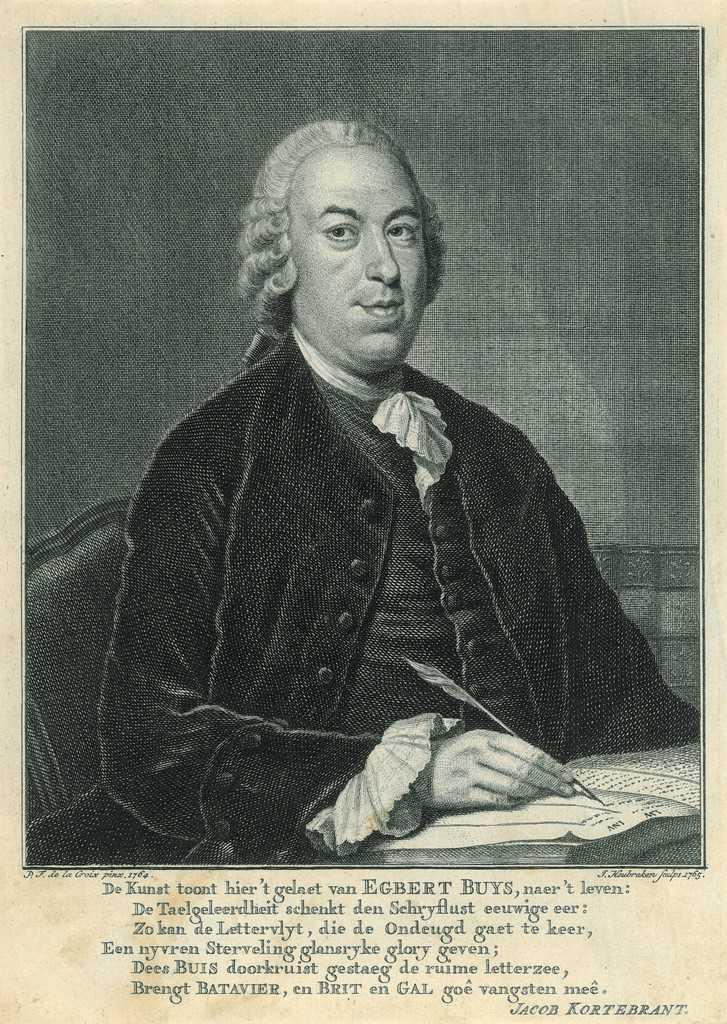
- The author, Egbert Buys, was a privy councilor or senior advisor (Hofrat) first to Augustus II of Saxony and Poland, and later to the King of Prussia, Frederick the Great. Buys lived in Amsterdam in mid-18th century and died there in 1769. He was the author of a series of essays and books concerning a diverse set of subjects and worked on two major encyclopedic works, a dictionary of the arts and sciences, and the work from which this section is taken, The World in Small, or the Swift Traveller (1762).
- The work aimed to be a two-volume compendium of all countries and their peoples, religions and societies. As Buys himself indicates, his work is based on a similar work by John Fransham, titled The World in Miniature, or the Entertaining Traveller (1740-1741). In fact, large sections of the text consist of translations of sections from Fransham’s book, which itself compiled a series of travel accounts from the decades before. Nevertheless, Buys has left out sections and added amendments and changes to the chapter on India, which shows what he thought his readers should know about this foreign country, its inhabitants, their religions and customs, and the political system.
- Buys mentions two diseases that were apparently common in 18th-century Bombay, which he names ‘Barbiers’ and ‘S… P…’. The first term refers to beriberi, a disorder of the nervous system caused by vitamin B1 thiamine deficiency, common among sailors and colonists with poor diets; the abbreviation S. P. refers to syphilis.
- Complete title
- De Waereld in ’t Klein, of de Spoedige Reiziger, Geevende een Beknopt Berhaal van al het Geene in alle Landen, Nuttig, Nodig en Wetenswaardig is, als de Gelegenheid, Gewoontens, Zeden, Temperament, Levenswyze, Uitspanningen, Godtsdienstige en andere Plechtigheden; Koophandel, Manufakturen, Konsten en Wetenschappen; Regeering, Staatskunde, Wetten, Gebouwen; Beesten, Vogels, Vissen en Planten; Steden, Bergen, Rivieren enz. van yder Land.
- Author details
- Buys, Egbert (ca. 1725 – 1769)
- Date of publication
- 1762
- Dates of travelling
- n.a.
- Publisher
- Hendrik Bakhuysen
- Place of publication
- The Hague
- Archival source or library
- n.a.
- Locations in India
- Bombay, Goa, Madras, Surat
- Keywords
- Banias, Brahmins, clean and unclean, colonialism, cows, East India Company, faqirs, ‘heathens’, idolatry, marriage, Muslims, Mughal Empire, Parsis, religion, trade
- Related literature
-
Fransham, John (1741). The World in Miniature: or, the Entertaining Traveller. London.
- Translator and copyright
- Jakob De Roover, September 2026
- Media
 image3.jpg