
Note on the Missions of the Discalced Carmelites at Malabar (Notice sur les Missions des Carmes Déchaussés au Malabar)
Item
- Item Number
- 37
- Title
- Note on the Missions of the Discalced Carmelites at Malabar (Notice sur les Missions des Carmes Déchaussés au Malabar)
- Date
- 1900
- Country / region
- Belgium
- Source language
- French
- Time period
- 1880-1900
- Description
- The author wrote this description of the Malabar region of India with the goal to obtain funding, public support, and recognition of Belgian Christian donors and churchgoers for the Belgian Carmelite mission’s efforts to convert native inhabitants of Malabar. For this goal, pamphlets and booklets (such as this one) were produced which are today kept in various repositories, as in the libraries of Carmelite cloisters in Ghent or Bruges. It details how Carmelite missionaries' conversion of the so-called ‘pagans’ or ‘heathens’ to the Christian faith worked on the Malabar Coast (and inland villages in Kerala).
- Translated text
-
[p. 1]
Erstwhile Malabar was about the only province of India known in Europe. Today its missions are almost entirely ignored. This is why a history of the origins and progress of the Catholic Faith in Malabar, its customs, and the religion of the inhabitants would undoubtedly excite a lively interest. Meanwhile, for the knowledge of the Malbarese map, we offer the following details to the wider public:
- Voyage from Quilon (Kollam) to Verapoly (Varappuzha)
At every step of our missions, the missionary and Christian traveler to Malabar would find the subject of admiration and praise for the power and infinite wisdom of the Creator, who by a single act of his will has filled the world for the use and charm of man, with uncountable richness and the most marvelous and most varied plants.
[p. 2]
The Malabar is one of the most beautiful countries and the most fertile in the world; however, the plants and trees are different there than those of Europe, as much so that while disembarking on the shores of India, the European believes oneself to be in another world. In Europe, the plants are renewed with the seasons ; their leaves fall in autumn and reflourish in springtime; they bloom before carrying fruits which only come on new branches. But in Malabar, the trees are always green and, although they change leaves, this is done with such order that they are always equally covered. Most of them flourish while they are laden with fruits, carrying at the same time flowers and fruits, green fruits next to fruits reaching maturity.
But above all the vigour, variety, and sumptuousness of the vegetation surpasses all imagination; it are not only gardens and fields, but most often, in our missions of Vérapoly and Quilon, they are forests of fruit trees growing hither-there and without culture. The coconut tree, the palmtree, areca palm, jackfruit tree, the mango tree, the bread tree, the sugarcane, the banana tree, the pepper tree and thousand other diverse trees and shrubberies dispute each other for the earth, air and sun.
[…]
The mountains most elevated and rocky, stripped from their savage forests by the work of man, are converted into coffee plantations. To the richness of the vegetation is added the variety of most picturesque views, and sometimes the sublimity of the most grandiose spectacles. All along the coast, the land seems like an immense forest of coconut-trees ; the rivers change into lakes as soon as the viewpoint fades; or retires into sinuous canals, crossing and multiplying into numerous isles (from Lettres sur l'Inde par M. Laouënan, Archev. de Pondicherry)
See here a description of Malabar by a Protestant minister, in a work published in 1892:
« The land is of a marvelous richness. In the forests of the Ghattes the hardened hunter meets everywhere with troops of savage elephants, tigers of all species, from the royal tiger to the cat, panthers, bears, and bisons. In the plains, the products of all kinds of palm trees, pepper, cardemom, enriching the markets of the ancient and new continent. It is a gripping contrast to see the always-green plants and trees of Malabar, and the dried-out plains covered by the sun at the other side of the Ghattes. Which hits the most in this country, is the grand navigable route extending to the other side of the country. It is a succession of lakes connected to each other, and separated from the sea by a strip of land.
[p. 4]
Animated by an infinity of villages with an immense population, pagan, Christian or Mahomedan. All commerce is done by water. ((the author adds here, in a footnote: in this year of 1900 the first railway line is traced, from the North of the diocese Vérapoly)). At each instance one sees Indian barges, rafts, and prows of all sizes sliding in all directions, giving life and movement to the frontispiece of this tableau, while the gloomy mountains of the background make the beauty of these landscapes stand out even more. Usually seated in the cabin of one of these barges, pulled along by the black arms of a dozen robust rowers, lulled by cadenced chants, which accompany their infatigable movements, in little time the traveler crosses the immense spaces across the rich growth of the tropics; during the day, he sees himself reflected in the blue waters of the canal, as by night the myriads of gleaming mosquitoes come to charm his vision with their fugitive shine. At each step one believes oneself transported in a magical fairytale land. The pagan priests have invented the legend that the western region of the Ghattes was torn from the sea by Vischnou, the second person of the Hindu trinity, to give it as a gift to Brahmes, his loyal servants ; but in what they are not mistaken, is when they proclaim Malabar to be a masterpiece of divine work.
[p. 5]
Let us complete this tableau by a description given of it by Monseigneur Marie Ephrem du S Coeur de Jesus, Archbishop of Quilon, which reveals itself as no less poetic than the traveling Carmelite :
« The voyage from Quilon to Cochin and at Verapoly ressembles a bit that of Trivandrum to Quilon, with the difference that the river on which the trajectory is done sometimes takes on incredible dimensions. (…) our rowers habituated to the country, find their way marvelously. (…) The lotus raises itself from the waters, and it is the sacred flower of the Indians, as the swan is one of their most venerated birds. Brahma, the first person of the Indian Trimurty is represented with a swan, while Vishnu, the second person, came out of a lotus flower, symbol of the water. From time to time the crocodiles come to stretch themselves out in the sun, on the sand of the riverbanks and watch our small barge, with a simultaneously savage and intelligent air.
[… description of animals…]
The night equally had its particular beauties, its moonlight without equal, the peaceful shine of scintillating constellations of stars, the tender and langourous singing of birds, but also had its contrasts in the lugubrious howling of jackals, often troubled the calmness of this mystery and tore us from our meditations. Alas ! We say melancholically, look at the image of our soul down here. It has days full of brilliant joy and nights of ineffable delights. But if such pure felicities are not always without the mixture and the passions similar to those of filthy birds or savage animals, often throwing their discordant cries tyranically in the middle of its most harmonious concerts. This is how we transport ourselves, by faith and by the heart, towards serene splendours where not a single cloud comes to trouble the chaste horizons of the soul ; we went to take refuge into he spirit of the sainted Motherland, where one tastes, in intoxicating contemplation of eternal beauty, this sovereign joy that the earth can not know and that God only reserves to those who would have loved it.
It is in the middle of these emotions that this charming voyage is made.
- The most necessary Apostolic Works for the Propagation of the Faith at Malabar
The Missions of the Carmelites Déch. are the most important of India, for the number of Catholics and the general propensity of its inhabitants to conversion. As in the North of India, in multiple Provinces one hardly finds one Christian in a thousand pagans, in the Diocese of Quilon, the Catholics constitute one tenth and in the Diocese of Vérapoly, a quarter of its total population.
In the Archdiocese of Vérapoly, the Latin Catholics are immediately placed under the jurisdiction of Carmelite Fathers, then the three Apostolic Vicariates of Syro-Malabarian Christians, enclaved within the same Diocese; the ones and the others work together for the extension of the Catholic Faith in the Missions of Carmel.
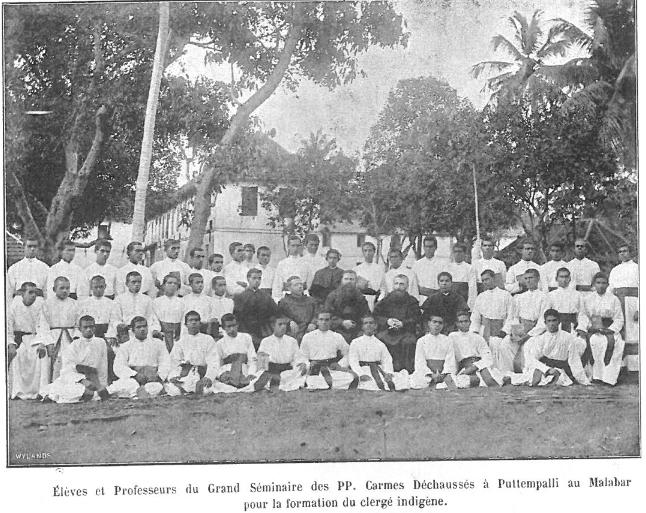
Apart from the Bishops and Carmes Déch Missionaries, there are in the two Dioceses more than 500 indigenous Priests, 100 religious Carmes Déch. Tertiary Priests, living communally in 12 convents. There are 14 communities of indigenous Tertiary Carmelite religious, for the education of young Malabarese.
[p. 8]
We have mentioned the richness of the country, and the general tendency towards Christian faith, but notwithstanding the high aristocracy of Malabar, mostly formed by Brahmes, or pagan priests, show themselves generally favorably towards our Sainted Religion, nevertheless they themselves do not convert; it is the bourgeois class, and especially the poor slaves, who very willingly embrace the Catholic Faith.
The rich properties belong to the state, to the pagan government, or they are the unalienable heritage of Brahmes, or the prerogative of the great pagodas. The Carmelite Missionaries can therefore not count on the resources of the country to continue the work of propagating the faith, in such a large number of districts that have never been evangelised, as one wants to convince oneself by an attentive look at the map of our Malabari Missions. This is why a Sacred Congregation for the Propagation, by a Decree of 3d April 1900, has established a chosen Committee in the two families of Carmel in Belgium, under the presidency of R. P. Provincial des Carmes Déch. Des Flandres with, a proper regulation to receive and administer the alms of fervent and charitable Belgians and assure them by means of the Catholic institutions of the progress of the Faith and the Christian civilisation at Malabar.
There is first of all the work of conversions properly saying, also called the work of 6 fr. 50 c. This is a convention made between the Procureur of the Missions in Belgium and the Missionaries of Malabar, that for each conversion of adult pagans, or children born from pagan parents, the Missionaries receive 6 fr 50 c. One estimates on average, by this modest sum, the costs of Missionaries for each conversion; indeed, if the catechised are poor, and as we have said, this is ordinarily the case, one needs to dress them to introduce them into a Catholic church, as the pagans at Malabar go almost entirely naked ; they are very crude, they have to be instructed daily during close to two months, before Baptism ; meanwhile, they do not work, and the Missionary needs to feed them ; also a catechist should be maintained to teach them the prayers that every Christian should know : the Pater, the Ave, the Credo, etc. the day where they are regenerated by the Baptism, they need to be treated a bit; after the Baptism, often a hut made of leaves needs to be constructed, or other expenses made, to separate them from the pagan families, or their Faith would be in danger. All these expenses are covered by 6 fr. 50 c. This small work, little in obligation, but great in results, annually procures the conversion of nearly 2000 pagans. One can send the alms to the Fathers Collectors named in each convent of the Discalced Carmelites in Belgium, for the Malabar Missions.
Almost every time there is a group of pagans to be baptised, there are male or female orphans among them, of which the maintenance and Christian education remains to the charge of the Comittee of Missions in Belgium. This has them raised in the orphanages of the religious Carmélites Tertiaires at Malabar, averaging a pension of 5 frs. per month, paid by the charitable Belgian Ladies, who thereby become adoptive mothers of the poor Malabarese children.
To be able to maintain a Carmelite Déch. Missionary or an indigenous priest at Malabar, it is sufficient to procure for them the fees from masses celebrated for the intentions of these Well-doers. The masses at 2 frs. are a great resource for the Malabar Missions; one may recall that there are multiple hundreds of priests in the Carmel Missions; a very great number of them does not receive the fees from masses, and engage themselves, if they are provided, to reserve these funds for the conversion of pagans.
[p. 10]
To establish a new Catholic parish at Malabar, one only needs to construct a church, a small school, and a little house for the Missionary, in the centre of pagan villages; three years later, one finds there a new Christianity of multiple hundreds of Néophytes. The costs for the three buildings, the church, the school and the Missionary's house, come unto 6000 frs.
May the rich of Europe be able to make this sacrifice ! What a rich monsoon of
[p. 11]
merits would they be able to acquire for the hour of death, by the salvation of that many souls ! The lives are short in India, the generations multiply themselves rapidly; what felicity would generous Christians enjoy in heaven, to whom hundreds and thousands of Malabarese owe their salvation, in the new parishes, and who will come one after the other, to the Chosen, to eternal felicity. Apostle St John says : « He who would have withdrawn a sinner from his bewilderment, would save his own soul and covers the multitude of his own sins »
- Annotations
-
- The author, Alphonse de la Mére des Douleurs (civilian name Louis Pavy) was a Discalced Carmelite (1842-1927) missionary and writer. He was sent to Mangalore (today: Mangaluru in Karnataka) as a missionary in 1869, where he had a church, hospital, an asylum for 150 children, a textile- and carpet factory, and a school constructed. Later on, he lived for two years in the ‘apostolic vicariate’ of Vérapoly (today: Varappuzha in Kerala), as Mangalore had been atrributed to the Jesuit missionaries from 1878 onwards. In 1880, he returned to Belgium where he recieved the function of 'Zélateur des Missions', which had been created for him. Since then, he devoted himself to the task of gathering funding for the Indian missions (especially for the diocese of Quilon, or current-day Kollam in Kerala) on the one hand and writing initiations to prayer according to the methods of St. Theresa of Avila on the other. (tl. And cfr. E. Alford, “Les missions des Carmes déchaussés”, Présences du Carmel, Desclée de Brouwer, Bruges, no. 13, 1977, p. 124).
- In his description of the Indian landscape or geography, the author borrows and translates from other sources. Unfortunately, the used citations are not always exactly specified. For instance, the author cites the work of “a Protestant minister” from 1892, without further specification. These citations have nevertheless been incorporated in this translation, as part of the text.
- Page numbers left out in this translation are irrelevant or illustrative.
- Complete title
- Missie der ongeschoeide karmelieten in Malabar / Notice sur les Missions des Carmes Déchaussés au Malabar
- Author details
- Alphonse de la Mére des Douleurs (Pavy, Louis) (1842-1927)
- Date of publication
- 1900
- Dates of travelling
- 1869-1900
- Publisher
- s.n. (Own Carmelite press, or hypothetically Desclée de Brouwer at Bruges)
- Place of publication
- s.n. (Internal use of Carmelite churches and cloisters; probably Bruges)
- Archival source or library
- Klooster Paters Ongeschoeide Karmelieten (Ghent, Belgium), GPOCD.129E019/E
- Locations in India
- Malabar, Kollam, Varappuzha, Kerala, Trivandrum
- Keywords
- Religion, India, Malabar, Kollam, Varappuzha, pagans, Brahmins, Brahma, Vishnu, Trimurti, labour, lotus, fairytale, conversion, catechism, education, government, pagodas, naked, construction.
- Related literature
-
E. Alford, “Les missions des Carmes déchaussés”, Présences du Carmel, Desclée de Brouwer, Bruges, no. 13, 1977, pp. 124.
- Translator and copyright
- Wim De Winter, September 2026.
- Media
 image2.jpg