
On the Affinity and Difference between the Slavs and the Indians. Excerpts from O národních písních a pověstech plemen slovanských (On National Songs and Myths of Slavic Peoples)
Item
- Item Number
- 38
- Title
- On the Affinity and Difference between the Slavs and the Indians. Excerpts from O národních písních a pověstech plemen slovanských (On National Songs and Myths of Slavic Peoples)
- Author
- Ľudovít Štúr
- Date
- 1853
- Country / region
- Slovakia
- Source language
- Czech
- Time period
- 1840-1860
- Description
- In these excerpts from O národních písních a pověstech plemen slovanských (On National Songs and Myths of Slavic Peoples, 1853), Ľudovít Štúr (1815–1856), who was one of the most important figures of the Slovak national revival, claims that the pantheistic worldview appears strongly in both Indian and Slavic traditions. According to him, Indian tradition seeks union with the divine through suppressing thought, desire, emotion, and even life itself, whereas Slavic legends emphasise courage, action, self-denial, and helping others. He thus sees a fundamental affinity and difference between the Slavs and the Indians.
- Translated text
-
If materiality—nature—holds complete sway over the idea, and the idea—spirit—is only dimly sensed, perceived in nature, and depicted by a terrestrial son, then symbolic poetry arises at this stage. It is so named because nature serves as the sole and unbroken symbol of that dimly sensed spirit or divinity. In these early stages of human development, nature is deified, and religion is natural, yet for this very reason, man, who can only rise through his spirit, is not yet aware of it and senses it only faintly in nature. He is degraded and defeated before the life of nature. He is made all the more oppressed because this life of nature, especially in the East, is grand and overwhelming. At this level, man has not yet attained free individuality and thus cannot be the true subject of symbolic poetry, except perhaps in subordinate or serving roles. The only truly worthy subject of such poetry is the divinity veiled in nature. And just as nature is one, so too is divinity one, although expressed through various natural forces, all of which are outshoots of the same essence, pervading the whole of nature. Therefore, whatever changes, in nature it remains fundamentally the same, merely taking on different forms and creations. These ideas permeate all of Eastern poetry, especially Indian poetry. For example, in the Ramayana and Mahabharata, Indian poetry sings of the deeds of deities. But as stated, in the Indian worldview, the divine appears through nature, and since nature is constantly transforming from one creation to another, the poetry reflects a sense of confusion and vertigo. In these poems, mountains arise, and from these mountains, gods emerge, who then wage war among themselves. The battle is fierce, yet shortly afterwards, everything disappears again, and only mountains and hills stand silently once more.
[...]
Slavic myths flowed from the same source as our folk songs, but their core worldview is much purer, older, and better preserved than that found in the songs. This worldview is pantheism, which still holds undisputed dominion in Slavic folklore. It looks at us from every aspect of the myths—from the settings in which the tales unfold to the events they narrate. In them, nature holds the principal, autonomous, divine power, against which man is small and in front of which he is crouched. In the earliest stage of nations endowed with a deeper spirit, it could not be otherwise. That immense nature, especially in Asia and India, from where our people also originated, with its sublimity and dazzling activity, with its phenomena—from time to time flashing across the sky in lightning and thunder, in storms and hurricanes—overwhelms the mind of man, who has not yet studied it and cannot yet analyse it into cause and effect. To him, placed upon the earth, nature does all things by its own will and power, and so he sees in it the supreme force, before which he subsides. And once nature appears in his eyes as the highest power, then nothing is impossible for it in his imagination. He attributes phenomena to it that don't even occur in it, imagines creatures within it that are not visible in the real world, and conjures matter and forms that do not exist in reality.
[...]
The Indian, to become one with the divine, plunges into deep contemplation without thinking, striving to extinguish all feeling, destroying all will, or even depriving himself of life, throwing himself into rivers or under the wheels of Vishnu's terrible chariot, or he undertakes harsh and often futile labours and trials, aimed at the annihilation of all personal vitality and of life itself. But already in the early Slavic tales, even in the age of legend, the person performing a god-pleasing act, a good deed to help the unfortunate or restore what was lost, must undergo labours, trials, and dangers—but only needs to renounce his desires and inclinations, not destroy his mind or nature as the Indian does. Or, when liberating cities or lands overshadowed by sorrow and plagued by ravenous beasts, serpents, and dragons, he must show courage and strength to defeat the forces of evil. Thus, all good and noble deeds are accomplished through effort, bravery, and self-denial in the face of one's own desires and attachments—and the finest crown of all is to accept no reward for them. This was the Slavic feeling even in his earliest days. Though his origins lie in India, and his myths are woven from notions drawn from there, there is already a vast difference in that first feeling and thinking between the Indian and the Slav!
- Annotations
-
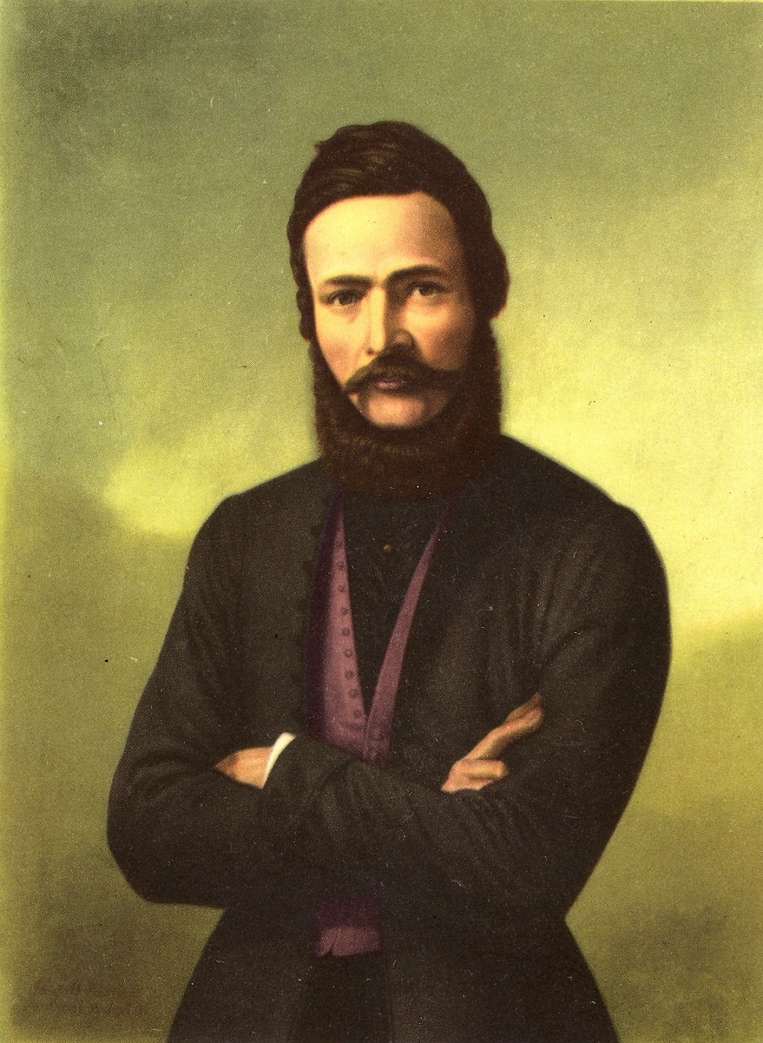
[1] Ľudovít Štúr (1815–1856) was one of the most important figures of the Slovak national revival. He was a linguist, writer, journalist, teacher, and politician. His greatest achievement was the codification of modern standard Slovak in the 1840s. His work O národních písních a pověstech plemen slovanských (On the National Songs and Myths of the Slavic Peoples), published in Prague in 1853, focuses on the folk songs, myths, and traditions of Slavic peoples. He believed that folklore expressed the character, worldview, history and cultural identity of a nation. His thought was significantly influenced by Hegelian philosophy.
- Complete title
- O národních písních a pověstech plemen slovanských
- Author details
- Ľudovít Štúr (1815–1856)
- Date of publication
- 1853
- Dates of travelling
- n. a.
- Publisher
- František Řivnáč
- Place of publication
- Prague
- Archival source or library
- n. a.
- Locations in India
- n. a.
- Keywords
- Divinity, Hinduism, Literature, Mahabharata, Nature, Ramayana, Worldview
- Translator and copyright
- Róbert Gáfrik, 2026
- Media
 Ľudovít Štúr